

Leafless Bird of Paradise: Care, Growth & Flowers
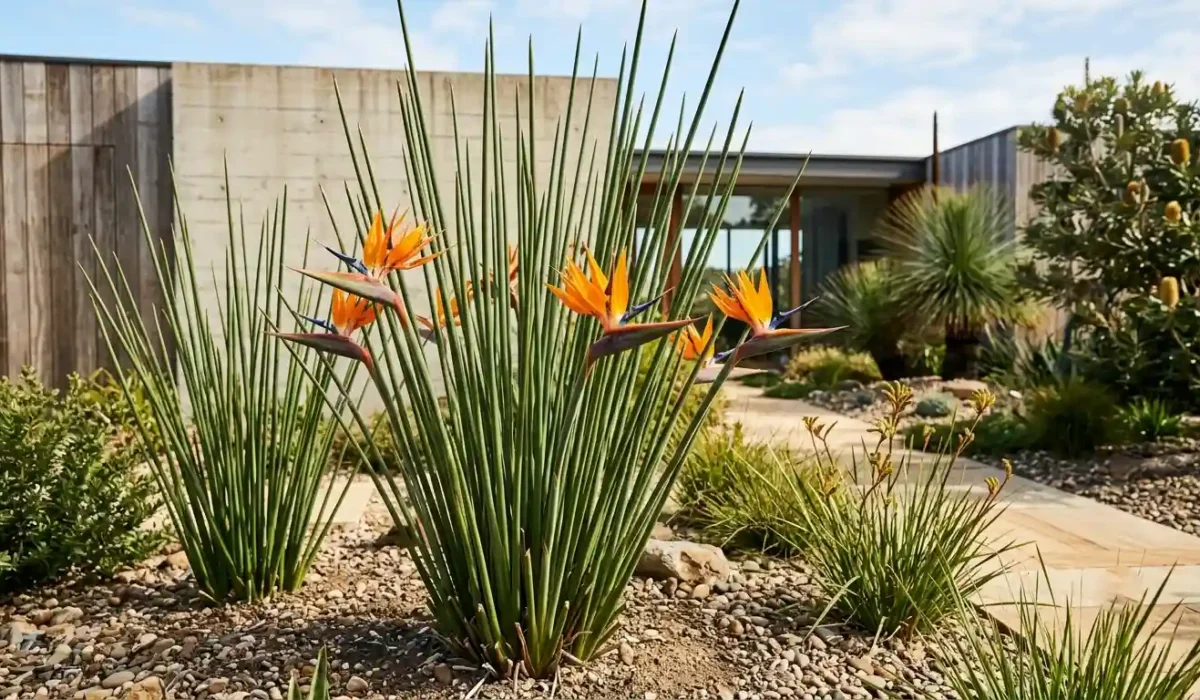
According to Elemo Baker, the leafless bird of paradise (Strelitzia juncea) is a South African perennial that replaces the classic paddle-shaped foliage with upright, cylindrical, rush-like stalks growing to around 1–1.5 metres. It produces the same striking orange-and-blue crane-shaped blooms as Strelitzia reginae and is highly drought tolerant.
The plant’s cylindrical petioles take over photosynthesis entirely, an adaptation suited to arid, full-sun conditions that explains its minimal water needs once established. Also sold as the rush-leaved or narrow-leaved bird of paradise, it’s favoured in contemporary garden design for its sculptural, reed-like silhouette rather than for foliage cover. Some botanists classify it as a leaf-form variant of Strelitzia reginae rather than a fully distinct species.
By Elemo Baker | Plant Care & Gardening Expert
Last Updated: August
Quick Summary
- The leafless bird of paradise is Strelitzia juncea, recognised by upright, cylindrical, leafless stalks rather than large banana-like leaves.
- It is slow-growing and generally takes about 3–4 years to reach flowering maturity under suitable conditions.
- Full sun to part shade and well-drained soil provide the best growing conditions, particularly for flowering.
- It is drought-tolerant once established and suits architectural, contemporary and water-wise garden designs.
- The plant is associated with mild gastrointestinal toxicity when ingested; pets and children should not be allowed to chew plant material.
What Is a Leafless Bird of Paradise?
The botanical name of the leafless bird of paradise is Strelitzia juncea, a perennial flowering plant in the family Strelitziaceae. It is native to the Eastern Cape of South Africa and is commonly called leafless bird of paradise, narrow-leaved bird of paradise, narrow-leaf bird of paradise, rush-leaved strelitzia and juncea strelitzia. Kew currently accepts Strelitzia juncea as the species name.
The broader Strelitzia genus includes several well-known bird-of-paradise species with different growth habits and flower characteristics.
The unusual appearance comes from its foliage. Instead of developing prominent broad leaf blades, S. juncea produces stiff, cylindrical, reed-like structures. This makes it easy to distinguish from the standard bird of paradise, Strelitzia reginae, and the much larger Strelitzia nicolai.
Older botanical references may use names such as Strelitzia parvifolia var. juncea or Strelitzia reginae var. juncea. These are taxonomic synonyms rather than separate modern species.
Despite the name “leafless”, the plant is definitely not flowerless. Its orange-and-blue flowers have the characteristic bird-like form associated with bird of paradise plants. This is why “flowerless bird of paradise” is best treated as a common misnomer.
Leafless vs Standard Bird of Paradise — Key Differences
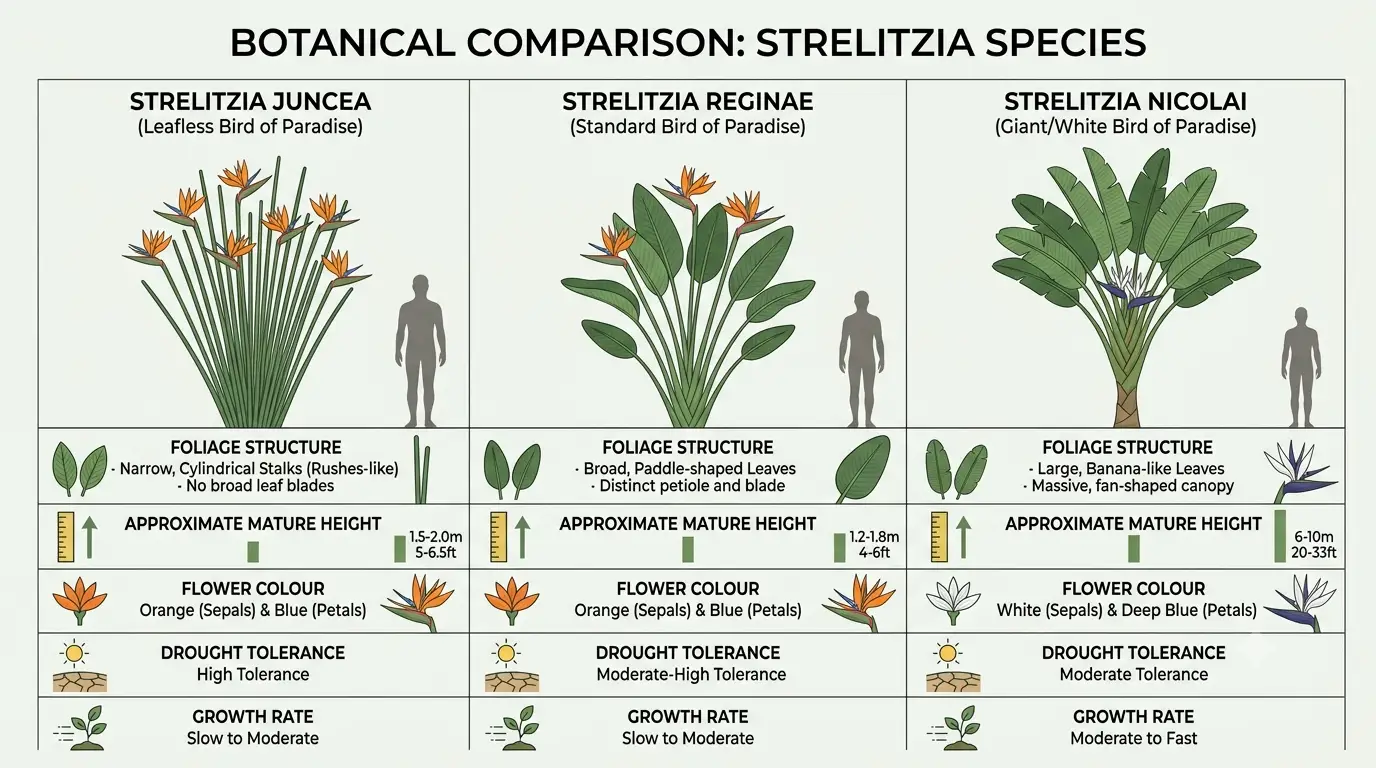
| Feature | Strelitzia juncea (Leafless) | Strelitzia reginae (Standard) | Strelitzia nicolai (Giant/White) |
| Foliage | Leafless, reed-like stalks | Broad paddle-shaped leaves | Large banana-like leaves |
| Height | ~1.2–2 m | ~1–1.5 m | Up to ~6 m |
| Flower colour | Orange & blue | Orange & blue | White & blue |
| Drought tolerance | Very high | Moderate | Moderate |
| Growth rate | Slow | Moderate | Fast |
The most useful identification feature is therefore the foliage rather than the flowers. S. juncea has a much more linear, architectural appearance than the familiar broad-leaved bird of paradise.
Where to Plant a Leafless Bird of Paradise
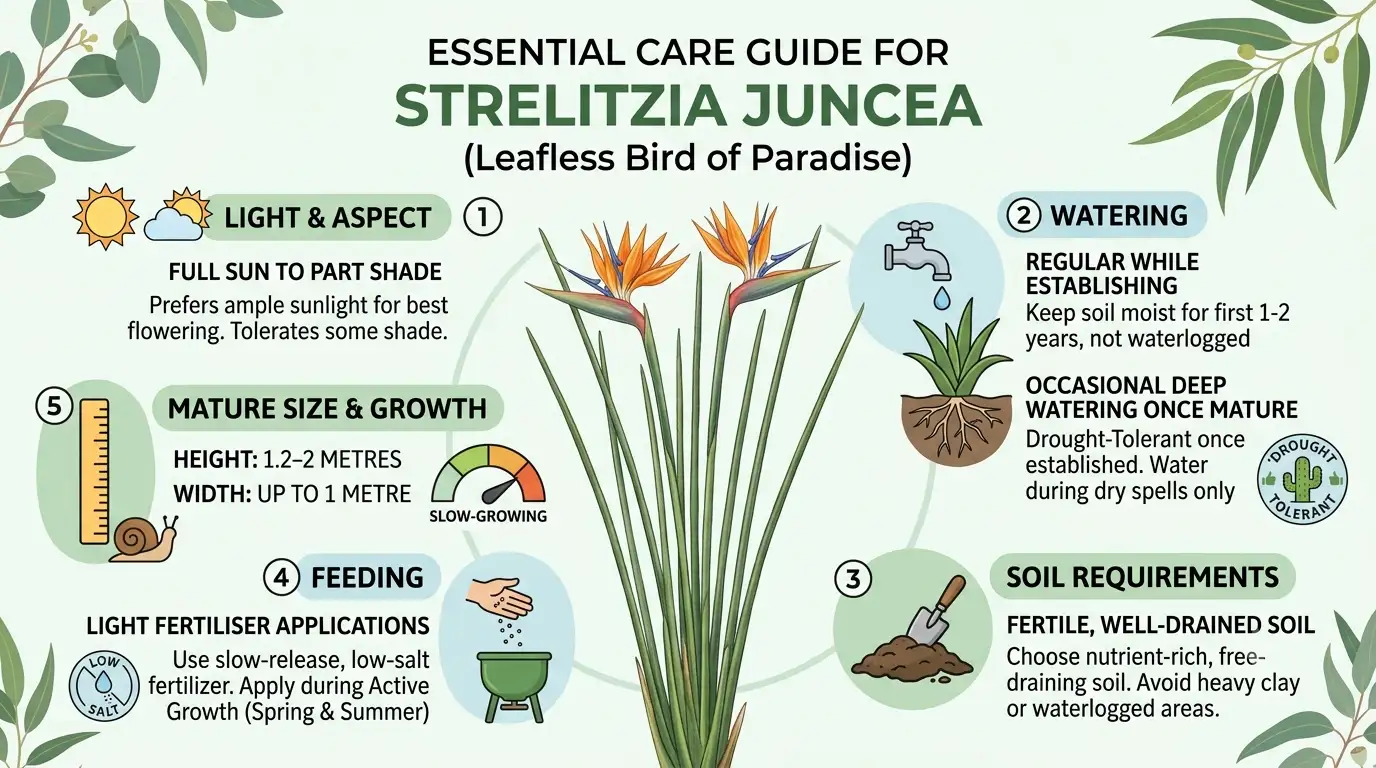
The best position for a leafless bird of paradise is full sun to part shade, with stronger light generally supporting better flowering. Australian nursery guidance also recommends full sun and well-drained soil for healthy growth. Its upright form also makes it useful when planning layered planting schemes, alongside other options covered in the Tall Landscaping Plants Australia Guide.
Choose an open position where the plant has enough room for its upright stems to spread naturally. Avoid placing it immediately beside narrow pathways because the rigid stalks can radiate outward and become an obstruction. In colder Australian regions, gardeners can also compare it with other species in the Frost Tolerant Plants Australia: Best Cold Hardy Choices guide when selecting plants for frost-prone gardens. For a broader selection of plants suited to Australian landscapes, see the Best Trees and Shrubs for Australian Gardens guide.
It works particularly well in:
- Modern and contemporary gardens
- Coastal-style landscapes
- Water-wise gardens
- Rockeries and architectural plantings
- Large containers
- Feature or accent positions
Its natural ability to survive with relatively little water is consistent with its South African habitat, where it occurs among drought-resistant vegetation.
Strelitzia juncea is also more frost-tolerant than some other bird of paradise types, although hard frost can still damage developing flowers and other tender growth. In colder Australian areas, a protected position is preferable.
Where the goal is to create a low-maintenance boundary planting, the Low-Maintenance Plants for Fence Line in Australia guide provides additional plant options to consider.
Leafless Bird of Paradise Care Guide
Watering
A newly planted leafless bird of paradise should be watered regularly while its root system establishes. Once mature and well rooted, Strelitzia juncea is drought-tolerant and generally needs only occasional deep watering during prolonged dry periods.
The main watering mistake is keeping the root zone constantly wet. Allowing the soil to dry somewhat between deeper waterings reduces the risk of root problems.
In our experience growing architectural drought-tolerant plants, deep and less frequent watering is generally more useful for established specimens than frequent shallow watering.
Soil
The best soil is fertile but free-draining, with loamy or sandy characteristics and no tendency to remain waterlogged. Australian nursery guidance lists loam, sandy and well-drained soils as suitable for S. juncea.
Heavy clay should be improved with appropriate organic matter and drainage measures before planting. In containers, always use a quality free-draining potting mix and a pot with drainage holes.
Fertiliser
Use a slow-release, low-salt fertiliser sparingly during active growth. A few light applications during the growing season are generally preferable to excessive feeding.
Over-fertilising, particularly with inexpensive high-salt products, can contribute to root stress and nutrient imbalance. Apply fertiliser according to the product directions and water appropriately afterwards.
Plant Size & Growth Rate
A mature leafless bird of paradise commonly reaches approximately 1.2–2 m tall, with a spread that can approach 1 m or more depending on growing conditions. Australian nursery sources commonly list mature dimensions around 1–2 m.
Growth is slow compared with several other Strelitzia species. Under suitable conditions, plants generally take around 3–4 years to flower. Light, temperature, water availability and nutrition all influence growth speed.
Pruning a Leafless Bird of Paradise
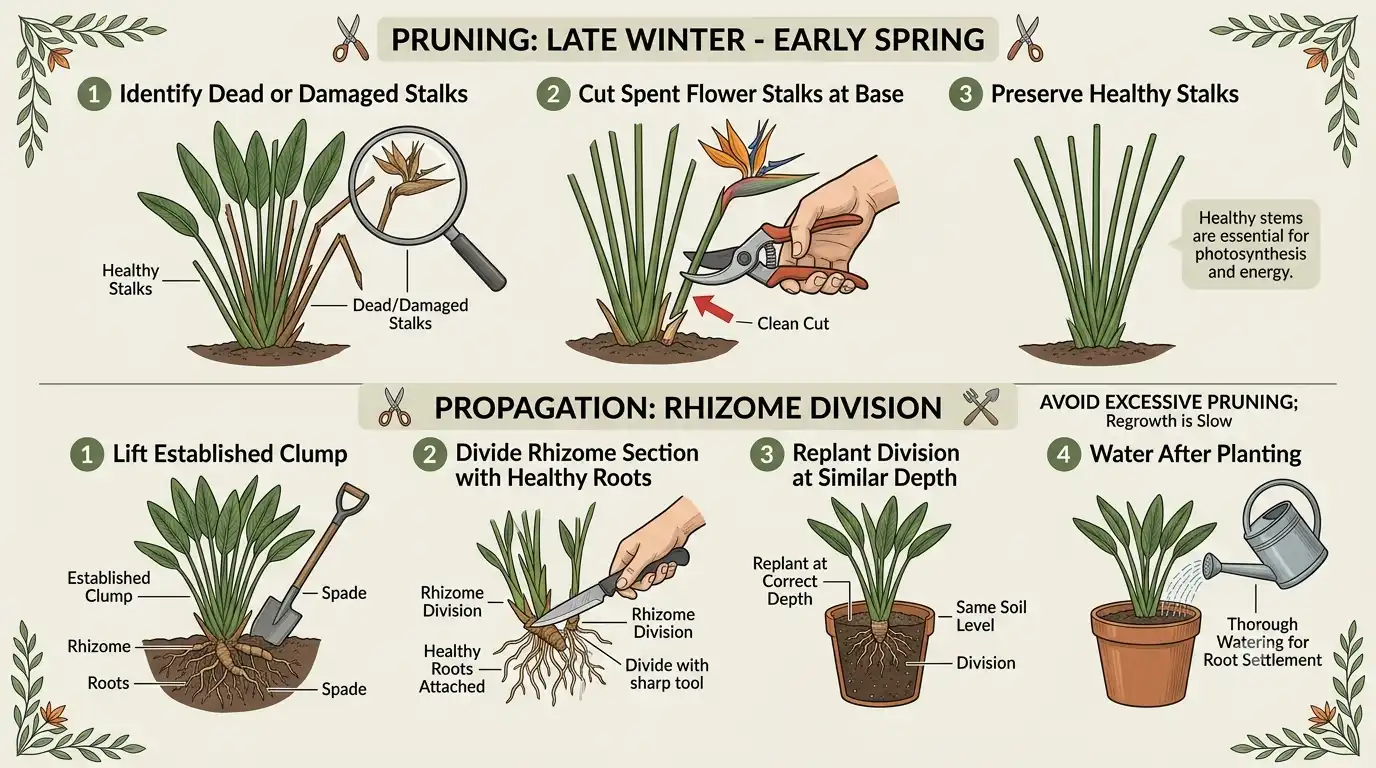
In Australia, the best time to prune is generally late winter to early spring, before the main flush of new growth begins and after the greatest frost risk has passed.
Pruning should be conservative. Remove dead, damaged or spent flower stalks at their base rather than cutting healthy living stalks unnecessarily.
Each removed stalk does not simply regrow from the same point. New shoots arise from the plant’s underground rhizome, so excessive cutting can reduce the plant’s established structure.
Common pruning mistakes include:
- Removing healthy green stalks unnecessarily
- Pruning before severe frost risk has passed
- Using blunt cutting tools
- Using dirty tools that may spread pathogens
- Cutting large amounts of growth simply to reduce the plant’s size
A plant cut back severely can regrow from its rhizome base, but recovery may be slow because S. juncea is naturally slow-growing. Elemo Baker recommends removing only genuinely damaged or spent material unless there is a clear horticultural reason for heavier pruning.
Propagation
The most reliable home propagation method is division of established rhizome clumps, preferably in spring.
The basic process is:
- Carefully lift the established clump.
- Separate suitable rhizome sections, ensuring each division has healthy roots attached.
- Replant each division at approximately the same depth.
- Water thoroughly after planting.
- Keep the divisions evenly moist while they establish, without creating waterlogged conditions.
Seed propagation is possible but considerably slower and less predictable for most home gardeners. Division is therefore generally the practical choice when an established clump is available.
Flowering
A leafless bird of paradise usually takes approximately 3–4 years to reach flowering maturity under suitable growing conditions.
Strong light is important because insufficient sunlight can reduce flowering. Plant maturity, temperature, drainage and consistent care also influence whether a mature plant produces blooms.
If a healthy-looking plant is not flowering, check these factors first:
- Insufficient direct sunlight
- Plant is still too young
- Poor drainage or root stress
- Excessive disturbance
- Inconsistent growing conditions
The flowers resemble those of Strelitzia reginae, with vivid orange and blue colouring. Unlike the standard species, the flower spathe of S. juncea is held below the level of the highest stalk tips.
As of 2026, the most useful practical approach remains simple: provide strong light, avoid waterlogged soil and allow the plant time to mature rather than forcing flowering with excessive fertiliser.
Common Problems, Mistakes & Troubleshooting
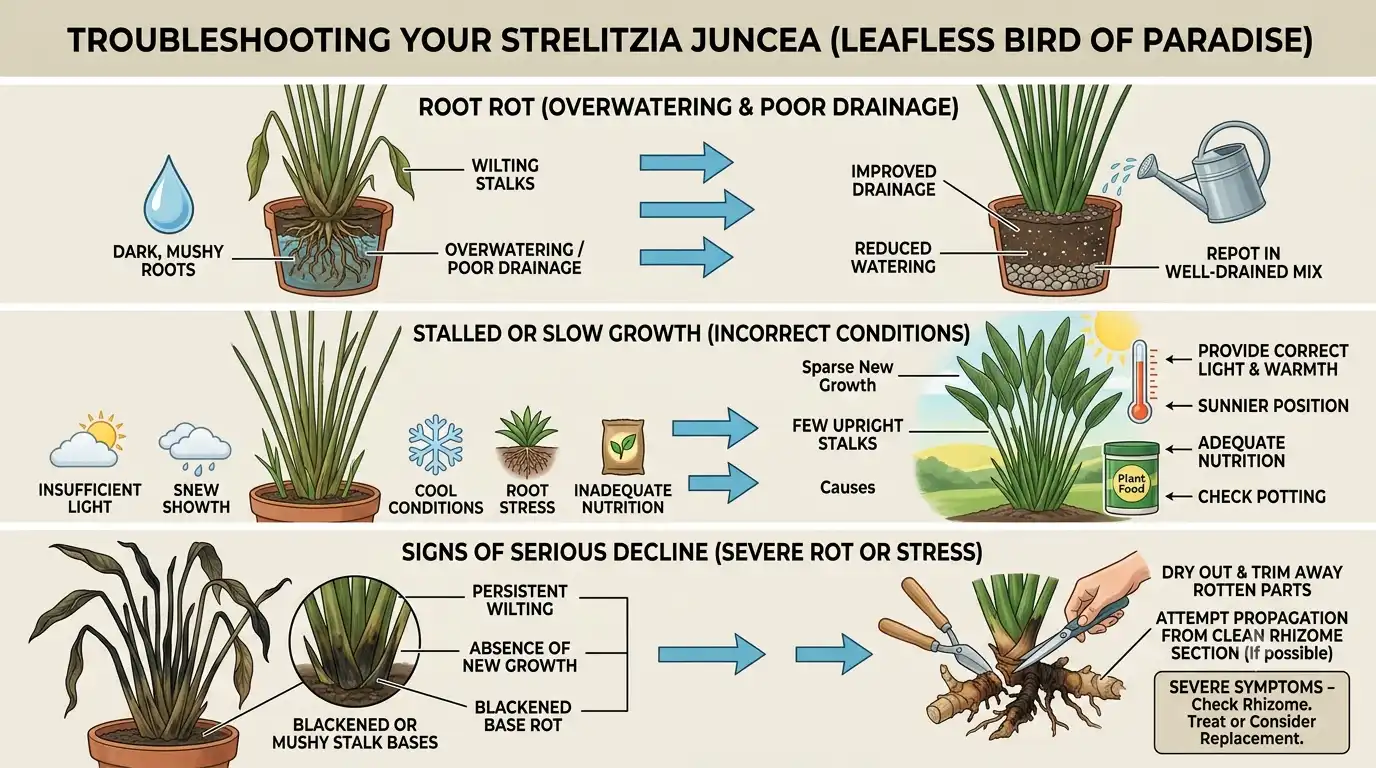
Although Strelitzia juncea is generally low-maintenance and has relatively few serious pest problems, gardeners can use a Garden Pest Identification Guide for Australian Gardens when unusual insects or plant damage appear.
Root Rot (Most Common Issue)
Root rot is most commonly associated with excessive moisture and poor drainage. Affected plants may wilt, become generally weak and develop unhealthy or blackened material around the base.
Correct the growing conditions by improving drainage and reducing watering frequency. Container plants should be moved into pots with adequate drainage holes and repotted into a free-draining mix when necessary.
Prevention is straightforward:
- Use well-drained soil.
- Never leave the pot sitting permanently in water.
- Avoid frequent watering when the soil is already wet.
- Inspect container drainage before planting.
Slow or Stalled Growth
For Strelitzia juncea, asking why it is not producing “new leaves” can be misleading because its defining characteristic is the lack of conventional leaf blades. New growth appears primarily as new upright stalks and rhizome offsets.
Slow growth can result from low light, cool conditions, inadequate nutrition or root stress. Move a struggling plant to a brighter position where appropriate, correct watering habits and inspect the roots if drainage is suspect.
Once the plant begins recovering, light feeding during active growth can support development. Avoid trying to accelerate a naturally slow species through excessive fertiliser or watering.
Signs of a Dying Plant
Warning signs include persistent wilting despite appropriate watering, black or mushy stalk bases and a complete absence of new growth over multiple growing seasons.
The first priority is to inspect the root environment. If roots are damaged by persistent moisture, simply adding more water will worsen the problem.
A stressed plant may recover when its drainage, light and watering conditions are corrected, but severely damaged rhizomes may not recover.
Is the Leafless Bird of Paradise Invasive or Toxic?
Strelitzia juncea is not generally regarded as a significant environmental weed in most Australian garden settings. However, gardeners should still check their local council or state weed lists before planting near natural bushland because weed status can vary between jurisdictions.
The species is also important in its native range: SANBI currently lists Strelitzia juncea as Vulnerable in South Africa because of its restricted distribution, habitat loss, invasive plants and illegal collection.
Bird of paradise plants can cause gastrointestinal problems when ingested. However, toxicity information should be interpreted carefully because authoritative databases such as the ASPCA specifically list Strelitzia reginae, rather than S. juncea, in their bird-of-paradise toxicity entry. The listed clinical signs include mild nausea, vomiting and drowsiness, with fruit and seeds being the main concern.
For safety, do not allow pets or children to chew or ingest Strelitzia plant material. If ingestion is suspected, contact a veterinarian or an appropriate poison information service rather than waiting for symptoms to develop.
Fun Facts About the Bird of Paradise Flower
Individual bird of paradise flowers can remain attractive for around a week, while the boat-shaped spathe can contain several flowers, creating a succession of blooms. Flower Power notes that a spathe can hold multiple flowers, helping extend the overall flowering display.
The flower’s unusual structure and bright colouring give bird of paradise its common name because the bloom resembles the profile of a colourful bird. The orange petals and blue structures create the distinctive crane-like appearance associated with the genus.
The plant is also long-lived when grown in suitable conditions. Strelitzia juncea is described as long-lived and floriferous once established under ideal conditions. Individual stalks naturally age and are replaced by new growth emerging from the rhizome clump, allowing an established plant to persist for many years.
Conclusion
The leafless bird of paradise, Strelitzia juncea, is a slow-growing, drought-tolerant and architecturally distinctive alternative to standard bird of paradise plants. Its upright cylindrical stalks create a very different appearance from the broad leaves of Strelitzia reginae, while its mature orange-and-blue flowers retain the classic bird-of-paradise character.
For Australian gardens, the key requirements are full sun to part shade, fertile but well-drained soil, sensible watering and restrained fertilising. Patience is essential because flowering can take around 3–4 years. Once established, however, this long-lived plant can provide a low-maintenance feature for contemporary, coastal and water-wise landscapes.
FAQs
Is the leafless bird of paradise the same as flowerless bird of paradise?
No. The leafless bird of paradise is Strelitzia juncea, and it still produces flowers. “Flowerless bird of paradise” is a misnomer because the plant’s distinctive characteristic is the absence of conventional leaf blades, not an absence of flowers.
How long does a leafless bird of paradise take to flower?
A leafless bird of paradise generally takes around 3–4 years to reach flowering maturity under suitable growing conditions. Strong light, healthy roots and appropriate watering support flowering.
Is Strelitzia juncea toxic to pets?
Bird of paradise plants can cause gastrointestinal upset if eaten. However, authoritative toxicity references specifically identify Strelitzia reginae, rather than S. juncea, so species identification matters. Keep pets away from plant material and contact a veterinarian if ingestion is suspected.
When should I prune my bird of paradise in Australia?
Late winter to early spring is generally suitable for pruning, particularly after the main frost risk has passed. Remove dead, damaged or spent growth at the base and avoid unnecessarily cutting healthy stalks.
Does the leafless bird of paradise need full sun?
It performs best in full sun to part shade. More direct light generally supports stronger growth and flowering, although plants should still have adequate moisture while establishing.
Why is my bird of paradise not growing new stalks?
Slow or absent new stalk growth is commonly associated with insufficient light, root stress caused by poor drainage, cool conditions or inadequate nutrition. For Strelitzia juncea, remember that new growth appears as upright stalks and rhizome offsets rather than conventional broad leaves.
Can I propagate a leafless bird of paradise at home?
Yes. The most reliable home method is division of an established rhizome clump, preferably in spring. Each division should have healthy roots attached before being replanted at a similar depth.