
Fruit Tree Pruning Calendar Australia
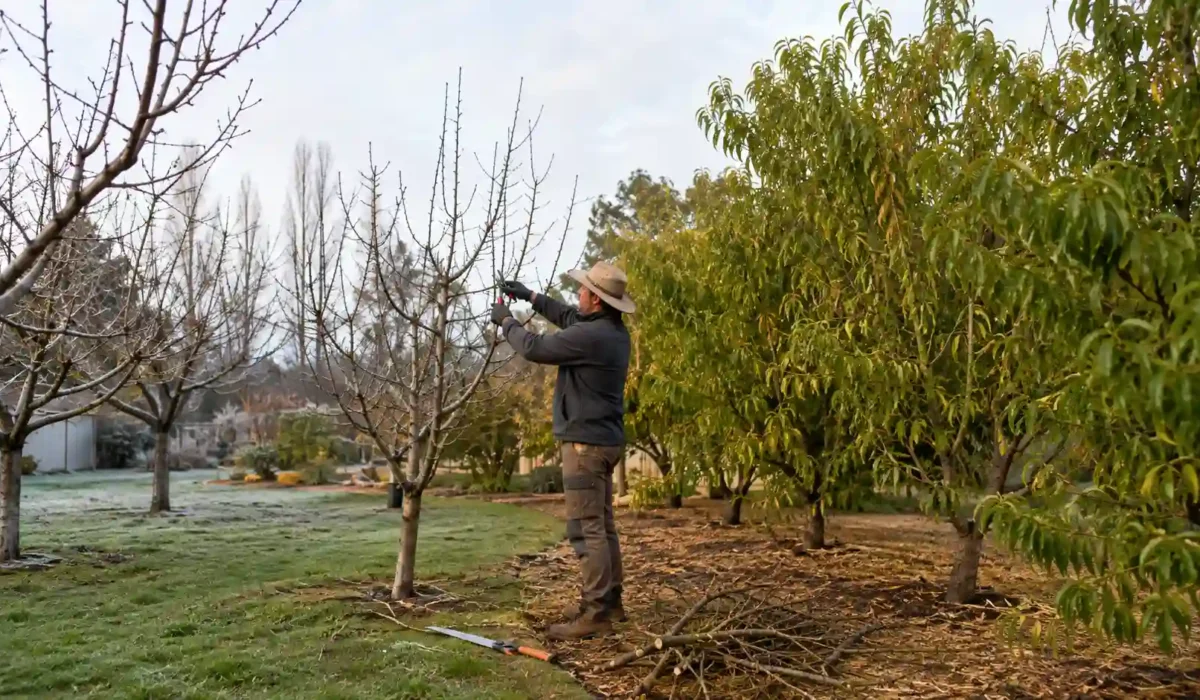
According to Elemo Baker, Australian fruit tree pruning follows two windows: apples and pears are pruned in winter (June–August) while dormant, whereas stone fruit—peaches, plums, apricots, cherries—are pruned in summer after harvest to reduce disease entry. Citrus, being evergreen, are lightly trimmed in late winter to early spring instead.
Regardless of species, no more than 20–30% of canopy should be removed in a single season, as heavier cuts stress the tree into excessive, unproductive regrowth rather than fruiting wood. Stone fruit is shifted to summer specifically because wounds made in cool, wet conditions are far more vulnerable to bacterial canker and silverleaf infection. Climate zone also narrows the calendar—warmer coastal areas see buds swell earlier, shortening the safe dormant-pruning window compared with cooler inland regions.
Pruning is one part of successful edible gardening, and our broader guide to Fruit Trees and Edible Plants for Australian Gardens covers the wider considerations involved in growing productive plants in Australian conditions.
By Elemo Baker | Plant Care & Gardening Expert
Last Updated: August 2026
Quick Summary
- Apples, pears and quinces are generally pruned in winter, from June to August, while dormant.
- Apricots, cherries, peaches, nectarines and plums are generally pruned after harvest in late summer to early autumn, rather than during cold, wet winter conditions.
- Citrus usually needs light pruning in late winter to early spring or after fruiting, depending on the species and local conditions.
- A conservative rule is to avoid removing more than one-third of the canopy in one pruning session, unless a specific horticultural or structural reason requires a different approach.
- The best pruning calendar in Australia depends on fruit type, local climate, tree age, disease pressure and the purpose of pruning.
Why Fruit Tree Pruning Timing Differs Across Australia
Fruit tree pruning timing differs because deciduous trees enter dormancy while evergreen trees continue growing, and disease pressure varies with temperature and moisture. A winter pruning calendar Australia guide therefore cannot simply say “prune every fruit tree in winter”. Apples and pears tolerate dormant-season structural pruning, whereas stone fruit is commonly pruned during warmer, drier weather after harvest. Gardening Australia likewise recommends winter pruning for dormant pome fruit and summer pruning for stone fruit.
Climate changes the exact window. In Melbourne and much of Victoria, winter dormancy is pronounced, making June to August suitable for apples and pears. In South East Queensland, winters are milder, so growth may continue and pruning dates should be based more on the tree’s growth stage than a fixed calendar date. South Australia and Western Australia also contain several climate zones, so local conditions can shift the ideal timing.
Before setting a pruning schedule, it is also useful to understand which species are best suited to different Australian climates; our Fruit Trees for Australian Gardens: Complete 2026 Guide covers suitable fruit trees and their growing requirements across Australia.
The underlying principle is simple: prune when the tree’s biology and disease conditions make the intended cut safest and most useful.
Pome Fruit vs Stone Fruit — The Key Distinction
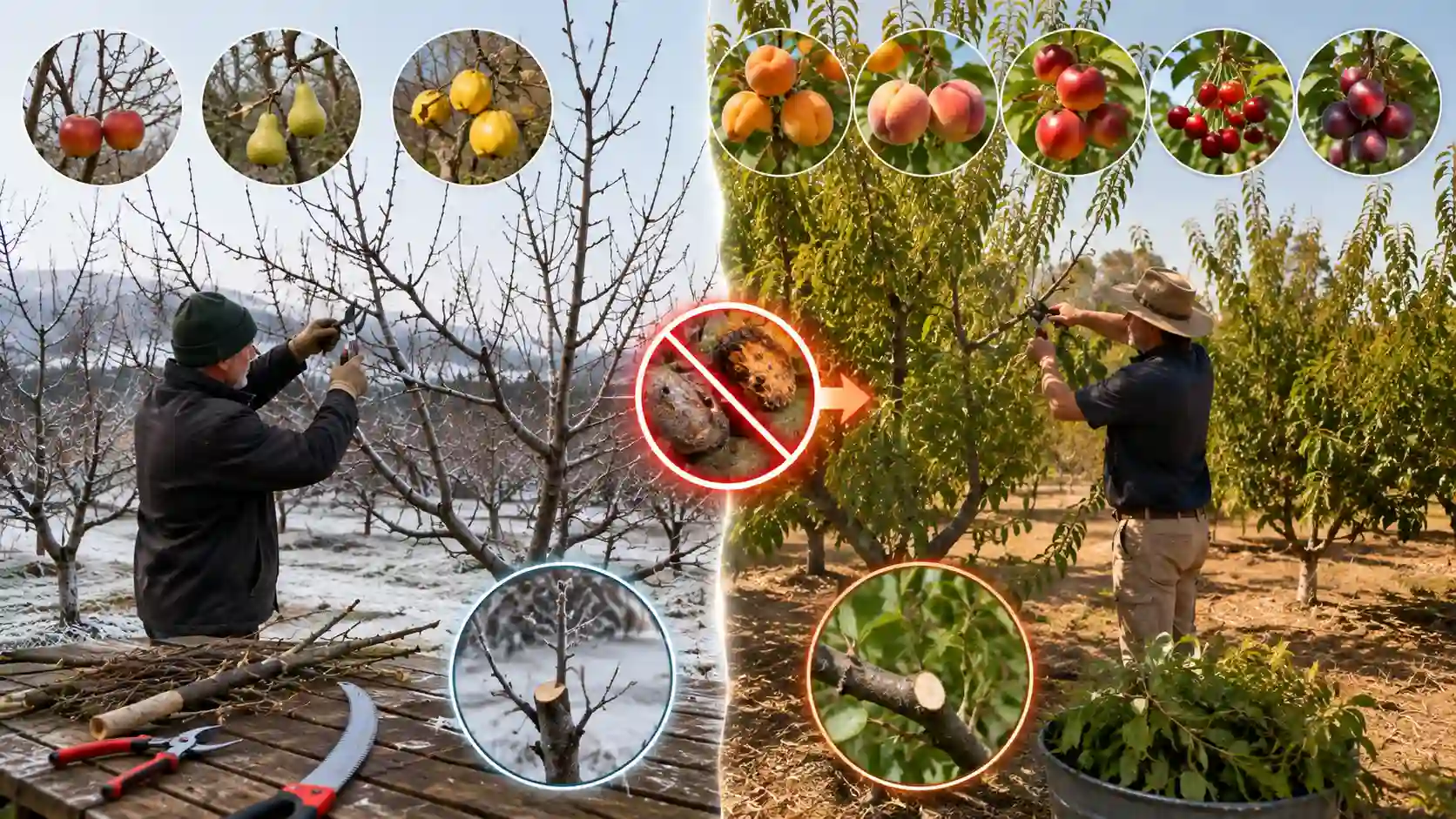
Apples, pears and quinces are pome fruits and are commonly given their main structural pruning while dormant in winter. Removing selected branches during dormancy helps establish structure without stimulating the same level of immediate leafy growth as summer pruning.
Stone fruit behaves differently. Apricots, cherries, peaches, nectarines and plums are generally pruned after harvest while the tree is actively growing. Warm, relatively dry conditions allow pruning wounds to begin healing quickly and can reduce disease risk compared with cold, wet winter cuts.
This distinction is one of the most important rules when deciding when to prune fruit trees Australia.
Fruit Tree Pruning Calendar by Month
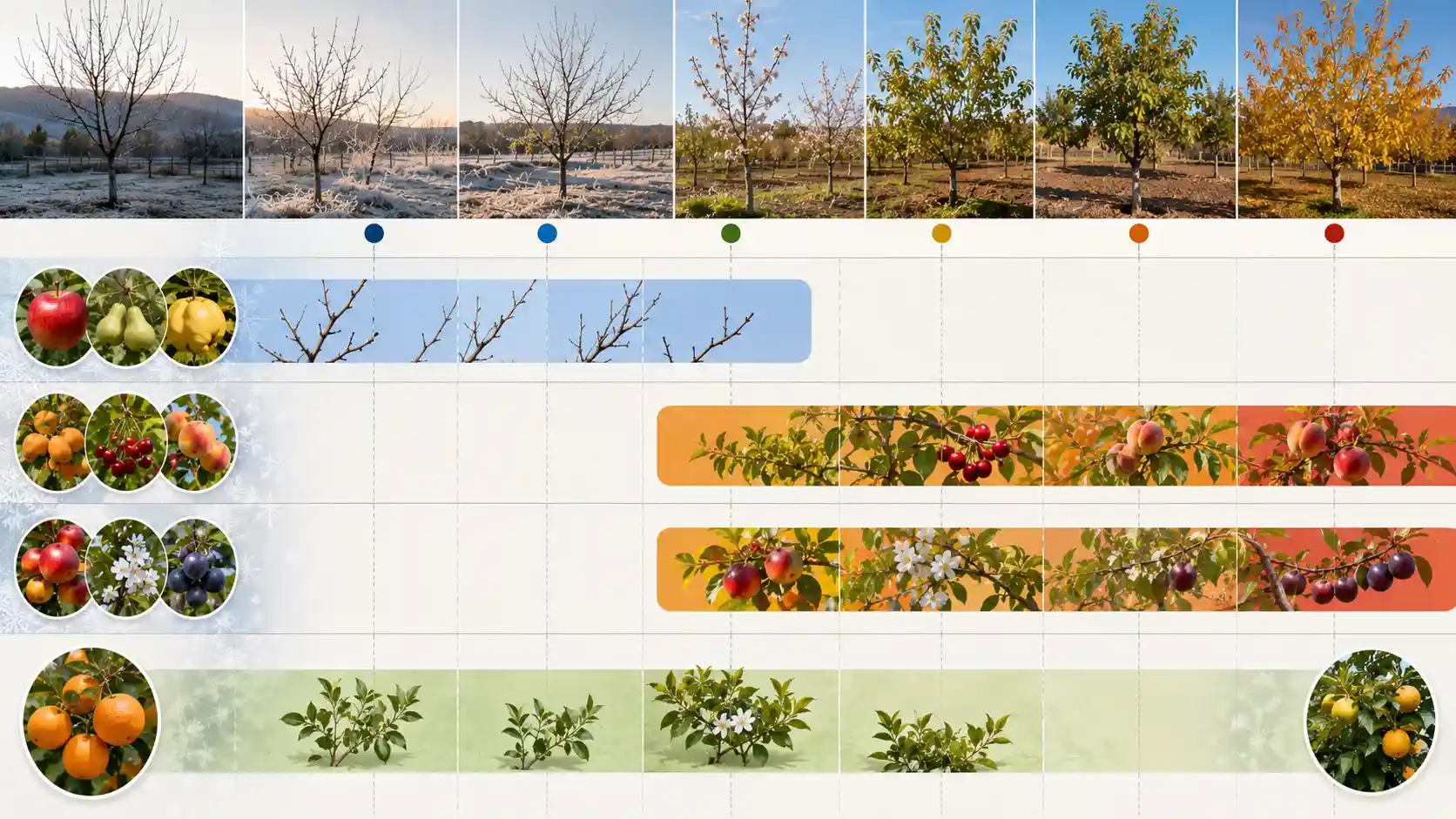
| Fruit Type | Best Pruning Window | Region Notes | Reason |
| Apple | June–August | Melbourne/Victoria and other cool regions: winter dormancy is ideal | Structural pruning while dormant |
| Pear | June–August | Similar timing to apples; adjust for mild climates | Improves structure and controls excessive growth |
| Quince | June–August | Cool and temperate regions generally suit winter pruning | Deciduous dormant pruning |
| Apricot | After harvest, late summer–early autumn | Particularly important in cooler, wetter regions such as Melbourne | Reduces problems associated with winter wounds |
| Cherry | After harvest, summer | Timing varies with cultivar and harvest date | Allows wounds to heal during active growth |
| Peach/Nectarine | After harvest, summer | Warm, dry conditions are preferable | Controls size and reduces disease-risk conditions |
| Plum | After harvest, late summer–early autumn | European and Japanese plums can differ in growth habit and harvest timing | Summer pruning limits excessive vigour |
| Citrus | Late winter–early spring or after fruiting | In warm regions, avoid unnecessary heavy pruning | Light shaping and removal of damaged wood |
These are practical seasonal windows rather than rigid dates. For example, when to prune apple trees Melbourne is generally answered by winter dormancy, while when to prune apricot trees in Melbourne points towards post-harvest pruning rather than a traditional winter cut.
Pruning schedules should also be considered alongside the tree’s fruiting cycle, as explained in our guide to When Do Mulberry Trees Fruit in Australia?
When to Prune Each Fruit Tree
Apples and Pears — Winter Dormant Pruning
The best time for major pruning of established apples and pears is generally winter, when the trees are dormant. Remove dead, damaged and diseased wood first, then address branches that cross, rub, grow inward or create excessive congestion.
Pruning is only one part of reliable fruit production; for trees that require compatible pollinators, see our Fruit Tree Pollination Chart Australia: Best Pairs to understand which varieties can be planted together.
For an apple or pear tree, pruning should create a productive framework with good light penetration and airflow. Avoid removing large amounts of healthy fruiting wood simply to make the tree look tidy.
A useful sequence is:
- Remove dead, diseased or damaged branches.
- Remove suckers from the base and unwanted water shoots.
- Remove crossing or rubbing branches.
- Thin congested growth.
- Reduce height by cutting back to suitable lateral branches.
For pruning apple trees Australia and pruning pear trees Australia, winter is usually the principal structural pruning season.
Stone Fruit — Apricots, Cherries, Peaches, Plums, Nectarines
Stone fruit is generally pruned after harvest in summer or early autumn, rather than during winter. Gardening Australia specifically recommends post-harvest pruning for stone fruit, noting that summer pruning allows wounds to heal while trees remain actively growing.
This applies broadly to apricots, cherries, peaches, nectarines and plums, although the exact date depends on when each cultivar finishes fruiting.
Winter pruning can expose some stone fruit to greater disease risk, particularly in cool, wet conditions. Therefore, when to prune a peach tree in Australia or when to prune a plum tree in Australia should not automatically be answered “winter”.
Citrus — Light Pruning After Fruiting
Citrus are evergreen rather than winter-dormant deciduous trees, so they do not follow the same pruning calendar as apples and pears. Light pruning can remove dead, damaged, crossing or poorly positioned growth after fruiting.
For a practical example of citrus-specific pruning, see our How to Prune a Kumquat Tree: Timing & Methods, which explains when and how to make selective cuts on a fruiting citrus tree.
Avoid unnecessary heavy pruning because excessive canopy removal can expose branches and fruit to intense sunlight and stimulate unwanted vigorous shoots. Citrus usually benefits more from selective maintenance pruning than aggressive annual reshaping.
How to Prune a Fruit Tree — Step by Step
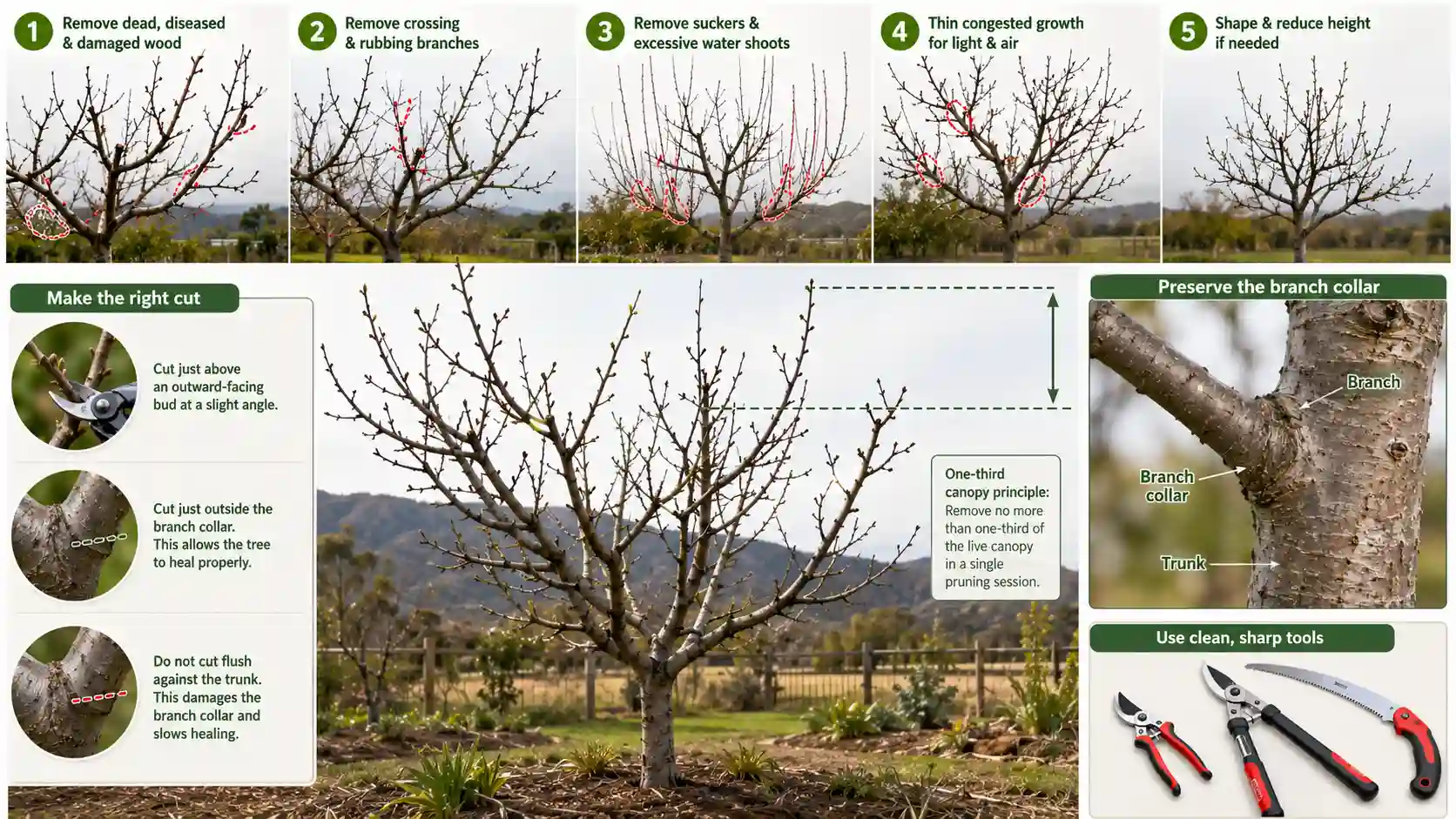
Use clean, sharp secateurs, loppers or a pruning saw appropriate to the branch diameter. Disinfect cutting tools when moving between trees, particularly when disease may be present. Gardening Australia recommends keeping blades sharp and positioning the cutting edge correctly for a clean cut.
Step-by-Step Cutting Sequence
- Remove dead, diseased and badly damaged wood first.
- Remove crossing and rubbing branches that interfere with healthy structure.
- Remove unwanted suckers and excessive water shoots where appropriate.
- Thin congested growth to improve light and airflow.
- Shape the tree gradually, preserving useful fruiting wood.
- Reduce height selectively by cutting back to suitable lateral branches.
- Step back regularly to assess the canopy rather than making many cuts consecutively.
- Avoid removing more than about one-third of the canopy in a year unless specialist advice indicates otherwise.
When shortening a small branch, make the cut just above a healthy outward-facing bud or suitable lateral branch. For larger limbs, use a controlled multi-cut technique to prevent the branch tearing and damaging the trunk.
Fruit-tree pruning involves selectively removing branches, shoots and other unwanted growth to control tree structure, health and productivity. The practice encompasses several techniques and pruning objectives, as outlined in the Wikipedia reference on fruit tree pruning.
What Part of a Tree Should Never Be Cut
Do not cut flush against the trunk or remove the branch collar. The collar is the swollen area where a branch joins its parent stem. Proper pruning respects this natural boundary and allows the tree to compartmentalise the wound.
Flush cuts remove protective tissue and can increase unnecessary injury. AS 4373 identifies flush cutting as an unacceptable pruning practice for amenity trees, reinforcing the broader horticultural principle of making a correct natural-target cut rather than cutting into the trunk.
Common Pruning Rules, Myths and Standards
What Is the “123 Rule” of Pruning?
The “123 rule” is not a universally standardised horticultural pruning rule. Different gardening sources use the phrase for different techniques, so it should not be presented as one official Australian pruning method.
For large branches, the genuinely established approach is a three-cut technique: an initial undercut, a second cut to remove most of the branch weight, followed by a final controlled cut near the branch collar. This reduces the risk of bark tearing.
What Are the Five Rules of Pruning?
A useful practical set of five principles is:
- Prune at the correct time for the fruit type.
- Use sharp, clean tools.
- Cut at the correct location rather than flush with the trunk.
- Avoid excessive canopy removal.
- Cut back to healthy wood, an appropriate bud or a suitable lateral branch.
The “one-third” guideline is a useful conservative limit, not a universal legal or botanical rule. Some trees and pruning objectives require different percentages.
Does Australia Have a Pruning Standard?
Australia has AS 4373, Pruning of Amenity Trees, but an important distinction is often missed: the standard is for amenity trees, not fruit production. Its scope specifically excludes practices relating to fruit and flower production.
Therefore, AS 4373 should not be described as Australia’s dedicated fruit-tree pruning standard. It is nevertheless highly relevant to professional tree-pruning principles, particularly for larger urban trees.
Which Trees Are Protected From Pruning or Removal in Australia?
There is no single national list of trees that can never be pruned. Protection varies according to state legislation, local council planning controls, heritage provisions, significant-tree registers and native vegetation rules.
For example, South Australia regulates significant and regulated trees, while Brisbane has local rules covering protected vegetation.
Before major pruning or removal of an established tree, check the relevant council or state authority, especially if the tree is large, native, heritage-listed, regulated or located in a development-controlled area.
Common Fruit Tree Pruning Mistakes
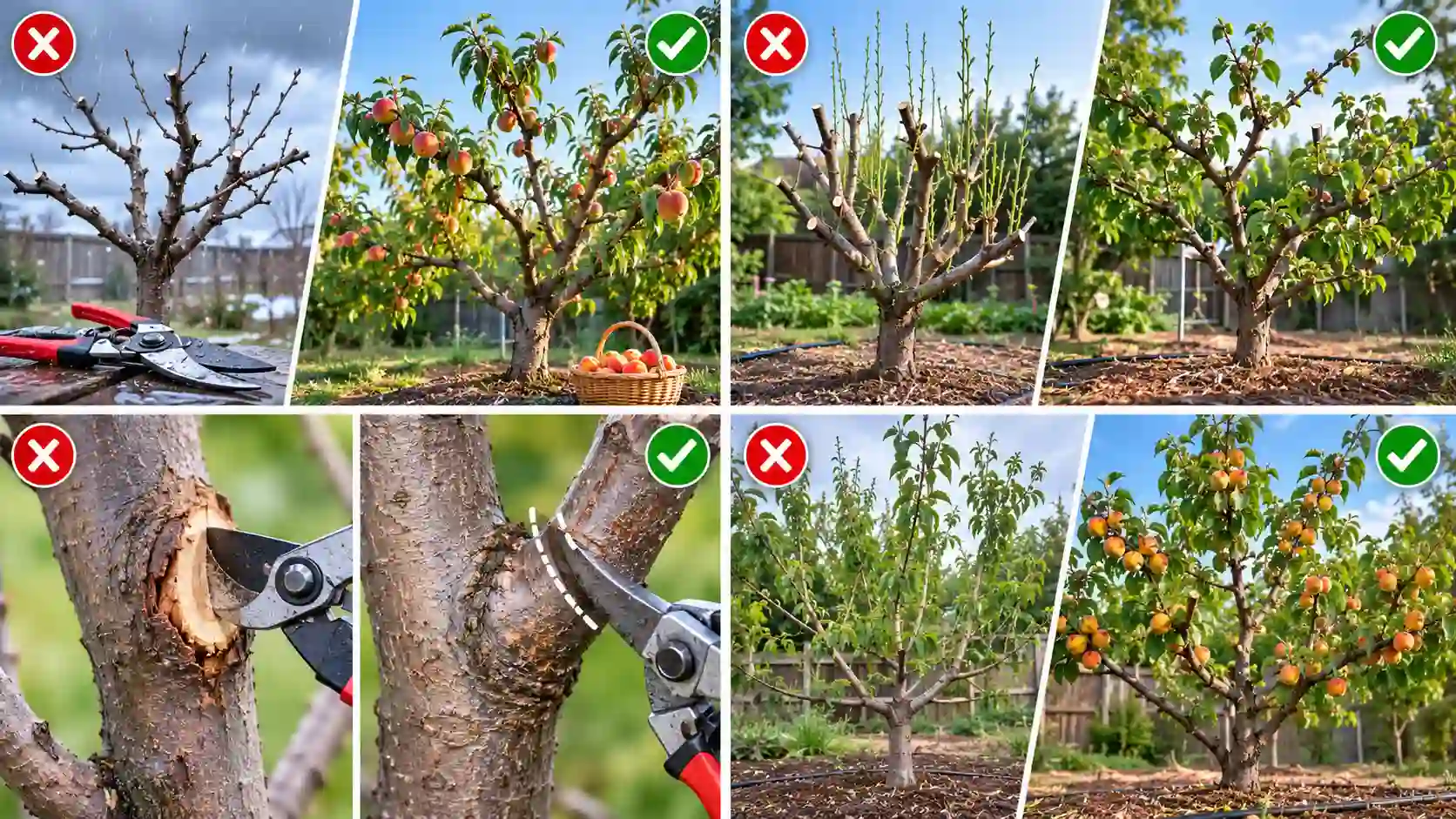
Problem: Pruning Stone Fruit in Winter
Why it happens: Many gardeners learn the general rule that deciduous trees should be pruned in winter.
Fix: Prune apricots, peaches, nectarines, cherries and many plums after harvest during warmer, drier conditions.
Prevention: Identify the fruit type before scheduling pruning.
Problem: Removing More Than One-Third of the Canopy
Why it happens: An overgrown tree can look as though it needs dramatic reshaping.
Fix: Stage major height and canopy reduction over multiple seasons.
Prevention: Make a pruning plan before cutting and remove only what is necessary.
Problem: Making Flush Cuts
Why it happens: Gardeners try to make the trunk look smooth.
Fix: Preserve the branch collar and use a proper target cut.
Prevention: Identify the branch collar before operating the saw.
Problem: Pruning at the Wrong Time
Why it happens: A single “winter pruning” rule is applied to every fruit tree.
Fix: Match pruning timing to the fruit type and local climate.
Prevention: Use a fruit-specific pruning calendar rather than a universal seasonal rule.
In our experience growing and maintaining fruit trees, the biggest pruning mistakes usually come from timing and overconfidence rather than from the cutting tool itself. Elemo Baker recommends identifying the species and pruning objective before making the first major cut.
Reducing Tree Height and Shaping for Easier Harvest
Fruit trees should be kept at a manageable height through gradual reduction pruning, not by cutting the top off abruptly. Reduce tall branches back to suitable lateral branches that are large enough to assume the role of the removed branch. For gardeners working with limited space, choosing a naturally compact tree can reduce the need for aggressive height reduction; our Dwarf Fruit Trees for Pots Australia: Best Choices guide covers suitable compact fruiting trees.
For an overgrown tree, spread height reduction over several seasons. Removing too much canopy at once can stimulate vigorous regrowth, including water shoots, and can reduce the tree’s productive balance.
The main pruning techniques include:
- Thinning: removing selected branches back to their point of origin.
- Heading: shortening a shoot or branch to stimulate branching.
- Reduction: lowering the height or spread by cutting back to suitable laterals.
- Deadwooding: removing dead or dying branches.
- Formative pruning: establishing good structure in a young tree.
A controlled, staged approach is usually safer and more sustainable than drastic topping.
Conclusion
A reliable Fruit Tree Pruning Calendar Australia starts with fruit type rather than the month alone. Apples, pears and quinces generally receive their main structural pruning during winter dormancy, while apricots, cherries, peaches, nectarines and plums are generally pruned after harvest in late summer or early autumn. Citrus needs lighter, selective pruning because it remains evergreen.
Correct timing is only half the job. Clean tools, proper cuts, preservation of the branch collar, gradual height reduction and avoiding excessive canopy removal all contribute to healthier trees. The best pruning calendar therefore combines species, climate, tree condition and pruning objective rather than relying on one universal Australian date.
This calendar covers fruit trees specifically, but good pruning habits apply garden-wide. Head to our pruning and maintenance hub for hedge, shrub, and ornamental tree techniques too. For the full picture — watering, soil, feeding and seasonal care across your whole garden — see our complete guide to plant care and growing in Australia.
Frequently Asked Questions
1. What month do you prune fruit trees in Australia?
Most apples, pears and quinces are pruned from June to August, while many stone fruit trees are pruned after harvest in late summer or early autumn. Citrus usually needs only light selective pruning.
2. What is the best month to prune fruit trees?
There is no single best month for every fruit tree. June to August suits dormant apples and pears, while stone fruit is generally better pruned after harvest during warmer conditions.
3. How and when do I prune fruit trees?
First identify the fruit type and ideal season. Then remove dead or diseased wood, crossing branches, unwanted suckers and congested growth before gradually shaping the canopy. Always preserve the branch collar.
4. What is the best time of year to prune a fruit tree?
The best time depends on species. Pome fruit is generally pruned in winter, stone fruit after harvest in summer or early autumn, and citrus receives light maintenance pruning according to fruiting and growth conditions.
5. When should you not prune fruit trees?
Avoid major pruning when the timing increases disease risk or when the tree is under significant environmental stress. In particular, avoid routinely applying winter pruning to stone fruit in cold, wet climates.
6. Is it true fruit trees should always be pruned in winter?
No. Winter pruning is appropriate for many dormant pome fruit trees, but it is not a universal rule. Stone fruit is generally pruned after harvest, and citrus follows a lighter evergreen pruning strategy. Gardening Australia continues to recommend summer pruning for stone fruit because wounds can heal during active growth.
2 Comments