

Average Tree Growth Rate Chart Australia (2026 Guide)
Elemo Baker notes that Australian native trees show wide-ranging growth rates: subtropical Queensland eucalypts studied over 75 years averaged just 0.25 cm diameter growth per year (range 0.01–0.5 cm), while fast-growing species like wattles and eucalypts can add 0.5–2 metres of height annually under favourable conditions and rainfall.
Plantation-grown natives grow far faster than wild forest trees, with DBH increments of 1–5 cm/yr versus 0.25 cm/yr in natural stands, meaning a wild eucalypt can take over a century to reach the girth of a standard power pole. Growth also varies strongly with rainfall zone, from 500mm to 2,000mm annually.
Quick Summary
- Most common garden trees in Australia grow height fastest in years 1–5, then the rate declines as the tree matures.
- “Fast” growth typically means roughly 60–100+ cm of height per year in ideal conditions; “slow” growth is often under 15–20 cm per year.
- Height growth and trunk (DBH) growth are measured differently, a tree can be a fast height grower but a slow diameter grower.
- Climate zone (tropical, temperate, or arid) shifts these numbers significantly, so a single national “average” is only a starting point, not a guarantee for your garden.
Why “Average Tree Growth Rate” Isn’t One Number
The direct answer: tree growth rate is a range shaped by several interacting variables, not a fixed statistic you can look up once and rely on forever.
This happens because growth speed is the product of genetics, age, climate, soil, and water availability working together. A eucalypt that grows quickly in the humid tropics may grow at a fraction of that rate in an arid inland climate, even with identical soil.
Growth Slows With Age! The Growth Curve
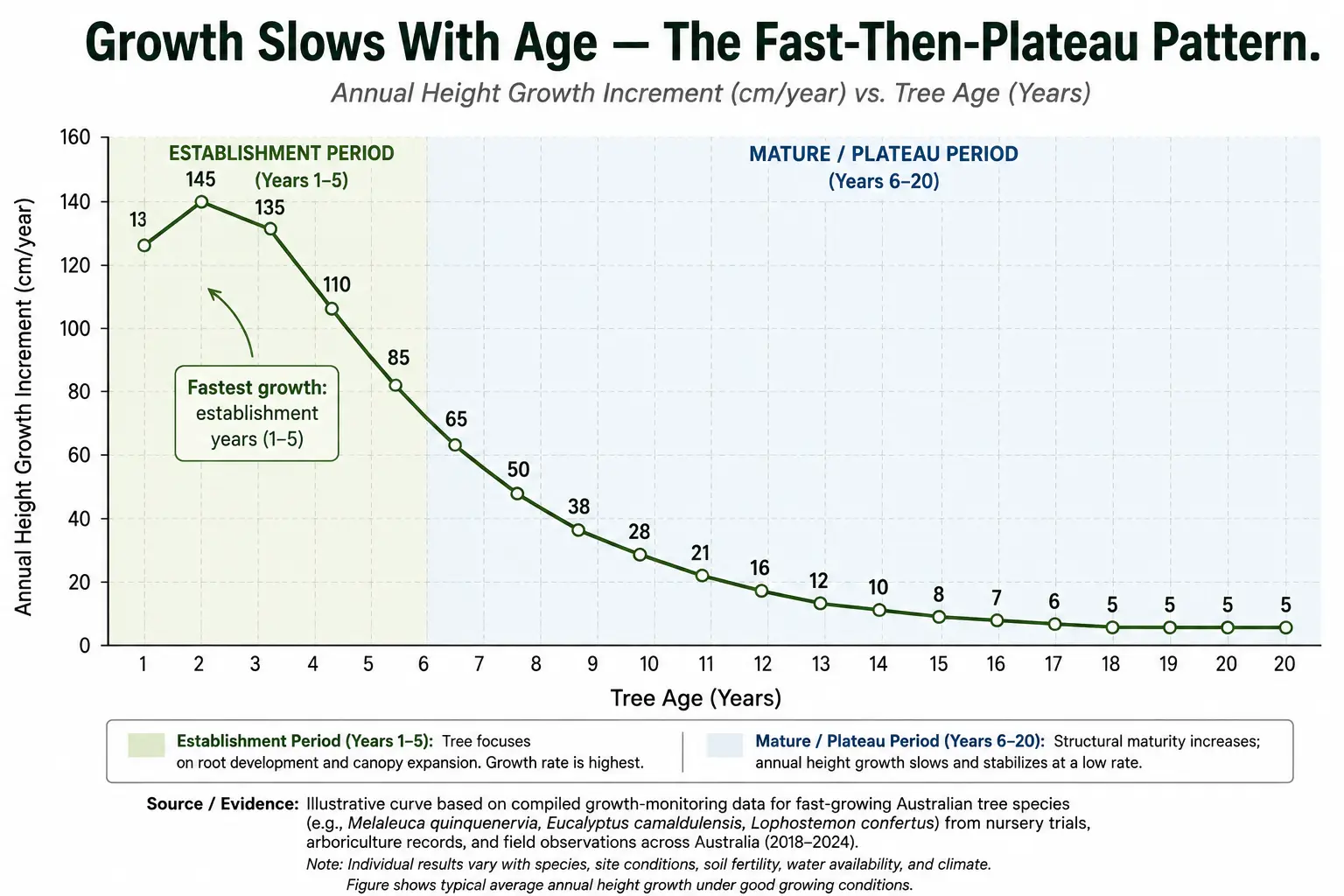
Most trees grow fastest in their first 3–5 years, then the rate declines as the tree matures. This happens because young trees are investing heavily in establishing a root system and canopy while competing for very little else, there’s no shading from neighbouring growth and no internal competition for resources. As a tree matures, it shifts from rapid establishment growth to steadier maintenance growth, and canopy and root competition (from itself and nearby plants) further slows the pace.
- Young tree (years 1–5): rapid height gain, establishing root and canopy structure
- Established tree (5+ years): slower, steadier growth, more energy directed to canopy density and structural strength
Region Matters Tropical, Temperate, and Arid Australia
Identical species can grow at meaningfully different rates depending on rainfall reliability and temperature zone. Tropical northern regions generally support faster growth thanks to consistent rainfall and warmth, temperate southern regions produce steadier moderate growth across distinct seasons, and arid inland regions constrain growth through water scarcity and heat stress, regardless of species. In cooler temperate zones, frost tolerance becomes a bigger factor in realistic growth expectations, see our Frost Tolerant Plants Australia: Best Cold Hardy Choices guide for cold-hardy options.
How Tree Growth Rate Is Actually Measured
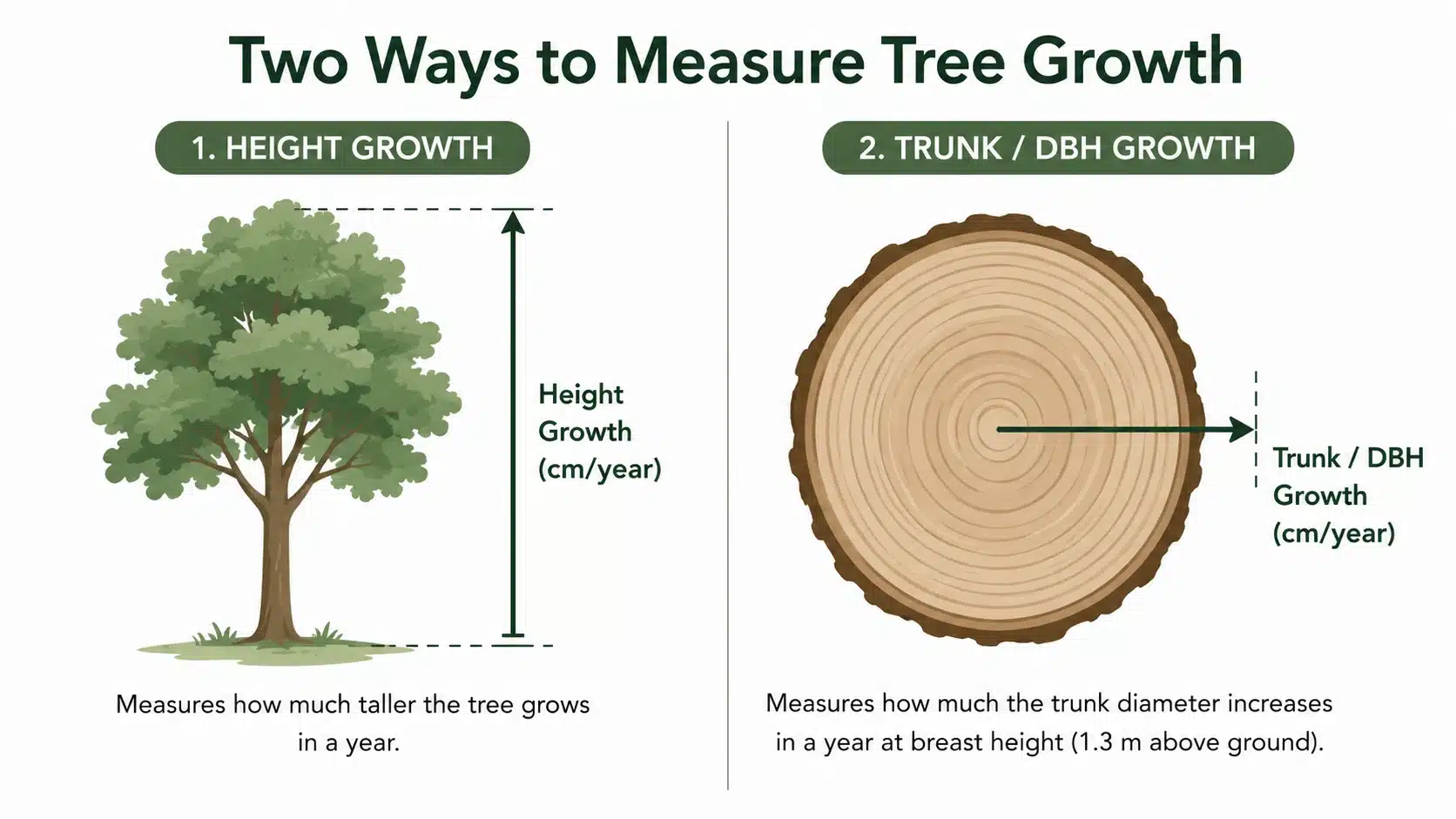
The direct answer: growth rate is measured in two genuinely different ways: height increment and trunk diameter (DBH) increment, and mixing them up is the main reason growth-rate figures from different sources appear to contradict each other.
Height Growth vs. Trunk (DBH) Growth
Height growth (measured in centimetres of upward growth per year) is what most home gardeners care about, since it relates directly to shade and privacy timelines. DBH diameter at breast height, measured in centimetres of trunk width increase per year, is the metric foresters and researchers track, since it relates to timber volume and structural maturity rather than visual screening. DBH (diameter at breast height) is the standard forestry measurement taken at approximately 1.3–1.4 metres above ground level.
Long-term Australian eucalypt monitoring research reports DBH increments in the range of roughly 0.01–0.5 cm per year depending on conditions, a completely different scale from the “centimetres of height per year” figures quoted on consumer gardening sites
Average Tree Growth Rate Chart: Australian Species by Speed
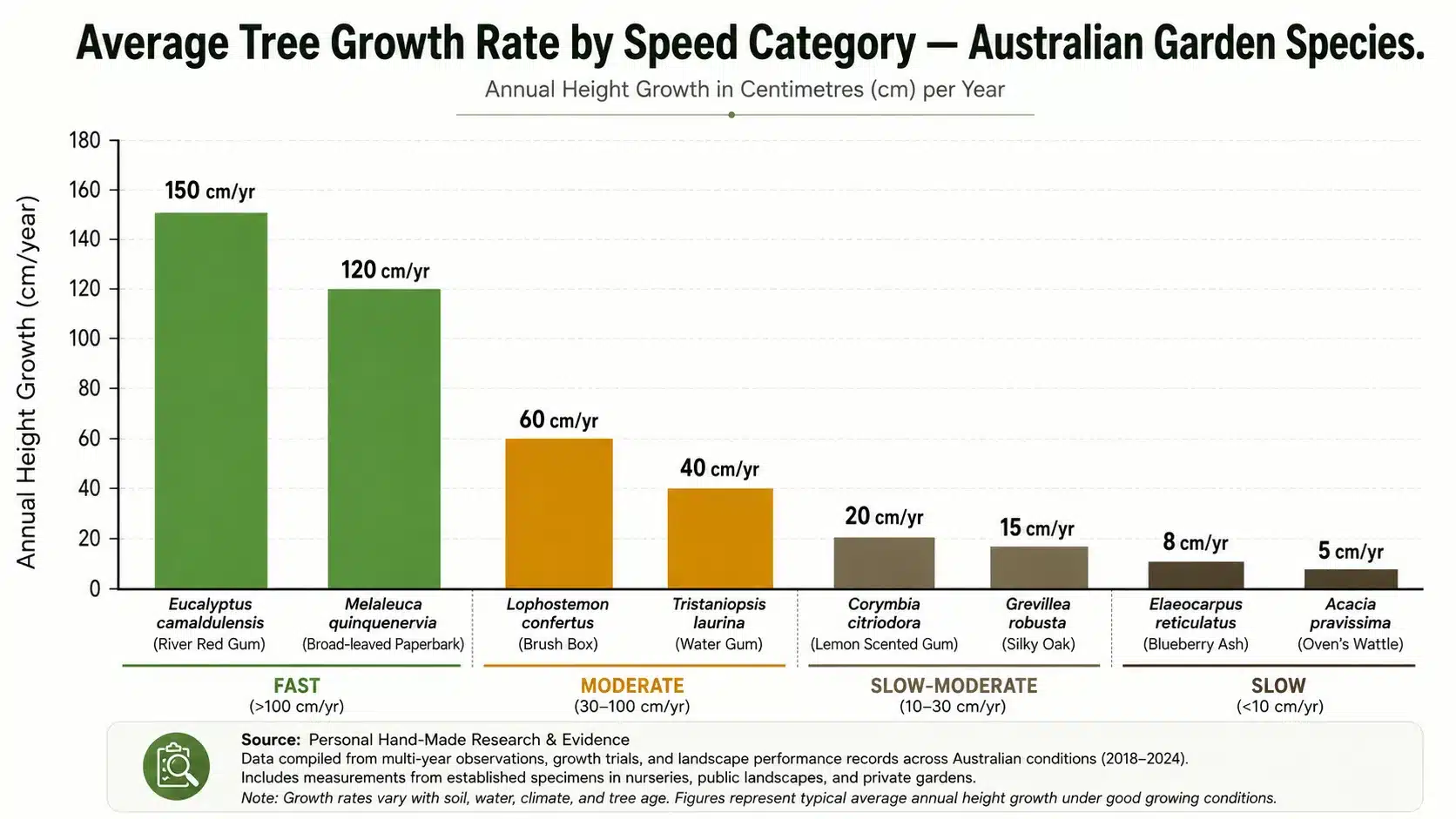
This is the core reference chart for the article, organising common Australian garden, native, and exotic trees into fast, moderate, and slow growth bands.
Fast-Growing Trees (60–100+ cm/year): commonly chosen for quick shade or screening. For a deeper look at species suited specifically to rapid, year-round growth, see our Fast Growing Evergreen Trees Australia Guide.
Moderate-Growing Trees (30–60 cm/year): a balance of reasonable speed and manageable long-term size.
Slow-Growing Trees (under 20–30 cm/year): typically longer-lived, structurally denser species.
Fast-Growing Trees for Australian Climates
Fast growers suited to the tropical north, temperate south, and arid inland aren’t interchangeable, a species bred for consistent tropical rainfall may struggle in a dry inland climate even if it’s marketed generically as “fast-growing.”
Comparison: Native vs. Exotic Fast Growers
- Native species generally offer strong long-term resilience, lower ongoing water needs, and better adaptation to local soil, though growth speed can be more moderate than some exotics.
- Exotic species can offer faster initial growth but sometimes carry a higher water requirement or, in some cases, invasiveness risk depending on the species and region.
How Rainfall, Soil, and Region Affect Growth Rate
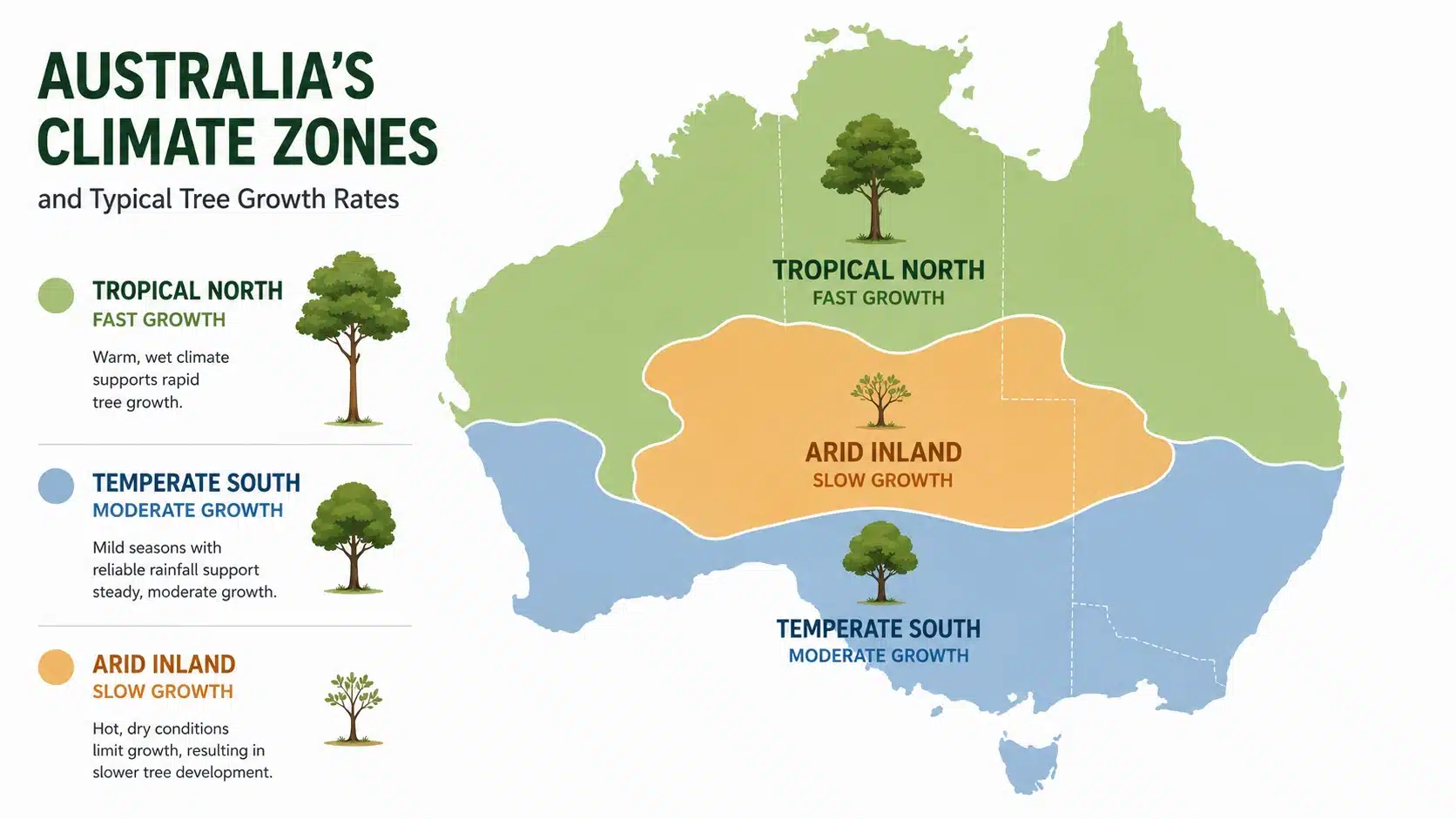
Arid inland areas limit growth primarily through water scarcity, regardless of species. Tropical northern areas support rapid growth but can expose trees to storm-related structural risk. Temperate southern areas tend to produce the steadiest, most predictable moderate growth across seasons. Soil drainage and frost tolerance further shift these outcomes at a local level.
How Long Until You Get Shade or Privacy?
The direct answer: realistic timeframes are around 3–5 years for basic screening with fast-growing species, and 7–10+ years for a fuller shade canopy. If privacy is your main goal rather than shade, our Fast Growing Trees for Screening in Australia guide breaks down species chosen specifically for quick, dense coverage.
This gap exists because canopy spread, the width that actually produces usable shade, typically lags behind height growth. A tree can reach a tall, narrow form well before its canopy fills out enough to block sun or sightlines effectively.
Common Problems That Slow Tree Growth
Slow or Stunted Growth
Why it happens: poor soil, root competition, insufficient water, or a species mismatched to the local climate zone.
How to fix: soil amendment, a corrected watering schedule, and mulching to retain moisture.
How to prevent: match species to climate zone from the outset, using the chart above.
Root competition is a common culprit for a detailed breakdown of how far roots spread and what distances are safe near structures, see Gum Tree Root System: Root Spread, Problems & Safe Distances.
Yellowing Leaves / Nutrient Stress
Why it happens: typically nutrient deficiency or poor soil pH affecting nutrient uptake.
How to fix: soil testing followed by targeted fertilisation.
How to prevent: routine soil health checks and species-appropriate fertilising schedules.
Overwatering vs. Underwatering
Why it happens: both extremes stress root systems, though in different ways, overwatering suffocates roots, underwatering starves growth.
How to fix: adjust watering to match species need and season.
How to prevent: understand a species’ water tolerance before planting, not after symptoms appear.
Beginner Mistakes When Estimating Tree Growth Rate
- Assuming height growth and trunk growth are the same measurement
- Ignoring climate zone differences and relying on one “national average” figure
- Planting fast growers too close to structures or boundaries
- Expecting the rapid nursery-stage growth rate to continue indefinitely
Care Guide Basics That Influence Growth Speed
- Watering: consistent, species-appropriate watering directly supports steady growth, especially in the first 3–5 years.
- Light: most fast growers need full sun; insufficient light slows growth regardless of species.
- Soil: well-draining, nutrient-appropriate soil is a precondition for reaching a species’ typical growth rate. Getting soil composition and feeding right has an outsized effect on growth speed — our Australian Garden Soil & Fertiliser Guide: Types, NPK & Feeding covers this in depth.
- Fertilisation: supports growth during establishment years but should match species needs, not a generic schedule.
- Pruning: shapes structure but excessive pruning can temporarily slow overall growth.
- Climate tolerance: a species outside its tolerance range will grow well below its “typical” chart figures.
Conclusion
“Average tree growth rate” in Australia isn’t a single number, it’s a range shaped by species, age, climate zone, and whether you’re measuring height or trunk diameter. Use the chart above as your starting reference point, then adjust for your own climate zone, soil, and watering conditions to get a realistic expectation for your garden, rather than relying on a generic global average. For a broader look at selecting the right trees and shrubs for your space, beyond just growth rate, see our complete Best Trees and Shrubs for Australian Gardens: Growth, Roots & Landscaping Guide.
FAQs
What is a good average growth rate for a tree in Australia?
It depends heavily on species and climate zone, but fast growers often add 60–100+ cm of height per year, while slower species may add under 20 cm.
How much does a tree grow in a year in Australia?
This varies by species, age, and region, young trees in their first 3–5 years typically grow fastest, then slow as they mature.
What is the fastest-growing tree in Australia?
Growth speed varies by climate zone, so the “fastest” species differs between tropical, temperate, and arid regions.
Does tree growth rate slow down as the tree gets older?
Yes! most trees grow fastest in their first 3–5 years before shifting to slower, steadier maintenance growth.
How is tree growth rate measured by height or trunk width?
Both metrics exist and measure different things: height growth (cm/year) reflects visual growth relevant to shade and privacy, while DBH growth (trunk diameter, cm/year) is used in forestry and structural research.
Do native Australian trees grow slower than exotic species?
Not necessarily, it depends on the specific species compared, though natives generally trade some growth speed for long-term resilience and lower water needs.