

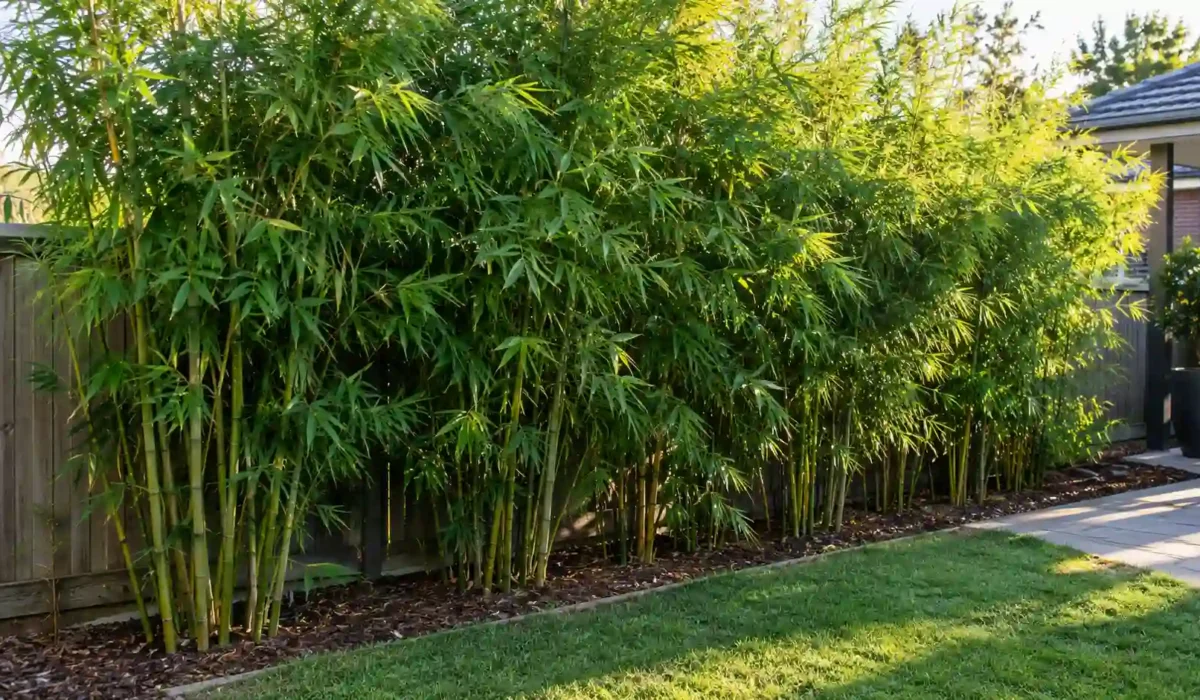
Bamboo Screening Plants Australia: Clumping Types & Spacing
If a neighbour can see straight into your yard, bamboo screening plants Australia gardeners can use are often a fast route to a tall evergreen privacy screen. The safest starting point is a clumping bamboo, such as Bambusa textilis ‘Gracilis’, planted with enough room for its mature clump and enough access to maintain the boundary. Running bamboos such as Phyllostachys are a different proposition because their underground rhizomes can spread well beyond the original planting area. Gracilis is commonly sold at around 6–8 m mature height, while narrower varieties such as Goldstripe suit lower screens and tight spaces.
Quick Summary
- Choose clumping bamboo, not running Phyllostachys, for most suburban privacy screens.
- Gracilis is the leading all-round choice for a tall, relatively narrow screen; Goldstripe suits lower or tighter screens.
- A practical starting point is roughly 0.5–1 m from a boundary, increasing the setback for wider species, walls, paving and difficult-to-access sites.
- Do not promise an exact “screening time”: one Australian nursery reports a continuous Gracilis wall at 1 m spacing within about three years, but climate, plant size, water and bed conditions can materially change the result.
Which Bamboo Is Safe to Plant? Clumping vs Running Bamboo
For a boundary screen, the key distinction is rhizome behaviour, not simply whether a nursery calls the plant “non-invasive”.
Clumping bamboo expands from a relatively compact rhizome system, keeping new culms much closer to the parent clump. Running bamboo spreads through long underground rhizomes that can produce new shoots away from the original planting. Weeds Australia describes Phyllostachys as running bamboo and identifies several species, including Golden Bamboo (Phyllostachys aurea), as problematic in Australia.
The Queensland Government similarly warns that running bamboo can escape containment and recommends a root barrier around garden bamboo plantings. Queensland does not classify bamboo generally as a prohibited or restricted invasive plant under its Biosecurity Act 2014, but local government requirements can still apply and landholders retain general biosecurity obligations.
For Australian gardeners, the practical rule is therefore simple: start with a verified clumping species and check your council or state weed requirements before planting any bamboo.
How to tell them apart
- Clumping habit: new shoots emerge close to the existing base and form a recognisable clump.
- Running habit: new shoots can appear some distance away from the original planting.
- Genus warning: Phyllostachys contains running bamboos and should not be treated as equivalent to a tidy clumping Bambusa.
Golden bamboo is a rhizomatous species that has naturalised in parts of New South Wales and south-east Queensland, and the Weeds Australia golden bamboo profile lists it as a declared weed in the ACT, NSW and WA. That makes it the main species to avoid when you want a boundary-safe screen.
Is it legal to grow bamboo in Australia?
There is no single Australia-wide “bamboo is legal/illegal” answer. Rules differ between jurisdictions and can also involve local councils. Weeds Australia currently lists Golden Bamboo as declared in ACT, NSW and WA, while Brisbane City Council lists it as council pest vegetation. Queensland’s state guidance says bamboo is not prohibited or restricted under the Biosecurity Act 2014, but local biosecurity plans and laws may impose controls. In NSW, running (Phyllostachys) bamboo is covered by the General Biosecurity Duty, so check the NSW WeedWise entry for rhizomatous bamboo and your local council’s rules before planting. Rules differ by state, so confirm what applies where you live.
Check the current state and council position for your property before buying, particularly for Phyllostachys. This is general gardening information, not legal advice.
| Clumping bamboo | Running bamboo |
| New culms remain associated with the clump | Rhizomes can spread away from the clump |
| Easier to manage in suburban gardens | Higher containment and neighbour-risk |
| Better choice for privacy screening | Generally unsuitable for casual boundary planting |
| Still needs space and maintenance | Requires serious containment if retained |
Best Bamboo Screening Plants Australia: Species Compared
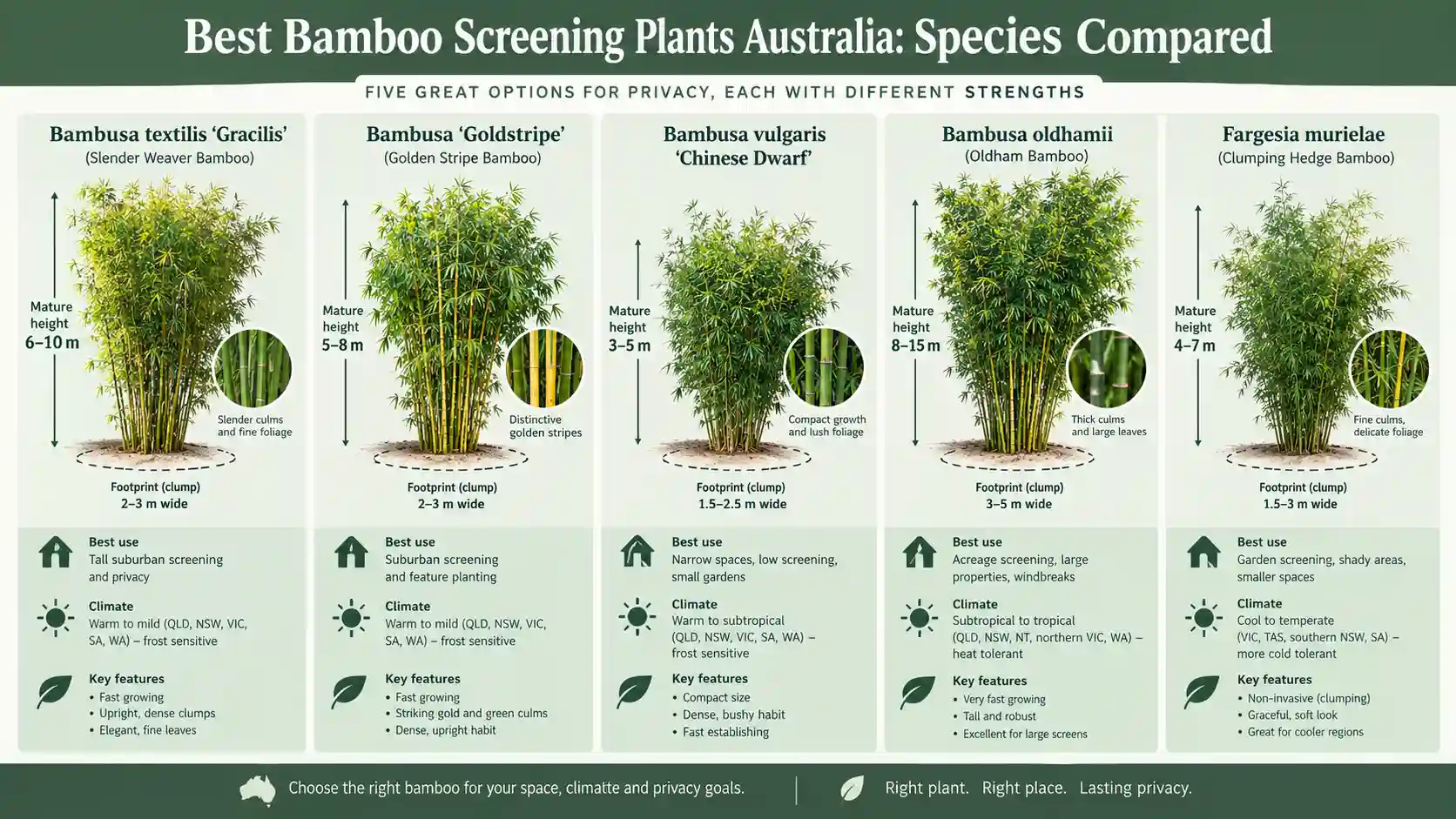
For most suburban gardens, Gracilis is the default tall screening choice because it combines height with an upright habit. Kew accepts Bambusa textilis as the species name; Australian nursery listings commonly sell Gracilis as Bambusa textilis ‘Gracilis’ or Bambusa textilis var. gracilis.
Nursery specifications vary, particularly for width. Current Australian listings put Gracilis around 6–8 m tall, with reported natural clump widths ranging from about 1–2 m depending on growing conditions and how the clump is maintained.
Table 1: Species comparison
| Species | Reported mature height | Clump width / habit | Best for | Main limit |
| Gracilis (Bambusa textilis ‘Gracilis’) | 6–8 m | Upright; roughly 1–2 m depending on site and management | 3–6 m+ privacy screens, narrow suburban beds | Still becomes a substantial plant |
| Goldstripe (Bambusa multiplex ‘Goldstripe’) | About 3–4 m | Upright, tight clump; around 1 m naturally | Lower screens, pots and narrow beds | Not the best choice when a tall 6 m screen is required |
| Chinese Dwarf (Bambusa guangxiensis) | About 4–8 m | Dense, bushy clumper | Dense hedges and privacy screens in warm areas | Needs trimming to stay compact; limited frost tolerance |
| Bambusa oldhamii | About 15–18 m reported by Australian nurseries | Large clump | Acreage, windbreaks and very tall screening | Far too large for many suburban gardens |
| Fargesia spp. | Often around 3–4 m for screening types | Tight clumping | Cool climates and protected screens | Heat and intense afternoon sun can be problematic |
Goldstripe is widely marketed as a smaller, upright screening bamboo around 3–4 m tall, while Chinese Dwarf is reported around 4–8 m and performs best in tropical, subtropical or warm protected temperate areas. Bambusa oldhamii is much larger and is better considered an acreage-scale screen.
Fargesia can be useful in cooler climates, but it is not automatically the best bamboo for Australia. An Australian nursery notes that prolonged heat can cause its foliage to curl, while RHS guidance recommends Fargesia in fertile, moist, well-drained soil and away from hot afternoon sun.
Narrow beds and pots
Bamboo can be grown in containers, but the container becomes part of the plant’s root-management system. Gracilis and Goldstripe are among the more practical choices for pots and troughs because of their relatively upright growth. Current Australian nursery listings specifically market both for narrow spaces and containers.
Expect more frequent watering in containers, particularly in hot Australian weather. Do not choose a huge species simply because it can be pruned shorter: root volume, wind exposure, container stability and watering demands still increase as the plant matures.
Climate selector
| Australian condition | Better starting choices | Use caution with |
| Tropical | Gracilis, Goldstripe, Chinese Dwarf, Oldhamii where space allows | Fargesia in hot exposed positions |
| Subtropical | Gracilis, Goldstripe, Chinese Dwarf | Fargesia in hot afternoon sun |
| Temperate | Gracilis, Goldstripe, suitable Fargesia | Warm-climate species in severe frost pockets |
| Cool / frost-prone | Gracilis, Goldstripe, suitable Fargesia | Chinese Dwarf and other frost-sensitive choices |
| Coastal / windy | Upright Gracilis or Goldstripe with establishment support | Very exposed sites where dense foliage creates a large wind load |
| Deep shade | Consider another screening plant | Bamboo generally performs better with usable light |
Is Bamboo Right for Your Site? When It’s the Wrong Choice
Bamboo is excellent when you need height without a very wide hedge, but it is not a universal screening solution. Deep shade, extremely narrow soil beds, severe frost, exposed sites and bushfire-sensitive locations all deserve extra scrutiny.
Bamboo also produces leaf litter and requires regular thinning when a clump becomes crowded. In bushfire-prone areas, do not assume a green evergreen screen is automatically a low-risk planting. Weeds Australia notes that dense bamboo infestations can restrict access to fence lines and present a fire risk, while Australia’s fire behaviour is strongly affected by the amount and dryness of available vegetation fuel.
For an alternative screen, compare the space before you compare the plants. A lilly pilly can offer dense evergreen foliage and is often easier to shape into a formal hedge, while Ficus hillii ‘Flash’ is another fast-growing screening option that can be maintained as a hedge.
Table 3: Bamboo vs lilly pilly vs other screens
| Factor | Clumping bamboo | Lilly pilly | Ficus hillii ‘Flash’ / similar hedge |
| Speed | Fast under good conditions | Moderate to fast, depending on species | Fast under favourable conditions |
| Width | Can be relatively narrow with upright forms | Varies widely by species/cultivar | Usually manageable with pruning |
| Height control | Easy to top, thin and selectively remove culms | Formal hedge pruning works well | Regular hedge pruning may be needed |
| Water demand | Higher during establishment and hot weather | Species-dependent | Higher while establishing |
| Fire considerations | Leaf litter and dense growth require site-specific assessment | Must still follow local bushfire guidance | Same principle |
| Neighbour risk | Lower with true clumping types, but not zero | Usually easier to contain as a hedge | Usually straightforward with pruning |
Decision flowchart:
Need a 3–6 m screen? → Yes → Bed at least roughly 0.75–1 m wide? → Yes → Warm enough for the species? → Yes → Neighbour-sensitive boundary? → Choose verified clumping bamboo + planned setback/barrier.
Very narrow bed / deep shade / severe frost / bushfire-sensitive site? → Compare lilly pilly, other screening shrubs or a purpose-selected hedge instead.
How Far to Plant From the Fence, and How to Space Bamboo
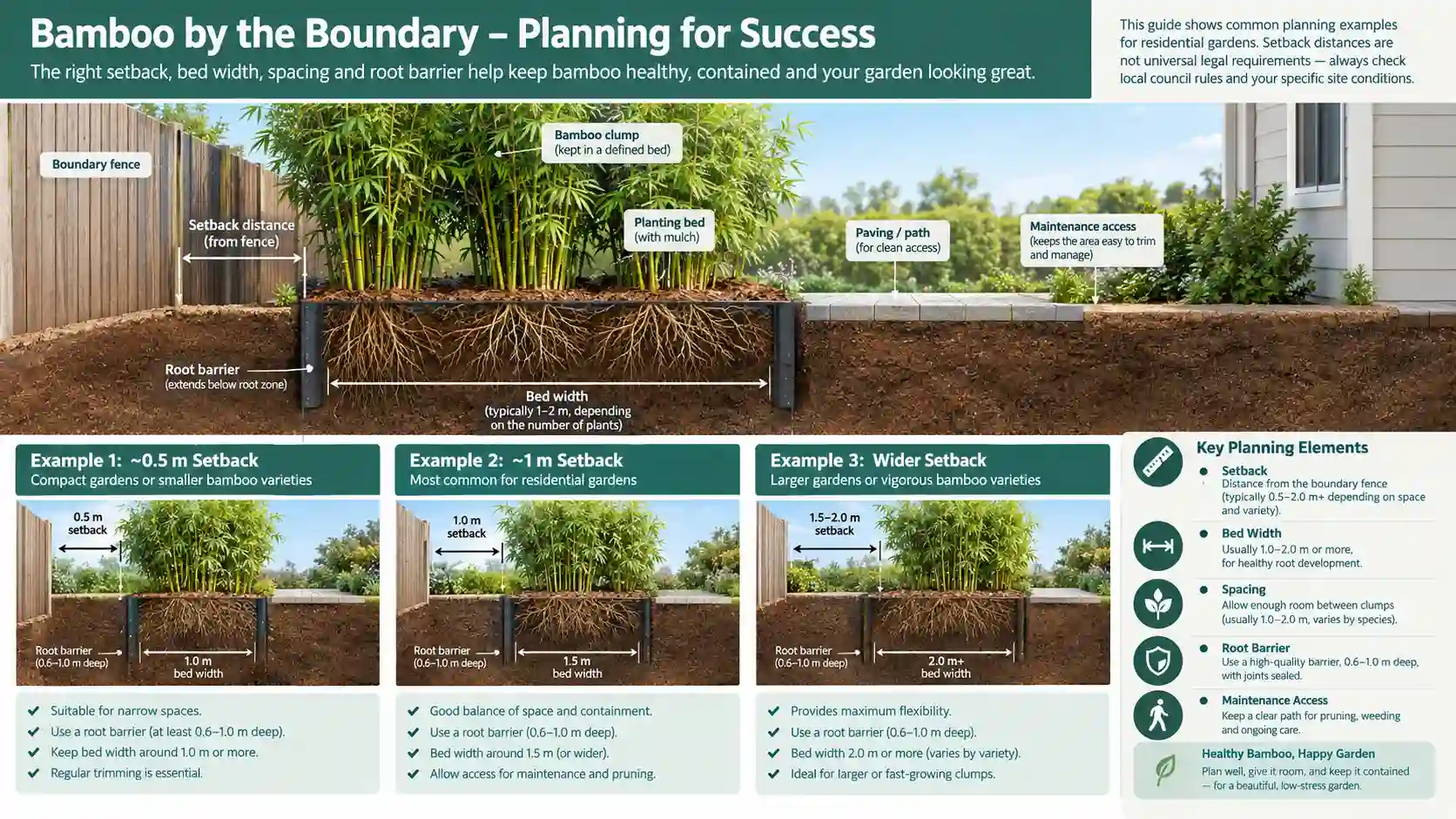
The safest answer to how far to plant bamboo from a fence is not one universal number. The correct setback depends on mature clump width, the species, whether the fence can be accessed for maintenance, and whether the planting is beside paving, masonry or other structures. The Queensland Government’s bamboo guidance recommends a root barrier around garden plantings, with the top edge sitting just above ground level. Use this as a baseline if you’re planting a spreading bamboo or want extra insurance on a boundary.
For Gracilis, Australian nursery guidance commonly starts around 0.5 m from a fence, with wider spacing recommended where the bed is broader or the clump is allowed to reach its natural footprint. Queensland Government guidance recommends root barriers for containing bamboo in garden situations.
A useful rule is to increase the setback rather than squeeze a mature plant into a gap that only fits its nursery pot.
Table 4: Setback and barrier decision guide
| Situation | Practical starting point | Root-barrier approach |
| Upright Gracilis, open fence, accessible bed | 0.5–1 m | Consider a barrier where spread or boundary access is a concern |
| Gracilis beside paving, masonry or a tight service area | Around 1 m or more | Strongly consider containment and leave maintenance access |
| Goldstripe in a narrow ornamental bed | Around 0.5–1 m | Barrier is useful where escape would be difficult to correct |
| Chinese Dwarf / denser wider clumper | Around 0.75–1 m+ | Match barrier and setback to expected mature width |
| Oldhamii or another large clumper | 1.5–2 m or more | Use a large-scale site plan rather than treating it as a hedge |
| Running Phyllostachys | Do not use as a routine boundary screen | Formal containment requires much more serious management; Weeds Australia cites about 75 cm as historical best-practice barrier depth for Phyllostachys |
These are planning ranges, not universal legal setbacks. For structural footings, pools, reactive soils, underground services or a regulated boundary, follow the relevant engineering, council or site-specific advice.
A broader discussion of mature size, root spread and planting distances is available in Leafy Heaven’s growth, roots and plant sizing guide.
Spacing and planting steps
- Measure the bed and boundary before buying plants.
- Confirm the species and mature width, not just the nursery-pot size.
- Prepare free-draining soil and improve poor structure before planting.
- Space plants for the screen you actually want: around 1 m spacing is a common starting point for a dense Gracilis screen; 1.5–2 m gives more room between clumps and can leave visible gaps at the base.
- Mulch after planting, keeping mulch away from direct contact with the culms.
- Water consistently during establishment, especially through hot weather.
Cost per linear metre
The basic calculation is:
Plants needed = screen length ÷ planting spacing
Plant cost = number of plants × current plant price
For example, a 10 m screen planted at 1 m spacing requires about 10 plants. If a nursery quote is A80perplant,theplantcostisA800 before delivery, soil improvement, mulch, barriers and labour. Replace the illustrative A$80 with the live price when purchasing.
Plant Size note
Mature height and width matter more than the height of the plant in its pot. A large advanced plant can give you a faster visual result, but it may cost more and still needs enough soil volume and watering to establish properly. A narrow bed can also slow growth when root space becomes limiting.
How Fast Does Screening Bamboo Grow, and When Will It Screen?
Bamboo growth is staged, not a guaranteed centimetres-per-year rate. New plantings first establish roots, then produce larger seasonal shoots as the clump becomes established. Warmth, water, soil fertility, available root space and spacing all influence the result.
For perspective, 20 ft is about 6.1 m, which is within the commonly reported mature height range of Gracilis. One Australian nursery currently states that Gracilis planted at 1 m spacing can form a continuous, dense wall within about three years, but that is a nursery benchmark rather than a universal Australian timeline.
Table 5: Years to full screen
| Spacing | Starting plant size | Realistic planning interpretation |
| 1 m | 200–300 mm pots | About 3+ years is a reported Gracilis benchmark for continuous coverage; allow for site variation |
| 1 m | 400 mm+ stock | Larger starting plants can reduce the visual waiting period, but no universal number applies |
| 1.5 m | Smaller starter plants | Longer to close at the base; upper foliage may join before the clumps do |
| 2 m | Smaller starter plants | Longer again for a solid base; better where budget and footprint matter more than speed |
For an evidence-based project, photograph the same row at fixed intervals and measure cane height and clump width rather than relying on a generic “fast-growing bamboo” promise.
Bamboo Care: Watering, Feeding, Thinning and Cutting Back
Bamboo needs reliable moisture while establishing, with demand increasing during hot Australian summers. Full sun to part shade is common for the mainstream screening types discussed here, provided soil moisture is managed.
Feed during active growth according to the product label, maintain mulch, and remove dead or overcrowded culms at ground level to improve the appearance and airflow of the clump.
A critical pruning point is often misunderstood: a cut bamboo culm does not extend upward again. The clump can produce new culms from its underground rhizome system, but the individual cut cane will not resume vertical growth like a hedge stem.
The RHS bamboo-growing guidance also recommends removing weak, dead, damaged or spindly stems and thinning bamboo to improve the display of the culms.
| Season | Main task |
| Spring | Feed and watch for new shoots |
| Summer | Maintain deep, consistent watering during heat |
| Autumn | Thin crowded or unwanted culms |
| Winter | Monitor frost exposure and remove damaged material when appropriate |
Common Bamboo Screen Problems and How to Fix Them
Most screening failures come back to spacing, water, site conditions or choosing a plant that is too large or too small for the job.
| Problem | Why it happens | How to fix | How to prevent |
| Leggy or bare base | Plants spaced too widely, insufficient light, or unsuitable growth habit | Thin selectively and improve spacing strategy | Choose a naturally dense species and plant for the finished screen |
| Yellow or curling leaves | Heat, dry soil, root stress or other growing conditions | Check soil moisture, drainage and exposure | Match species to climate and keep new plantings watered |
| Leaf drop | Stress, seasonal shedding or drought | Check watering and weather history | Maintain mulch and consistent establishment watering |
| Leaning canes | Wind, heavy foliage or weak establishment | Stake young plants where needed and thin excessive growth | Use an upright species and allow enough establishment space |
| Post-frost browning | Cold damage to exposed foliage | Wait for new growth before assuming the clump is dead | Choose a frost-tolerant species for the location |
| Neighbour complaints / encroachment | Planting too close, poor maintenance or escaping rhizomes | Cut back, remove unwanted shoots and restore boundary clearance | Choose clumping bamboo, inspect the boundary and maintain regularly |
For general symptom diagnosis, our Plant Problems & Troubleshooting guide provides a broader framework for separating environmental stress from pest and disease symptoms.
The best prevention is simple: inspect the base of the clump regularly. A neighbour dispute is much easier to prevent when an unwanted shoot is removed early than after roots or foliage have crossed the boundary.
Conclusion
For most Australian suburban gardens, the strongest bamboo privacy-screen strategy is to choose a true clumping species such as Gracilis, match its mature size to the site, plant it with a sensible setback and allow several growing seasons for full density. Bamboo can be an excellent screen, but it is not a substitute for correct species selection, containment and ongoing maintenance.
FAQs
1. Is bamboo a good privacy screen in Australia?
Yes. Upright clumping types such as Gracilis can form tall evergreen screens, but climate, spacing, water and boundary management determine success.
2. How far from the fence should I plant clumping bamboo?
A practical starting range is about 0.5–1 m for upright clumping types, with more room for wider species and difficult-to-access boundaries.
3. How fast does screening bamboo grow?
Screening bamboo can grow quickly after establishment, but the time to a dense screen varies substantially with species, plant size, spacing, water and climate.
4. Can I grow bamboo in pots in Australia?
Yes. Smaller clumping types such as Goldstripe and Gracilis can work in large containers, but pots require more frequent watering and root-space management.
5. What are the downsides to bamboo?
Potential drawbacks include leaf litter, summer water demand, regular thinning, wind exposure and serious spread problems if the wrong running species is planted.
6. Does bamboo grow back after cutting?
A cut culm does not grow taller again, but the clump can produce new culms from its underground rhizome system.
7. Does bamboo need a lot of water?
It needs reliable moisture during establishment and usually more water during hot weather. Mature plants can be more drought-tolerant, depending on species and conditions.
1 Comment