
Australian Native Plants: A Complete Beginner’s Guide (2026)
Australian native plants are a good fit for beginners because most are drought-tolerant and adapted to poor soils once established — but “native” doesn’t automatically mean “easy.” Success comes down to matching the plant to your soil, sun, and region, avoiding high-phosphorus fertiliser on sensitive species, and resisting the urge to overwater.
If you’ve ever killed a “hardy” native within its first few months, you’re not alone, and it’s rarely bad luck. It’s almost always a mismatch between the plant and the spot it was put in, or a well-meaning gardening habit — daily watering, a generous handful of all-purpose fertiliser — that natives simply didn’t evolve to handle. The good news is that once you understand a handful of basic principles, growing natives becomes genuinely low-effort. This guide walks through what to plant, how to set it up to survive its first year, and the specific mistakes that catch most beginners out.
Why Grow Australian Native Plants?
Australian natives have spent tens of thousands of years adapting to this continent’s particular mix of poor soils, unreliable rainfall, and extreme temperature swings. Australian natives have spent tens of thousands of years adapting to this continent’s particular mix of poor soils, unreliable rainfall, and extreme temperature swings. For broader background on Australia’s plant diversity, see Flora of Australia.
That evolutionary history is exactly what makes them useful in a home garden. Once established, most natives need far less supplementary watering than exotic species bred for gentler climates, which translates to a lower water bill and a garden that copes better with an Australian summer.
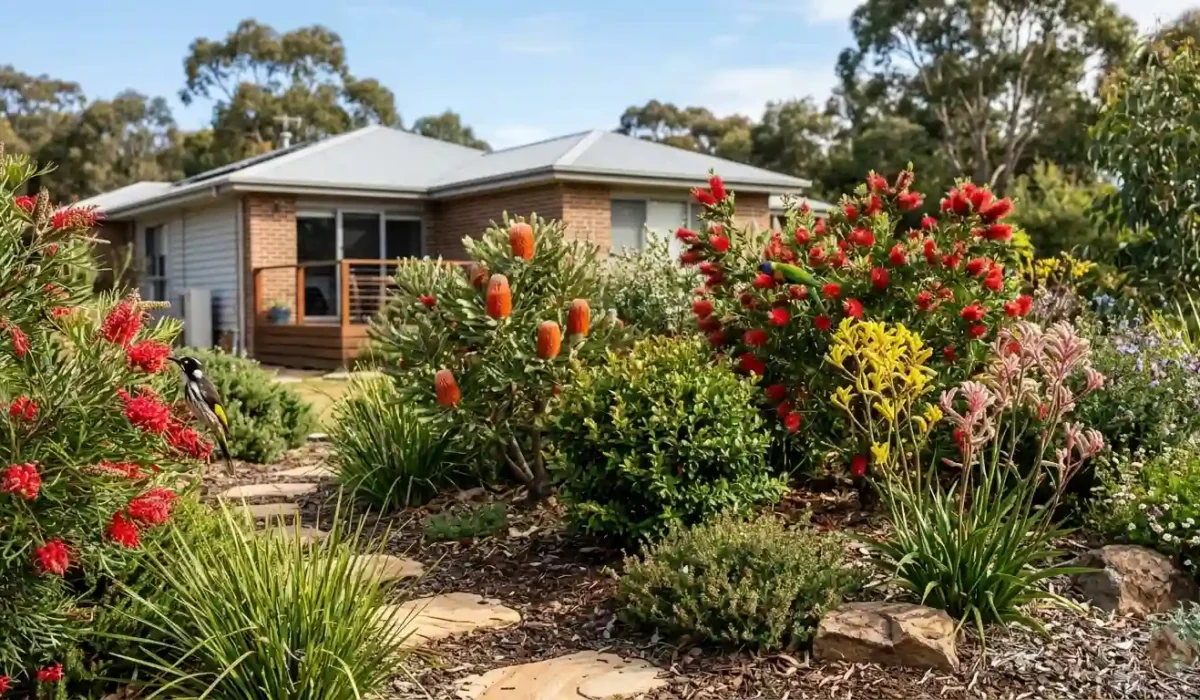
There’s also a habitat argument that’s easy to overlook. Grevilleas, banksias, and bottlebrushes are magnets for honeyeaters, lorikeets, and native bees in a way that most imported ornamentals simply aren’t. A native garden tends to feel alive with birdsong in a way an all-exotic garden doesn’t.
One honest caveat worth setting up front: “low maintenance” describes a native plant’s life after establishment, not the first six to twelve months in the ground. Every new planting, native or not, needs consistent attention while its root system develops. Skip this step and you’ll be back at the nursery buying a replacement.
Are Native Plants Actually Easier for Beginners?
Broadly, yes — but the word “easier” hides a few conditions.
The truth about “set and forget” natives
Once a native’s roots are established (typically after one to two growing seasons), many genuinely can be left alone. They’ll flower, cope with dry spells, and need little more than an occasional light prune. That’s a real advantage over high-maintenance exotics that expect regular feeding and watering indefinitely.
Where beginners go wrong
The mistakes that kill natives are almost always habits carried over from growing exotic or vegetable-garden plants:
- Overwatering new plantings out of anxiety. Natives are more likely to die from root rot due to constantly wet soil than from underwatering.
- Planting the wrong species for the soil type. A grevillea bred for sandy, free-draining Western Australian soil will often struggle in heavy Melbourne clay.
- Reaching for a general-purpose fertiliser. Some natives are genuinely sensitive to high phosphorus levels — more on exactly which ones below, because this point gets oversimplified constantly.
Understand Your Conditions Before You Buy Anything
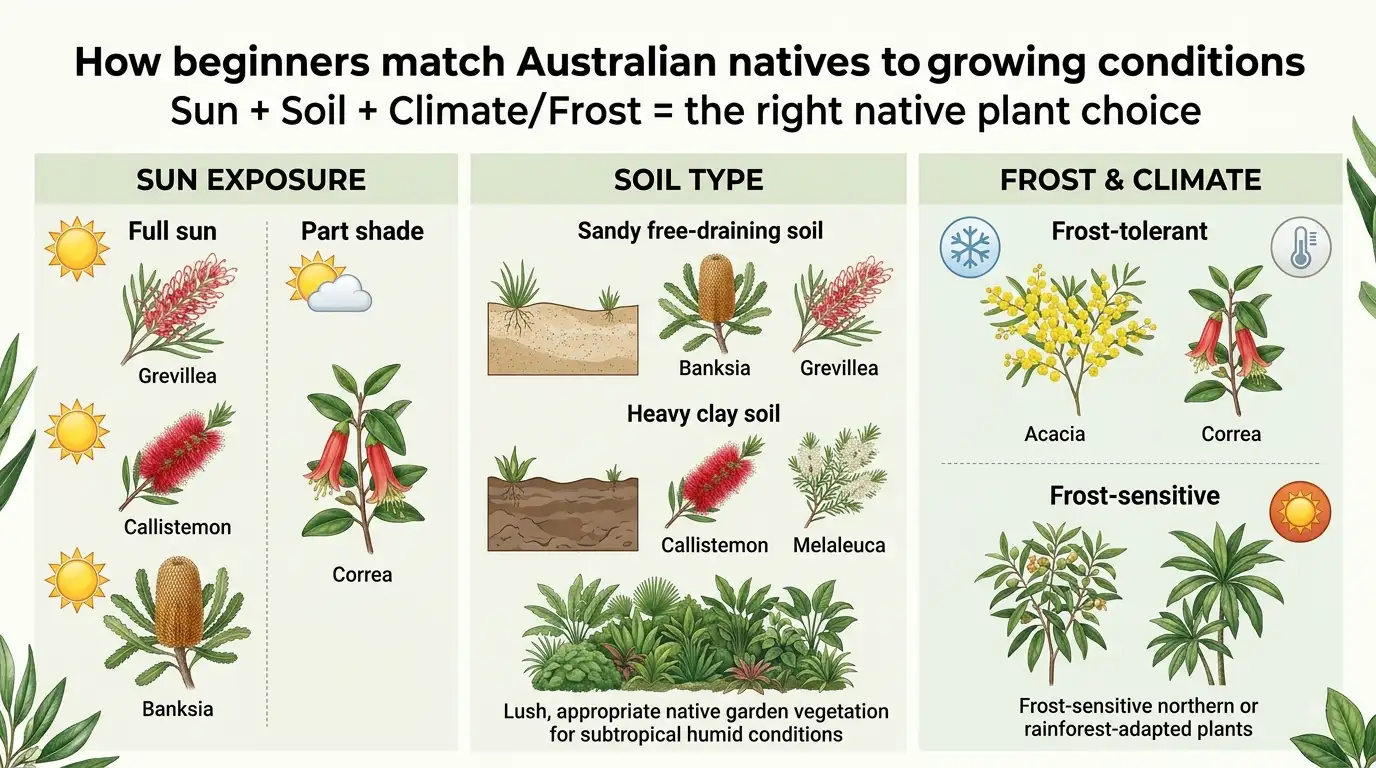
The single biggest predictor of whether a native plant thrives or sulks isn’t the plant — it’s whether it suits the spot you’re putting it in. Work this out before you go shopping.
Sun exposure
Most of the classic beginner natives (grevillea, callistemon, banksia) want full sun — at least six hours a day — to flower well and stay compact. A smaller number, including correa and some ferns, tolerate or prefer part shade. Check the plant tag or ask your nursery specifically about your spot’s sun exposure rather than assuming “native” means “sun-loving.”
Soil type by region
Australia’s soils vary enormously by region, and this matters more for natives than for many exotics because natives have often adapted narrowly to their local conditions:
- Sandy, free-draining soils (much of coastal WA, parts of South Australia): ideal for Proteaceae like banksia, grevillea, and hakea, which are highly intolerant of “wet feet.”
- Heavy clay soils (inland Victoria, parts of Sydney): improve drainage before planting anything phosphorus-sensitive, or choose more clay-tolerant genera like callistemon and melaleuca, which handle heavier soils far better than most Proteaceae.
- Subtropical, humid soils (Brisbane and northern NSW): good drainage still matters, but humidity and fungal disease pressure become a bigger factor than in drier southern states.
Frost tolerance
If you’re gardening in the highlands, inland NSW, or Canberra, check frost tolerance specifically — many rainforest-adapted and northern natives will burn or die back in a hard frost, while hardier genera like acacia and correa generally cope well. If frost is a major concern in your area, our Frost Tolerant Plants Australia: Best Cold Hardy Choices guide provides more options for gardens exposed to colder conditions.
10 Beginner-Friendly Australian Native Plants
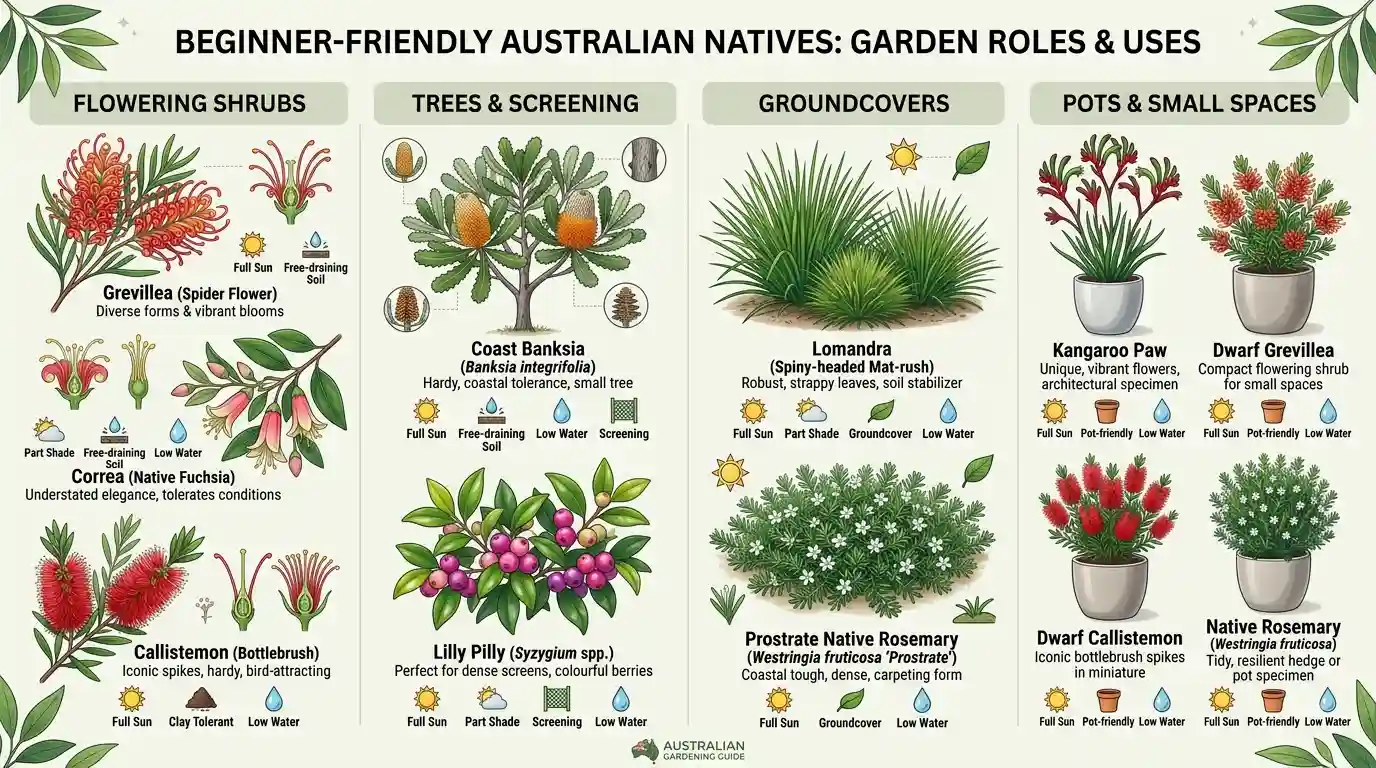
These are grouped by role in the garden rather than listed alphabetically, since “what do I actually need this plant to do” is usually the more useful starting question.
Easiest flowering shrubs
- Grevillea (many cultivars): reliable, near-constant flowering, strong bird appeal. Needs full sun and sharp drainage.
- Correa: tougher in part shade and cooler climates than most flowering natives, with a longer flowering window through autumn and winter.
- Callistemon (bottlebrush): one of the most forgiving natives going — tolerates heavier soils and occasional overwatering far better than Proteaceae species.
Easiest trees and screening
- Coast banksia (Banksia integrifolia): adaptable from coastal sand to inland soils, useful as a small-to-medium tree or clipped screen.
- Lilly pilly: a genuinely beginner-proof screening and hedging option; if you want cultivar-specific guidance, our lilly pilly cultivar comparison covers varieties suited to different hedge heights. If screening is your main goal, our guide to Fast Growing Trees for Screening in Australia can help you compare suitable options for creating privacy more quickly. For narrower garden boundaries, you can also explore our guide to Low-Maintenance Plants for Fence Line in Australia for ideas that require less ongoing maintenance.
Easiest groundcovers
- Kangaroo paw (Anigozanthos): striking flower spikes, well suited to pots and garden borders, though it appreciates good drainage and airflow to avoid fungal ink spot disease.
- Lomandra: close to indestructible once established; see our guide to Lomandra ‘Evergreen Baby’ for a compact, low-maintenance option. Lomandra is close to indestructible once established. For a compact, low-maintenance option, see our Evergreen Baby Lomandra: Size, Care & Growing Guide.
Easiest for pots and small spaces
- Dwarf grevillea and callistemon cultivars: bred specifically for confined root space and container life.
- Native rosemary (Westringia fruticosa): extremely tolerant of neglect, wind, and coastal exposure, and copes well in pots.
| Plant | Sun | Soil | Water once established | Flowering | Pot-friendly? |
|---|---|---|---|---|---|
| Grevillea (compact cultivars) | Full sun | Free-draining, sandy | Low | Most of the year | Yes (dwarf types) |
| Correa | Full sun–part shade | Tolerant of most soils | Low | Autumn–winter | Yes |
| Callistemon | Full sun | Tolerates clay | Low–moderate | Spring–summer | Yes (dwarf types) |
| Coast banksia | Full sun | Sandy to loam | Low | Autumn–winter | Only when young |
| Lilly pilly | Full sun–part shade | Adaptable | Low–moderate | Spring | Yes (dwarf cultivars) |
| Kangaroo paw | Full sun | Free-draining | Low | Spring–summer | Yes |
| Lomandra | Full sun–part shade | Very adaptable | Very low | Insignificant | Yes |
| Native rosemary (Westringia) | Full sun | Tolerates poor, sandy, coastal soil | Very low | Most of the year | Yes |
Growing Native Plants in Pots
For renters or anyone gardening on a balcony, pots open up a lot of native options that would otherwise need in-ground planting. A few things matter more in a pot than in the ground:
- Drainage is non-negotiable. Use a free-draining native potting mix and a pot with genuine drainage holes — natives are especially unforgiving of sitting in waterlogged soil.
- Choose dwarf or compact cultivars where available; standard-sized grevilleas and banksias will eventually outgrow all but the largest pots.
- Repot every one to two years as roots fill the container, moving up one pot size rather than jumping straight to something oversized.
Fertilising Natives: What Actually Needs Low-Phosphorus Feed
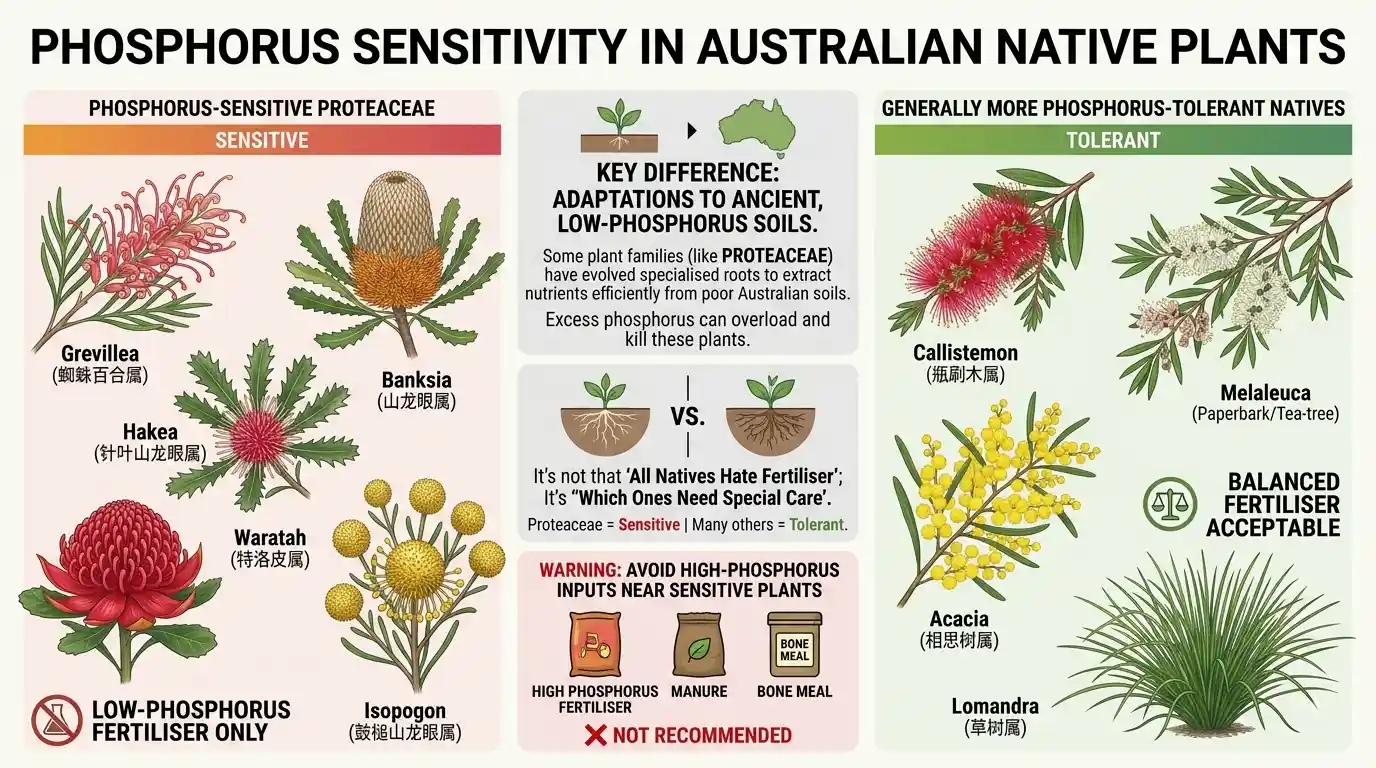
This is one of the most misunderstood topics in native gardening, and it’s worth getting right because the common advice — “never fertilise natives” — isn’t accurate.
Australia’s soils are genuinely phosphorus-poor by global standards, and members of the Proteaceae family (grevillea, banksia, hakea, waratah, isopogon) evolved specialised root structures to extract nutrients from that low-phosphorus environment. That adaptation is exactly what makes them sensitive to excess phosphorus: a standard all-purpose fertiliser can cause toxicity, showing up as stunted growth, dark or burnt-looking foliage, and poor flowering.
But that sensitivity doesn’t extend to every native plant. Callistemon, melaleuca, acacia, and lomandra generally tolerate general-purpose or even balanced slow-release fertilisers without issue.
A simple rule of thumb for beginners: check whether your plant belongs to the Proteaceae family, or check the nursery label. If you’re not sure, a low-phosphorus native-specific fertiliser is a safe default across your whole garden — it won’t harm the non-sensitive species, and it protects the sensitive ones.
It’s also worth knowing that phosphorus deficiency and phosphorus toxicity can look superficially similar to a beginner (both can cause poor growth), which is why guessing and adding more fertiliser “just in case” is risky. If a plant looks unwell, it’s worth checking watering and drainage first before assuming it needs feeding at all.
Watering Native Plants: The First Year vs After Establishment
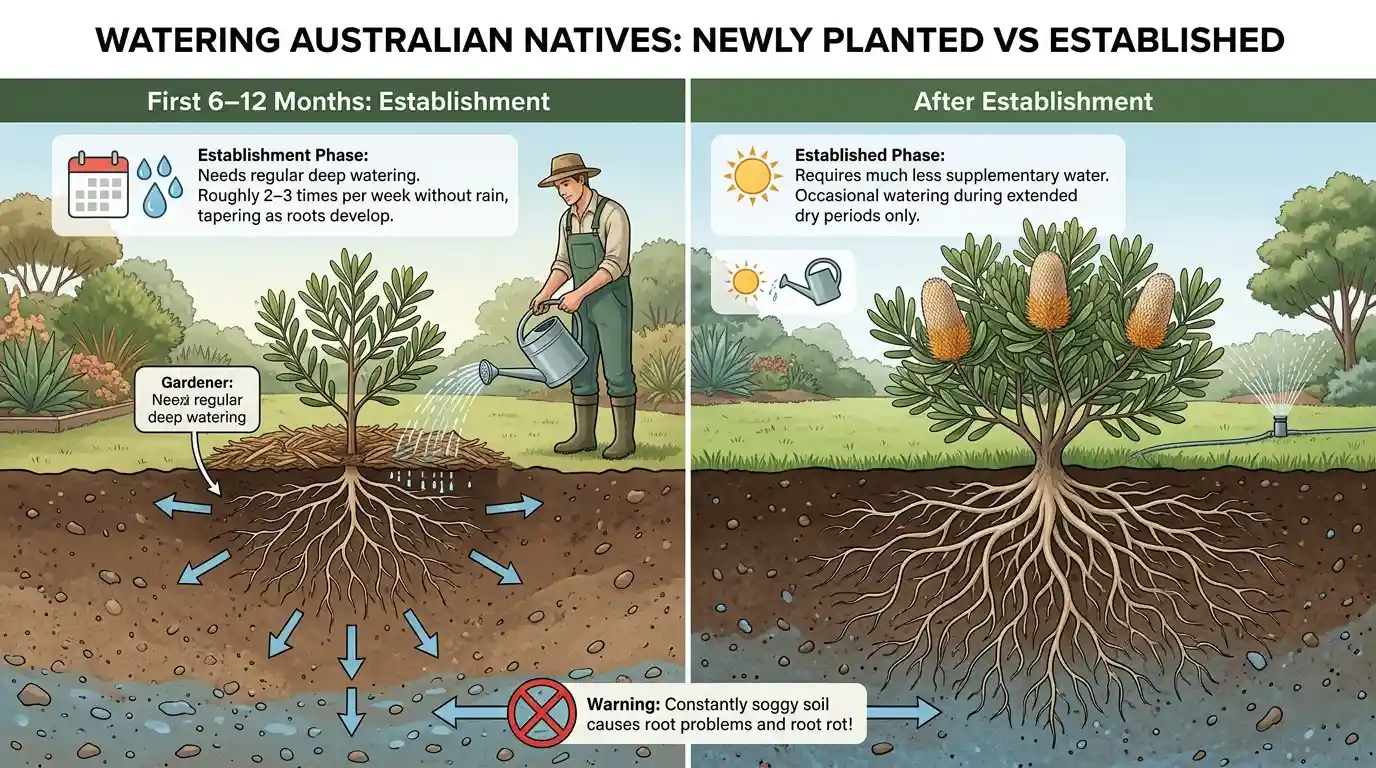
Establishment phase (first 6–12 months)
New native plantings need regular, deep watering — generally two to three times a week in the absence of rain, tapering as the plant develops roots. The goal is to encourage roots to grow deep and wide, not to keep the surface soil constantly damp.
Once established
This is where the “low maintenance” reputation is earned. Most established natives only need supplementary watering during extended dry spells. Overwatering an established native is a far more common cause of decline than underwatering — root rot from consistently soggy soil is one of the most frequent reasons a seemingly hardy native fails.
When to Plant and Prune Natives in Australia
Best planting windows
Autumn and early spring are generally the safest windows across most of Australia, giving roots time to establish in mild temperatures before the stress of either a hot summer or a cold winter. Planting in the peak of summer heat significantly increases the watering burden during establishment.
Basic pruning rules
Many popular flowering natives, particularly grevillea and tea-tree, grow quickly and can become leggy if left unpruned — but they don’t always respond well to hard cuts into old, woody growth. The safer approach is to start light, regular pruning early in the plant’s life (from as soon as it reaches your desired size) rather than waiting years and then attempting a drastic cutback.
Common Beginner Mistakes
- Using general garden compost or mulch near phosphorus-sensitive species. Many bagged composts contain manure or bone meal, both high in phosphorus.
- Planting in poorly drained spots. If water pools after rain, either improve drainage or choose a more tolerant genus like callistemon rather than a Proteaceae species.
- Overwatering out of habit. Treating a native like a vegetable garden plant is one of the fastest ways to kill it.
- Ignoring mature size at purchase. A grevillea or banksia in a small nursery pot can still grow into a multi-metre shrub or tree; check the tag’s mature dimensions before choosing a spot.
Reading Nursery Labels: What Beginners Should Actually Look For
Nursery tags carry more useful information than most beginners use. Beyond the common name, look for the botanical name (this avoids confusion between similarly-named cultivars with very different care needs), and note whether the plant is described as “Australian native” versus “local” or “indigenous” to your specific region — the latter is generally the safer bet for matching your exact soil and climate. Tube stock (small, cheap starter plants) generally establishes just as well as larger advanced pots for most native species, and costs considerably less if you’re planting in volume.
Final Thoughts
The plants themselves aren’t the hard part — matching them to your actual conditions is. Get the sun, soil, and watering right for the first year, keep phosphorus-sensitive species away from general fertiliser and rich compost, and most of the natives on this list will genuinely take care of themselves after that. If you’re ready to plan a fuller garden around these principles, our Best Trees and Shrubs for Australian Gardens guide is a useful next step for choosing suitable trees and shrubs and building out a layered Australian garden.
What natives are you growing (or struggling with)? Let us know in the comments — it helps other beginners working out what suits their own patch.
Frequently Asked Questions
Do Australian native plants need fertiliser?
Most benefit from occasional feeding, but the type matters. Phosphorus-sensitive natives (mainly Proteaceae — grevillea, banksia, hakea, waratah) need a low-phosphorus native fertiliser, while others like callistemon, melaleuca, and acacia generally tolerate general-purpose feeds. When unsure, a low-phosphorus native fertiliser is the safer default for the whole garden.
What is the easiest Australian native plant to grow?
Callistemon (bottlebrush) and lomandra are among the most forgiving for beginners, tolerating a wider range of soils, watering habits, and light conditions than more soil-sensitive genera like banksia or waratah.
Can Australian natives grow in pots?
Yes, particularly dwarf cultivars of grevillea, callistemon, and kangaroo paw. Drainage is critical in containers — use a free-draining native potting mix and repot every one to two years as the plant grows.
Why is my native plant dying even though it’s low maintenance?
Low maintenance applies once a plant is established, not immediately after planting. Common early-death causes include overwatering, poor drainage, or a species mismatch with your local soil and climate.
Do native plants attract more wildlife than exotic plants?
Generally yes. Australian birds, bees, and other pollinators co-evolved with native flowering plants like grevillea and banksia, which tend to produce more accessible nectar for local species than many exotic ornamentals.
What’s the difference between “native” and “indigenous” plants?
“Native” typically means Australian-origin broadly, while “indigenous” refers to species that occur naturally in your specific local region. Indigenous plants are usually better matched to your exact soil and climate.
When is the best time to plant natives in Australia?
Autumn and early spring, in most regions, giving the plant mild conditions to establish roots before facing summer heat or winter cold.
Do all natives hate phosphorus?
No — this is a common myth. Only a minority, mainly Proteaceae family members (grevillea, banksia, hakea, waratah, isopogon), are genuinely phosphorus-sensitive. Most other natives tolerate general-purpose fertilisers without issue.
How much water do native plants need in their first year?
Regular deep watering, roughly two to three times a week without rain, tapering off as the root system develops over 6–12 months.
Are native plants cheaper to maintain long-term than exotics?
Generally, yes, once established — lower water use and less frequent fertilising add up over time, though the first year of establishment carries similar watering demands to any new planting.
4 Comments