Fruit Tree Pollination Chart Australia: Best Pairs
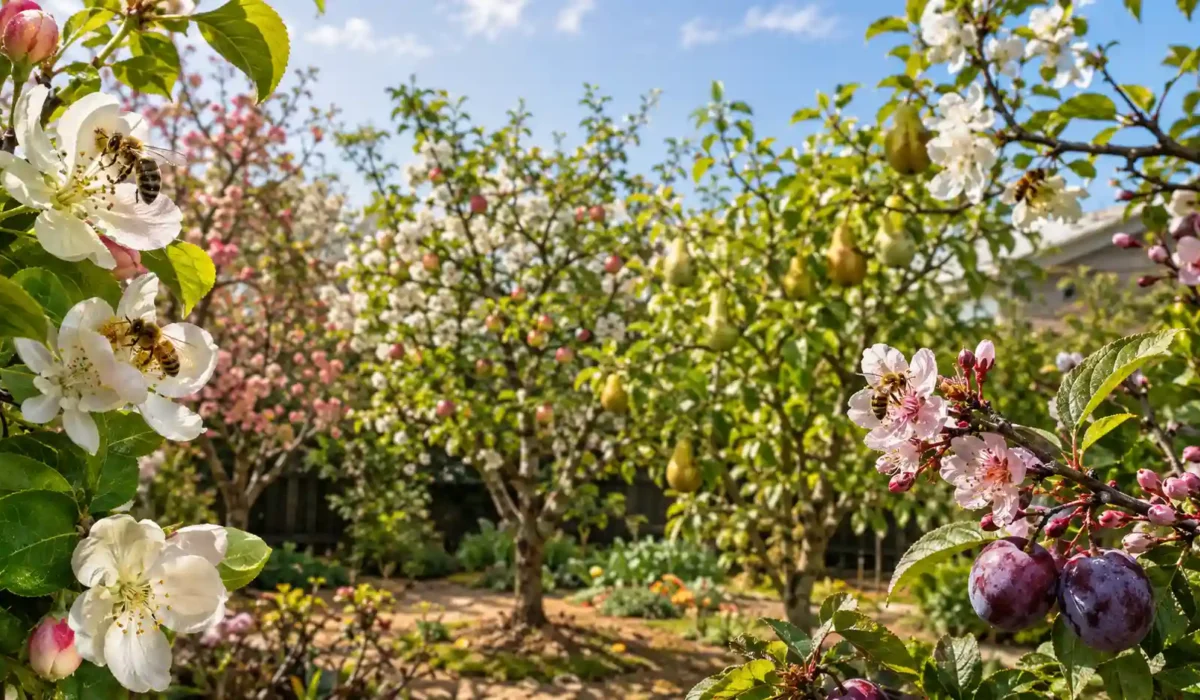
According to Elemo Baker, a fruit tree pollination chart maps which Australian garden fruit trees self-pollinate and which need a second variety nearby. Citrus, figs, and most peaches, nectarines and apricots are self-fertile; apples, pears, sweet cherries and plums generally require a compatible cross-pollinator planted within around 10 metres, with bees carrying pollen between blooms.
Avocados add a further twist: their flowers are bisexual but open as female then male on staggered schedules, so pairing a Type A variety like Hass with a Type B like Shepard lifts fruit set even though a lone tree will still crop. Multi-graft “fruit salad” trees carrying two or three compatible varieties on one rootstock solve the space problem in small gardens. Note that two trees of the same clonal variety, whatever the nursery, cannot pollinate each other — true cross-pollination needs a genetically distinct cultivar flowering at the same time.
If you are choosing several fruiting plants for your garden, our Fruit Trees for Australian Gardens: Complete 2026 Guide also covers suitable species, growing requirements and practical selection considerations for Australian conditions.
By Elemo Baker | Plant Care & Gardening Expert
Last Updated: August 2026
Quick Summary
- Most apples, pears and many sweet cherries benefit from a different compatible variety flowering nearby; peaches and nectarines are generally self-fertile.
- Satsuma plum performs best with a compatible Japanese plum such as Mariposa, Santa Rosa or another suitable cultivar; Mariposa is commonly listed with Satsuma as a pollinator.
- Japanese and European plums should not automatically be treated as interchangeable pollination partners.
- Keep compatible trees reasonably close so bees can move efficiently between blossoms; around 4–6 m is a practical home-garden target where space allows.
- Pollination depends on more than variety: overlapping bloom, viable pollen, bee activity and suitable weather all affect fruit set.
What Is Fruit Tree Pollination and Why Does It Matter?
Fruit tree pollination is the transfer of pollen from the anther, the flower’s pollen-producing structure, to the stigma, the receptive part of the female flower. The pollen then grows through the flower’s style towards an ovule, where fertilisation can occur and seeds begin developing. Successful fertilisation is what allows many fruit trees to develop a crop. Pollination is a fundamental biological process in flowering plants; see Wikipedia’s overview of pollination for a broader explanation of how pollen is transferred between flowers.
How Do Fruit Trees Pollinate? The 7 Steps
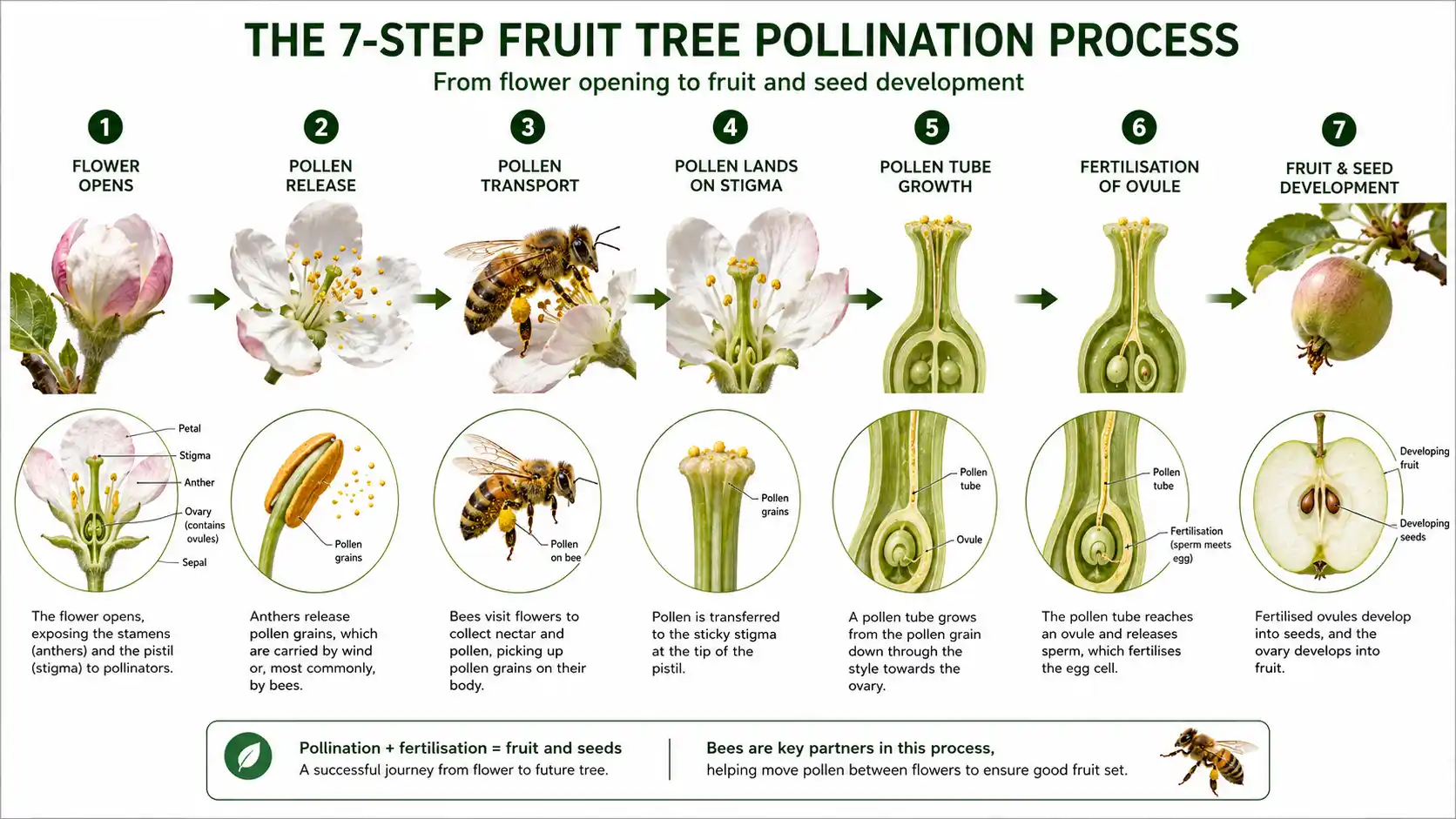
- The flower opens and its reproductive structures become accessible.
- Pollen is released from the anthers.
- A pollinator carries pollen, usually between flowers visited by bees or other insects.
- Pollen lands on the stigma of a compatible flower.
- A pollen tube develops and grows towards the ovary.
- Fertilisation occurs when compatible male and female cells unite.
- Fruit and seeds develop, provided the flower remains viable and other conditions are suitable.
The two main types relevant to home fruit trees are self-pollination and cross-pollination. Self-fertile trees can use pollen from the same cultivar, whereas self-incompatible trees require pollen from a genetically compatible cultivar.
Self-Pollinating vs Cross-Pollinating Fruit Trees
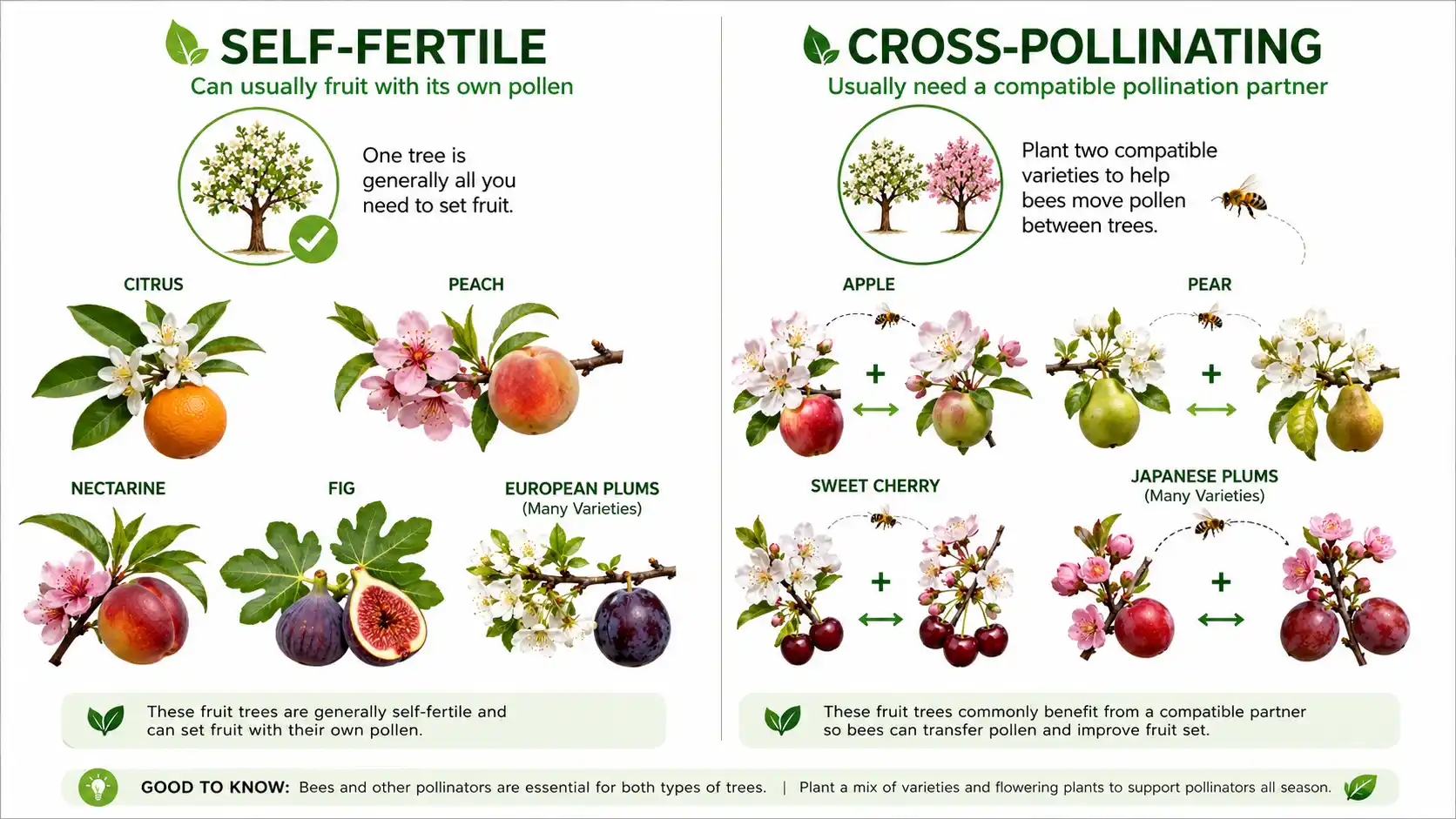
| Fruit type | Typical requirement | Practical home-garden advice |
| Citrus | Usually self-fertile | One tree can generally fruit |
| Peach | Usually self-fertile | One suitable cultivar is normally sufficient |
| Nectarine | Usually self-fertile | One tree can generally fruit |
| Fig | Depends on fig type | Common figs can set without cross-pollination |
| European plum | Many are self-fertile | A partner can improve cropping |
| Japanese plum | Cultivar-dependent | Check the specific pollination requirement |
| Apple | Usually cross-pollinated | Plant a compatible second variety |
| Pear | Usually benefits from cross-pollination | Choose overlapping varieties |
| Sweet cherry | Often cross-pollinated | Choose a compatible or self-fertile cultivar |
These are general categories rather than guarantees for every cultivar. Pollination requirements can vary significantly within a fruit species.
How to Read a Fruit Tree Pollination Chart
A fruit tree pollination chart normally matches a variety with another variety that has compatible pollen and overlapping flowering. For apples and some other deciduous fruit, nurseries often assign varieties to flowering or pollination groups.
As a practical rule, varieties in the same or adjacent flowering groups are often suitable partners, but the exact compatibility should always be checked for the cultivars being planted. Flowering groups are not universal across every fruit species.
A chart should therefore be read in this order:
- Identify the exact fruit-tree cultivar.
- Check whether it is self-fertile or self-incompatible.
- Find its flowering or pollination group where one is provided.
- Choose a compatible cultivar with overlapping bloom.
- Confirm that the potential polliniser produces viable pollen.
- Plant the trees close enough for pollinating insects to move between them.
Species boundaries matter. An apple cannot pollinate a pear, and a plum cannot pollinate a cherry. A pollination partner must be biologically compatible, not simply another fruit tree flowering at the same time.
Triploid apple cultivars require additional care because they can have sterile or poorly functional pollen. A triploid should not be treated as the sole polliniser for another apple; a suitable diploid polliniser is needed.
For a printable reference, gardeners can save or print the tables in this guide as a simple fruit tree pollination chart Australia reference. Always cross-check a nursery’s cultivar-specific information before purchasing.
Apple Pollination Chart (Australia)
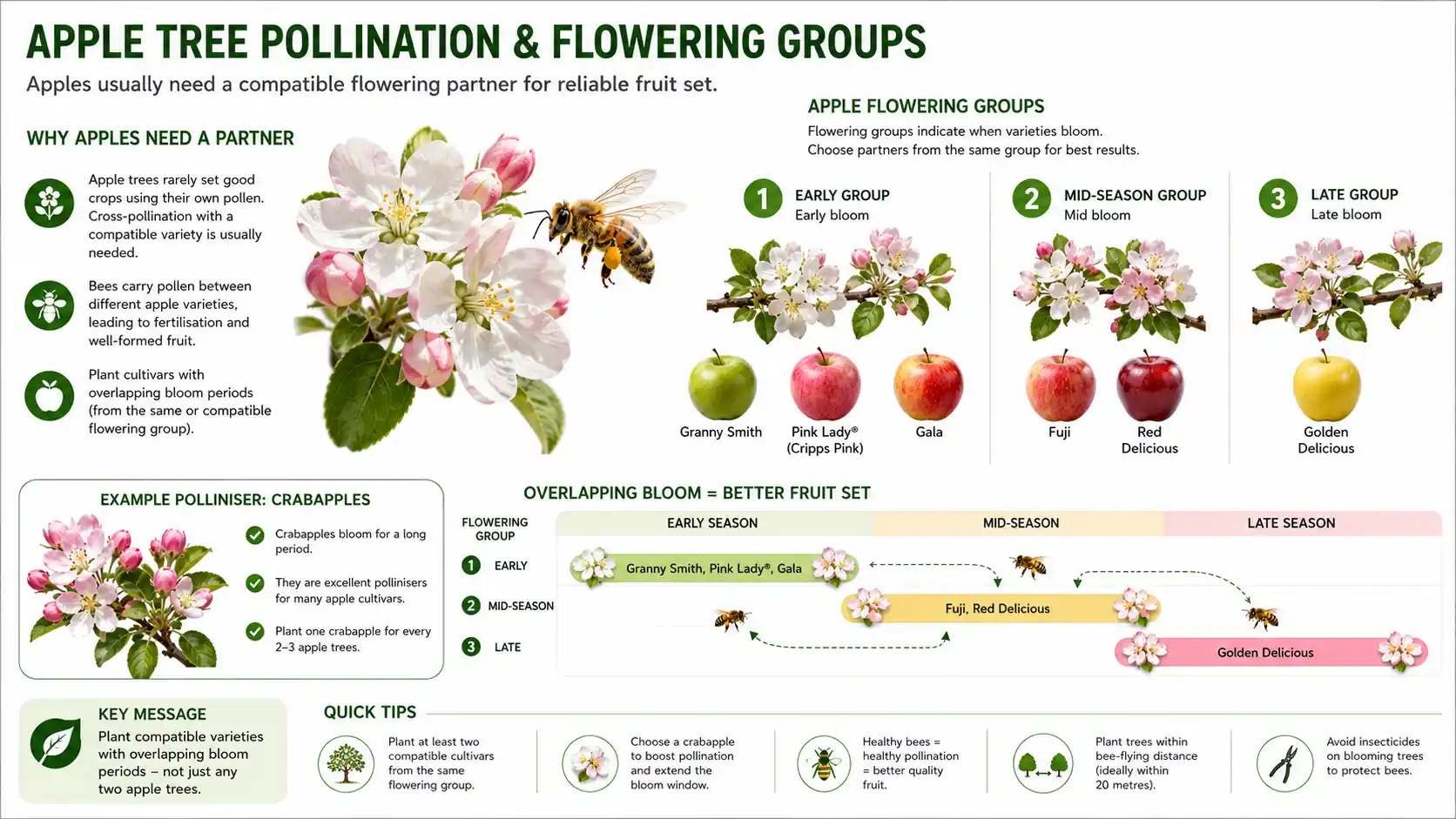
Most apple cultivars produce better crops when another compatible apple flowers at the same time. Even cultivars described as partially or fully self-fertile can benefit from compatible cross-pollination. Australian nursery listings commonly identify flowering groups; for example, Granny Smith is listed as PG3, Pink Lady/Cripps Pink as PG3, Fuji as PG4 and Gala as PG4.
| Apple variety | Flowering group* | Compatible pollinators |
| Granny Smith | PG3 | Other compatible Group 2–4 apples |
| Pink Lady / Cripps Pink | PG3 | Compatible Group 2–4 apples |
| Gala | PG4 | Compatible Group 3–5 apples |
| Fuji | PG4 | Compatible Group 3–5 apples |
| Red Delicious | PG4 | Compatible Group 3–5 apples |
| Golden Delicious | PG4 | Compatible Group 3–5 apples |
| Honeycrisp | Check local cultivar chart | A compatible apple with overlapping bloom |
| Crabapple | Cultivar-dependent | Often useful as an apple polliniser |
Flowering-group numbers can vary between reference systems, so use the pollination information supplied for the exact tree you purchase rather than assuming every chart uses identical group numbering.
For example, Australian listings show Gala being paired with varieties such as Granny Smith, Pink Lady, Red Delicious and Fuji in multi-grafted combinations, demonstrating why compatible flowering periods matter in small gardens.
Crabapples are also frequently used as pollinisers because many produce abundant pollen and overlap with common apple flowering periods.
Are Any Apple Trees Self-Pollinating?
Yes. Some apple cultivars are described as self-fertile or partially self-fertile, but self-fertile does not mean a second tree is useless. Cross-pollination can improve fruit set and crop reliability.
Granny Smith, for example, is listed as self-fertile while also benefiting from compatible pollen.
For a small Australian garden, Elemo Baker recommends choosing a self-fertile cultivar when only one tree can fit, but selecting a compatible second cultivar whenever space permits.
Plum Pollination Chart (Australia) — Satsuma, Mariposa & More
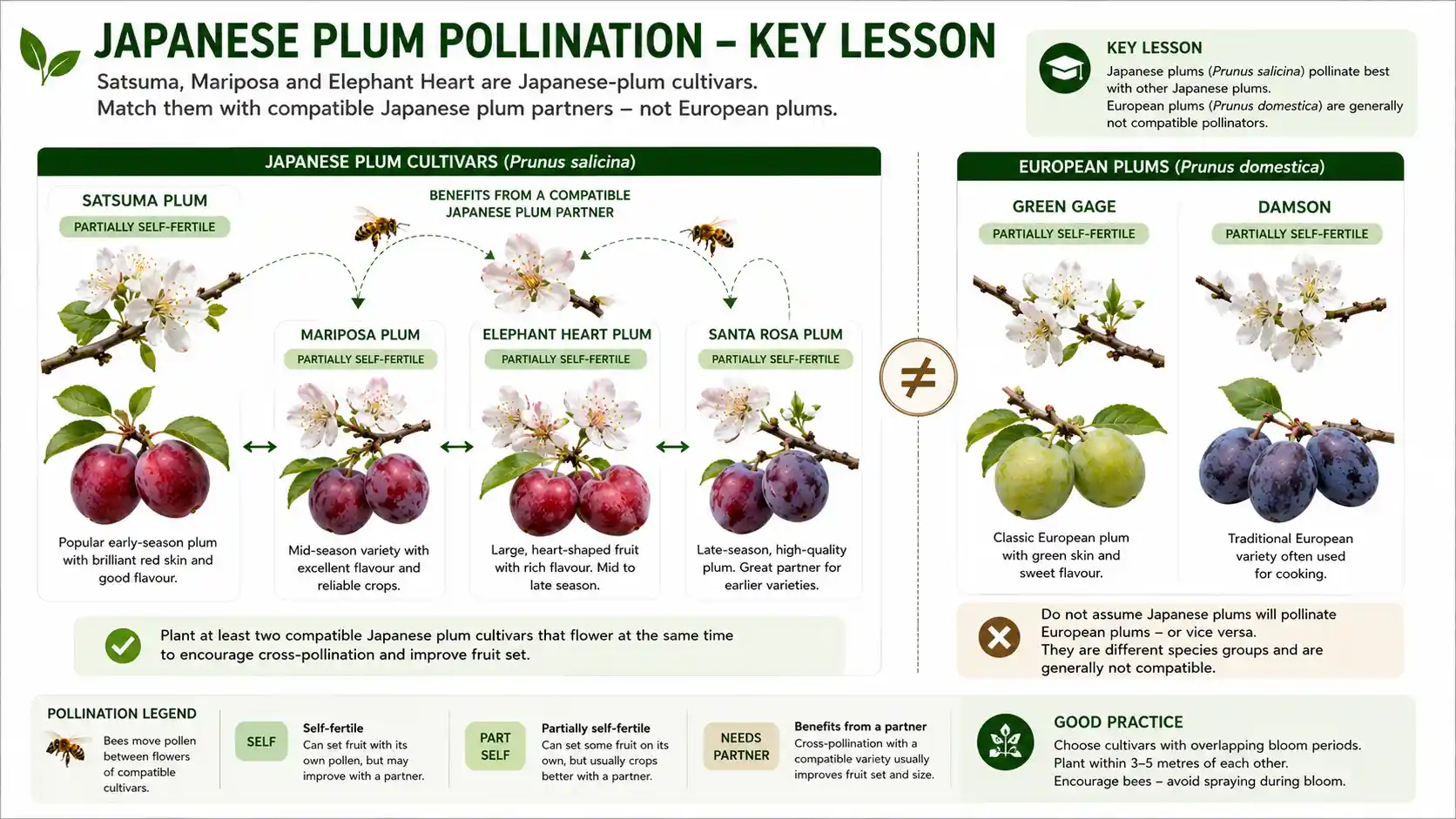
Plum pollination is more complicated than simply asking whether a plum tree is self-fertile. Different plum groups and cultivars have different compatibility requirements.
| Plum variety | Self-fertile? | Useful pollinators |
| Satsuma | Cultivar-dependent; often benefits strongly from cross-pollination | Mariposa, Santa Rosa or another compatible Japanese plum |
| Mariposa | Often described as self-fertile/partially self-fertile | Satsuma or another compatible Japanese plum |
| Elephant Heart | Requires careful compatibility checking | Suitable Japanese-plum partner such as Santa Rosa or Satsuma |
| Santa Rosa | Often self-fertile | Useful polliniser for compatible Japanese plums |
| European plums | Many are self-fertile | Compatible European plum can improve set |
Australian fruit-tree sources specifically list Satsuma with Mariposa and Santa Rosa as cross-pollination partners, while Mariposa is commonly listed with Satsuma as its pollinator.
Japanese Plums vs European Plums — Why It Matters for Pollination
Japanese plums such as Satsuma, Mariposa and Elephant Heart belong to a different plum group from European plums such as Green Gage and Damson. They should not be treated as automatically interchangeable pollination partners.
| Japanese plums | European plums |
| Satsuma | Green Gage |
| Mariposa | Damson |
| Elephant Heart | Many Prunus domestica cultivars |
| Santa Rosa | Other compatible European cultivars are not automatically suitable |
This is an important home-garden mistake: planting one Japanese plum and one European plum does not guarantee useful cross-pollination. The exact cultivar relationship matters. General extension guidance likewise distinguishes European plums from other plum groups because their compatibility characteristics differ.
Pear and Cherry Pollination in Australian Gardens
Pears follow a similar principle to apples: many cultivars benefit from a second compatible variety flowering at the same time. A few pears can set some fruit alone, but cross-pollination generally improves reliability.
Sweet cherries can be even more demanding because genetic incompatibility occurs between particular cultivars. Blooming at the same time is therefore not always enough. Self-fertile sweet cherries can be an easier choice for a small home orchard.
For both pears and cherries, 4–6 m apart is a practical home-garden target when there is room. The important principle is not an exact magic distance but allowing bees to move easily between trees. Research-based guidance confirms that closer pollinisers generally improve pollen distribution by bees.
Elemo Baker recommends avoiding a layout where a required polliniser is isolated at the far end of a large garden. A compact grouping of compatible trees is usually easier for pollinating insects to service.
What Fruit Trees Don’t Need Pollination?
Some fruit trees can set fruit without pollen from another cultivar, although the biological mechanism differs between species.
Mulberries are another useful example for Australian gardeners, and understanding when mulberry trees fruit in Australia can help distinguish pollination requirements from other factors that influence fruit production.
Choosing the right cultivar also matters, so our guide to Mulberry Varieties Australia: Best Types, Care & Fruiting provides further information about cultivar selection and fruiting characteristics.
Peaches, nectarines and many citrus trees are generally self-fertile, so a second cultivar is normally unnecessary. Many common fig cultivars can also produce fruit without cross-pollination.
Persimmons require more caution. Some cultivars can produce seedless fruit without fertilisation, while pollination can influence seed formation and fruit characteristics in certain types.
The key distinction is between self-fertility and fruit development without fertilisation. They are not identical biological processes.
If you are deciding which lemon to grow, Eureka Lemon vs Meyer Lemon: Key Differences Explained provides a useful comparison of two commonly grown lemon types.
For gardeners growing citrus, questions about fruit characteristics often overlap with pollination and seed formation; for example, Are Imperial Mandarins Seedless? explains why seedlessness is not simply a matter of whether a tree requires a pollination partner.
Cross-Pollination FAQs — Taste, Hand-Pollination and Spacing
Cross-pollination generally does not change the flesh flavour of the current season’s fruit. The pollen fertilises the ovules and primarily influences the resulting seeds; it does not normally change the genetic makeup of the surrounding fruit flesh.
When bee activity is poor, hand-pollination can help. Use a clean, soft artist’s brush or cotton bud to collect pollen from an open flower of the compatible variety and gently transfer it to the stigma of the target flower. Repeat across several flowers while they are receptive.
For reliable results:
- Work during dry weather.
- Use fresh, viable pollen.
- Move between compatible varieties.
- Avoid brushing flowers roughly.
- Repeat over the main flowering period.
Pollination success also depends on temperature, rain, wind and insect activity. Insecticides should not be sprayed on flowering trees when pollinators are actively visiting unless the product label specifically permits that use.
As of 2026, protecting wild bees and other beneficial pollinators remains an important part of productive home-orchard management; honey bees are not the only insects capable of transferring fruit-tree pollen.
Common Pollination Mistakes
Planting only one tree
Problem: An apple, pear or incompatible plum is planted alone and flowers but sets very little fruit.
Fix: Add a compatible cultivar with overlapping flowering. If space is limited, select a documented self-fertile cultivar.
Prevention: Check pollination requirements before buying rather than after the first failed crop.
Mismatching pollination groups
Problem: Two trees flower together but belong to incompatible groups or even different plum types.
Fix: Match the exact cultivars using a reliable nursery or horticultural pollination chart.
Prevention: Do not assume that “same fruit” means “compatible pollen”.
Planting trees too far apart
Problem: Bees have to travel unnecessarily far between isolated trees, reducing the efficiency of pollen transfer.
Fix: Group compatible trees where practical, ideally within several metres of one another.
Prevention: Design the orchard layout around pollination before planting.
Spraying insecticide during bloom
Problem: Insecticide applications can reduce or harm visiting pollinators at the precise time flowers need them.
Fix: Avoid unnecessary insecticide use during flowering and follow the product label carefully.
Prevention: Monitor pests before spraying and use the least disruptive appropriate control method.
Conclusion
A fruit tree pollination chart Australia is most useful when it is treated as a compatibility guide rather than a simple list of fruit trees. Successful fruit set depends on choosing the right cultivar, matching compatible flowering periods, ensuring viable pollen, keeping trees close enough for effective bee movement and protecting pollinators during bloom. Apples and pears generally benefit from compatible partners, Japanese plums require careful cultivar matching, and sweet cherries can have particularly specific compatibility requirements. For small Australian gardens, checking pollination compatibility before planting is one of the simplest ways to prevent a healthy, flowering tree from becoming a fruitless one.
FAQs
1. Do plum trees need a pollinator?
Some plum trees need or strongly benefit from a compatible pollinator, while many others are self-fertile. Japanese plums such as Satsuma commonly perform better with a compatible Japanese plum nearby, whereas many European plums can crop alone.
2. How close do cherry trees need to be to pollinate?
For a home garden, keeping compatible cherry trees around 4–6 m apart is a practical target where space allows. The closer planting helps bees move efficiently between flowers, but cultivar compatibility and overlapping bloom remain essential.
3. What are the main types of pollination?
The main types relevant to fruit trees are self-pollination and cross-pollination. Self-pollination uses pollen from the same plant or compatible flowers on the same cultivar, while cross-pollination transfers pollen between genetically compatible plants.
4. Does cross-pollination change the fruit?
Usually, cross-pollination does not change the flesh flavour of the current season’s fruit. It primarily determines whether fertilisation and seed development occur, although seed formation can influence characteristics in some fruit types, particularly certain persimmons.
5. What fruits don’t need to be pollinated?
Many peaches, nectarines and citrus trees are self-fertile and do not require a second cultivar for fruit production. Some figs can also develop fruit without cross-pollination, depending on the fig type.
6. How do you cross-pollinate fruit trees by hand?
Use a clean, soft brush to collect fresh pollen from an open flower of a compatible cultivar and gently brush it onto the receptive stigma of another flower. Repeat across multiple flowers during the flowering period, preferably in dry weather.
7. Is Satsuma plum self-pollinating?
Satsuma should not be relied upon as a completely independent pollination solution. It is commonly grown with a compatible Japanese plum, and Australian fruit-tree sources list Mariposa and Santa Rosa as useful pollination partners.
2 Comments