

Beginner Gardening Guide Australia: Start Growing Right
According to Elemo Baker, beginner gardening in Australia starts with identifying your climate zone: tropical, sub-tropical, warm temperate, cool temperate, or arid! since Australia’s seasons run opposite the Northern Hemisphere, with spring falling in September to November. Match plant choices to your zone, test soil drainage, and start with hardy natives or vegetables suited to your region’s rainfall and frost patterns.
Microclimates can override broad zone classifications: an elevated garden within a warm temperate area may behave more like a cool temperate one, shifting frost timing and plant survival. Gardeners in cooler zones typically get better results choosing quick-maturing varieties, around six to twelve weeks, since alpine and tableland growing seasons run noticeably shorter than coastal areas classed within the same nominal zone.
By Elemo Baker | Plant Care & Gardening Expert
Last Updated: August 2026
Quick Summary
- Identify your Australian climate zone before choosing plants or planting times.
- Start with soil health, basic tools and a small group of suitable plants rather than a large garden.
- Water according to soil moisture, plant needs and local conditions instead of following a rigid weekly schedule.
- Watch early signs such as yellow leaves, pests and stalled growth so problems can be corrected before they become severe.
Why Australian Gardening Is Different From Overseas Guides
Australian gardening differs from many overseas guides because the seasons are reversed relative to the Northern Hemisphere and the country covers a very large range of climates. A UK planting calendar, for example, cannot simply be shifted by six months and applied across Australia because local heat, rainfall, frost and humidity also change what plants can tolerate.
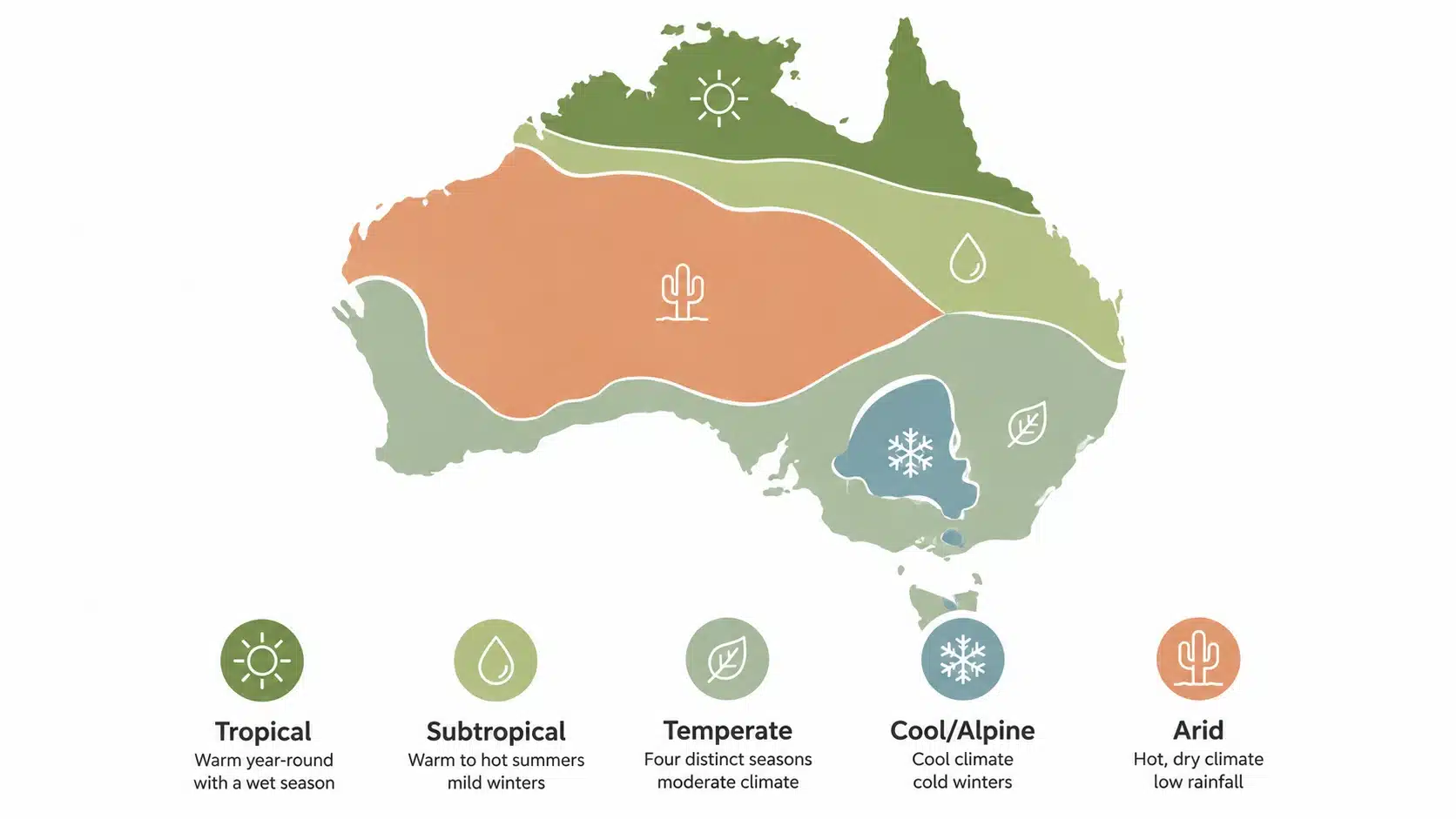
Australia contains tropical regions in the north, subtropical areas, broad arid and semi-arid interiors, and temperate to cool regions in the south. Mountains and coastal influences create further local variation. Australia spans everything from tropical monsoon regions to alpine cold, a range of climate zones far broader than most single countries — which is why generic overseas planting advice so often fails here.
Australia’s Main Climate Zones (Tropical, Subtropical, Temperate, Cool/Alpine, Arid)
Climate zones describe areas with broadly similar temperature and rainfall patterns. For gardening, your local zone helps determine plant selection, sowing times, frost risk and watering needs.
| Climate zone | Typical Australian examples | Key characteristic |
| Tropical | Darwin, Cairns, Townsville | Hot conditions; humid summers and seasonal rainfall |
| Subtropical | Brisbane, coastal southeast Queensland, northern NSW | Warm summers, mild winters and variable humidity |
| Temperate | Sydney, Adelaide, Perth and much of southern NSW | Moderate seasonal change; timing varies by location |
| Cool/Alpine | Canberra, alpine Victoria, parts of Tasmania | Colder winters, greater frost risk and shorter growing periods |
| Arid | Alice Springs and much of inland Australia | Low rainfall, dry air and large temperature variation |
Use an Australian climate-zone guide, local nursery advice and your local planting calendar together rather than relying only on your state name. Even within one state, growing conditions can differ substantially.
Getting Your Soil Right Before You Plant
Healthy soil gives roots access to air, water and nutrients, making soil preparation one of the highest-value steps for a beginner. Australian gardens commonly contain sandy, clay or loamy soils, each behaving differently with water and nutrients.
Elemo Baker recommends improving the growing medium before spending heavily on plants. A good root environment prevents many problems later. For a deeper dive into soil types, amendments and feeding schedules, see our full Australian Garden Soil & Fertiliser Guide.
Common Australian Soil Challenges
Heavy clay can drain slowly and become difficult to work when wet. Sandy soil usually drains quickly and may hold fewer nutrients and less moisture. Compacted or low-organic-matter soil can restrict root development.
A simple home texture test is to wet a handful of soil and squeeze it. Clay tends to hold together and form a pliable shape, while sand falls apart readily; loam generally forms a crumbly but cohesive texture.
Practical improvements include:
- Add mature compost to improve structure and organic matter.
- Consider raised beds where existing soil has persistent drainage or contamination problems.
- Use gypsum specifically where clay is sodic or structurally affected; gypsum is not a universal cure for every clay soil.
- Avoid repeatedly digging saturated soil, which can worsen compaction.
Elemo Baker recommends improving the growing medium before spending heavily on plants. A good root environment prevents many problems later.
Essential Tools and Budget-Friendly Setup for Beginners
You do not need a large collection of equipment to begin. A practical starter kit is a trowel, watering can, gloves, secateurs and hand fork. Add a shovel, hose or pruning saw only when your garden actually requires them.
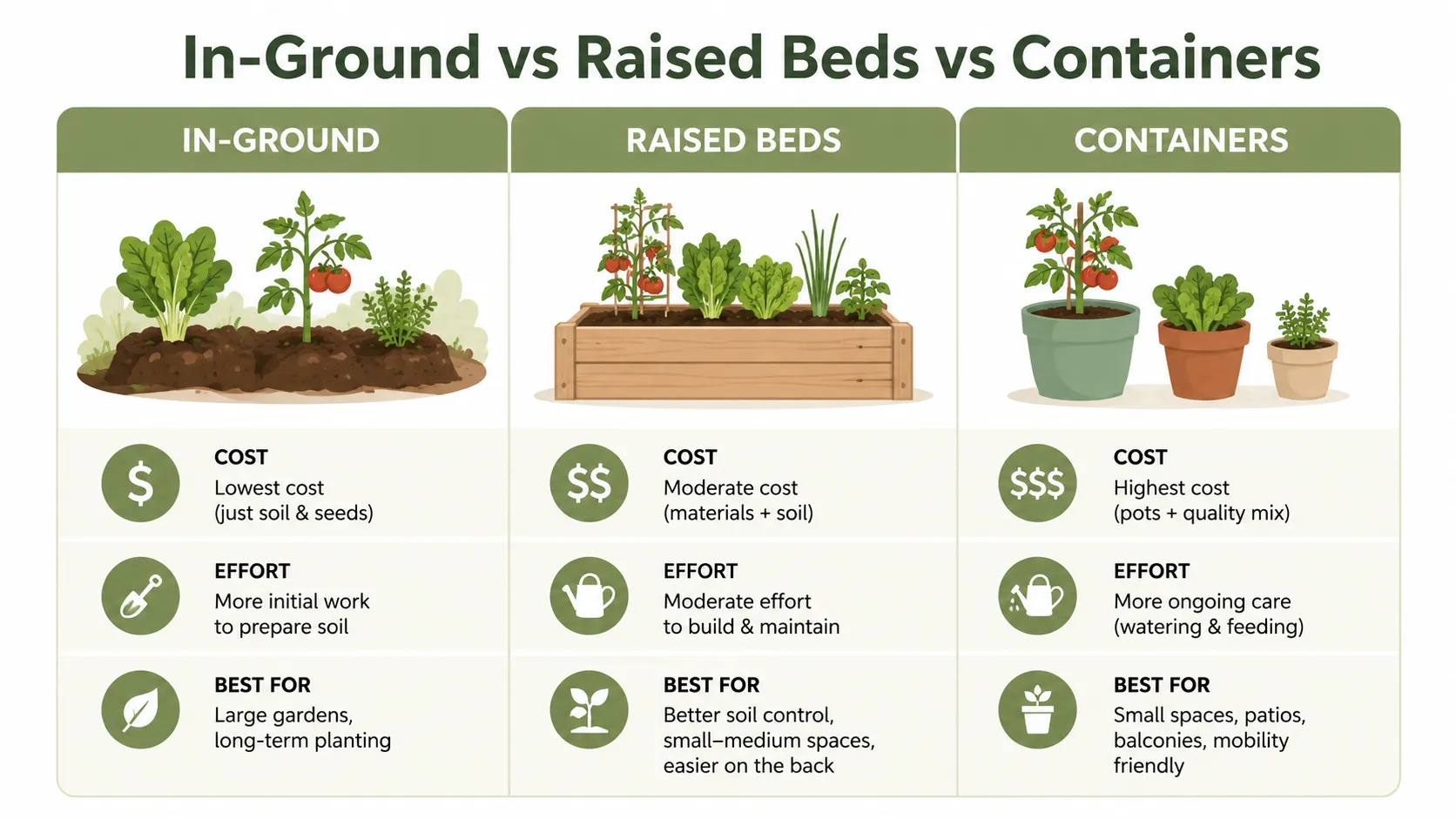
| Setup type | Upfront cost | Best for |
| In-ground bed | Low to medium | Good existing soil and larger spaces |
| Raised bed | Medium | Poor soil, easier soil management and defined growing areas |
| Containers | Low to medium | Rentals, balconies, courtyards and limited space |
Reuse suitable buckets, tubs and containers for edible or ornamental plants where they have adequate drainage and are safe for the intended use. The cheapest setup is not always the most practical: drainage, sunlight and access to water matter more than appearance.
Want a companion resource to explore while planning your first garden? Browse the Leafy Heaven Australian Garden Starter Guide on Issuu for another way to explore our Australian gardening resources.
Choosing the Right Plants as a Beginner
The best beginner plants are not simply labelled “easy”; they are plants suited to your climate, available light, soil and watering habits. Gardening Australia similarly recommends choosing plants according to the conditions they prefer and starting small.
Beginner-Friendly Australian Native Plants
Australian natives can be excellent beginner choices because many are adapted to local conditions, although water and soil requirements still vary between species.
Useful general examples include Westringia fruticosa (coastal rosemary), Lomandra longifolia and selected Correa species. Check the requirements of the particular species and local provenance before planting. If natives spark your interest, our Australian Native Plants: A Complete Beginner’s Guide goes deeper into species selection and care for first-time growers.
Easy Edible Plants for Australian Beginners
Herbs and leafy vegetables are useful starting points because they can produce results without requiring a large garden. Depending on season and climate, consider parsley, chives, spring onions, lettuce, silverbeet and other suitable leafy greens.
Herbs and leafy vegetables are useful starting points because they can produce results without requiring a large garden. Depending on season and climate, consider parsley, chives, spring onions, lettuce, silverbeet and other suitable leafy greens. Ready to grow more than greens? Our guide to fruit trees and edible plants for Australian gardens covers what to plant once you’re ready to expand into productive crops.
Planting calendars should be climate-specific. ABC Gardening Australia, for example, provides separate planting guidance for tropical, subtropical, arid/semi-arid, warm-temperate and cold-temperate conditions. Short on backyard space? Our guide to dwarf fruit trees for pots in Australia shows you exactly which varieties thrive in containers.
Low-Maintenance Flowering and Ornamental Options
For confidence-building, choose plants that tolerate ordinary garden conditions and do not demand constant pruning or feeding. Salvias, for example, can be useful flowering plants for beginners when their light, drainage and climate requirements are suitable.
For confidence-building, choose plants that tolerate ordinary garden conditions and do not demand constant pruning or feeding. Salvias, for example, can be useful flowering plants for beginners when their light, drainage and climate requirements are suitable. If you’re thinking beyond flowers, our guide to the best trees and shrubs for Australian gardens can help you choose sturdy, low-fuss structural plants for the years ahead.
Watering Wisely in Australian Conditions
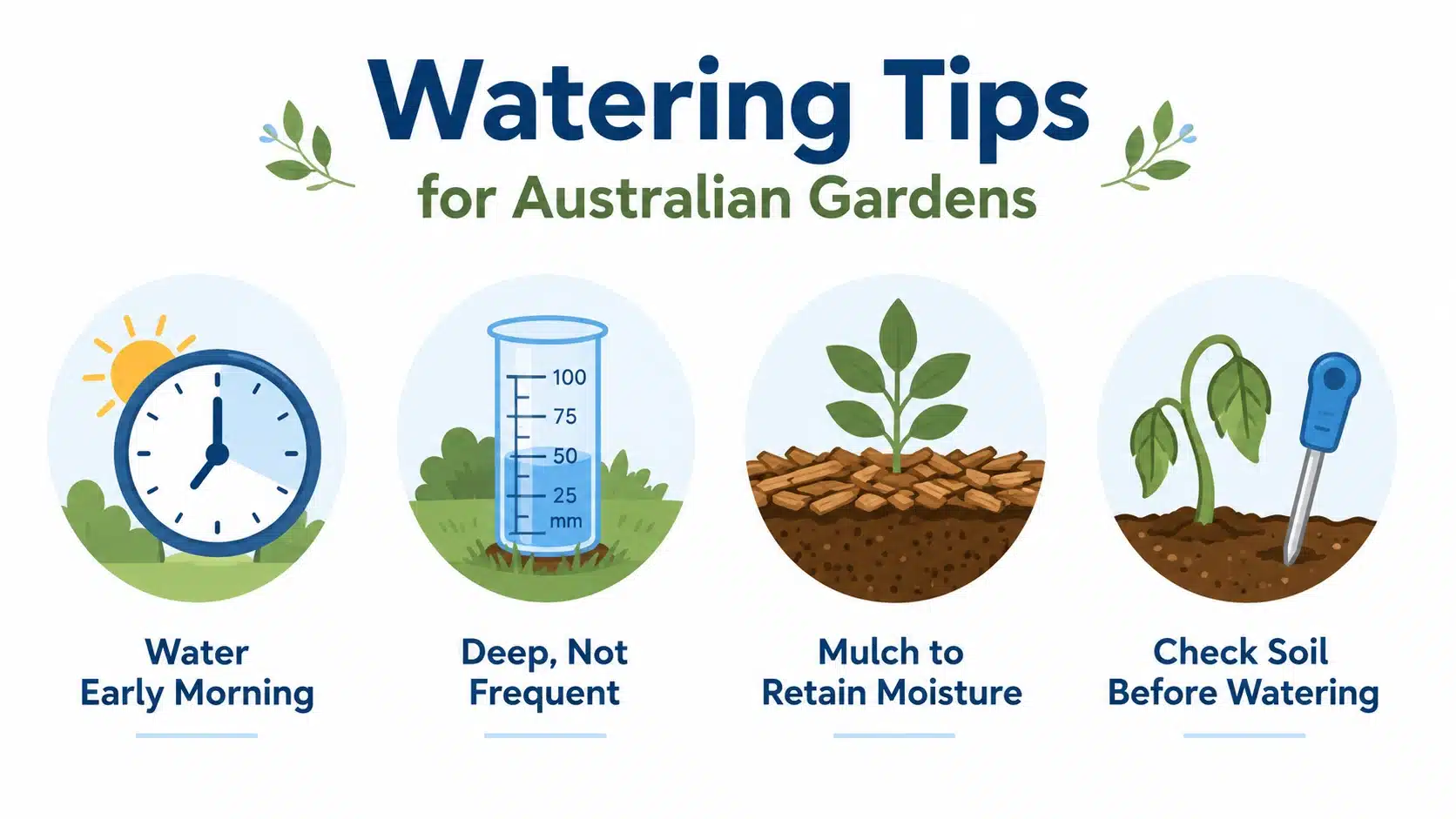
Good watering means supplying enough moisture to reach the root zone without keeping the soil permanently saturated. Water needs depend on plant species, soil, weather, season and climate.
- Water in the morning where practical, particularly when foliage disease is a concern.
- Water deeply enough to wet the root zone rather than repeatedly wetting only the surface.
- Check the soil before watering instead of following an automatic schedule.
- Use organic mulch to reduce evaporation and suppress weeds, keeping mulch away from direct contact with stems.
- Check current local water restrictions where they apply.
Gardening Australia recommends checking soil moisture directly and notes that shallow watering can encourage shallow rooting.
Feeding and Maintaining Your Garden
Fertiliser supplements plant nutrition; it does not replace suitable soil, light or water. Start with compost and organic matter where appropriate, then use a fertiliser suited to the plant type and follow its label.
Avoid assuming that more fertiliser means faster growth. Different plants have different nutrient requirements, and excessive application can cause nutrient imbalance or salt accumulation.
Basic maintenance includes removing damaged material, monitoring weeds, checking moisture and learning simple pruning cuts. Prune according to the plant’s natural growth cycle rather than applying one schedule to every species. Once your garden is established, our Pruning and Maintenance guide walks you through ongoing care to keep plants healthy year-round.
Common Beginner Mistakes and How to Avoid Them
The most common early mistakes are usually caused by doing too much rather than too little.
- Overcrowding: Allow mature plants enough space for airflow and root development.
- Planting out of season: Use a climate-specific calendar rather than a generic monthly list.
- Overwatering: Check the soil first; saturated roots can suffer from oxygen deficiency.
- Ignoring soil preparation: Poor soil can restrict plants before fertiliser can help.
- Ignoring aspect: Match sun, shade, wind and exposure to the plant’s requirements.
A useful beginner habit is to start with three to five plants, observe them for several weeks, and expand once you understand how your garden behaves. Gardening Australia also recommends starting small and learning from what survives.
Troubleshooting Common Plant Problems for Beginners
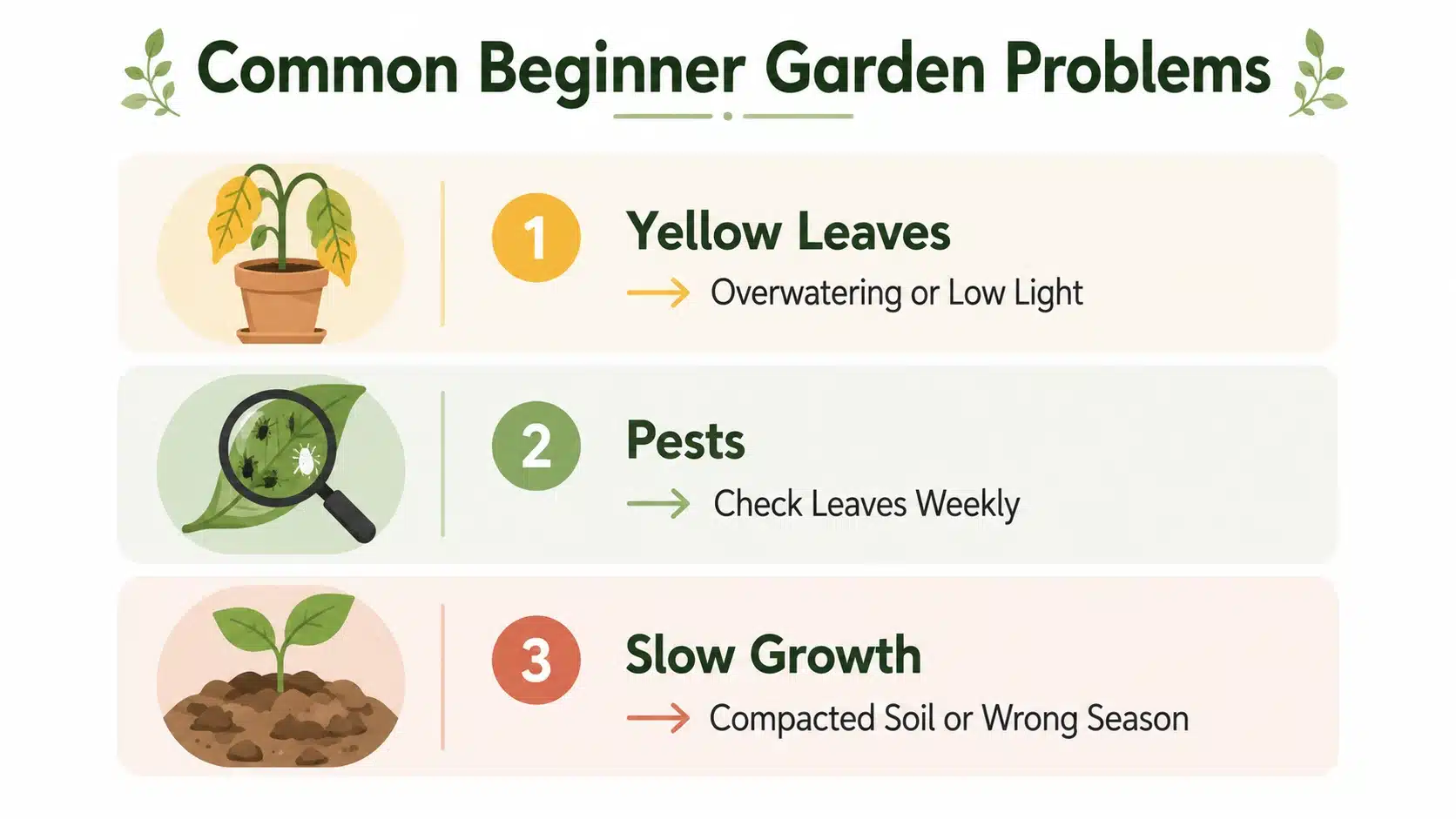
Yellowing Leaves
Yellow leaves can result from overwatering, nutrient deficiencies, unsuitable light, ageing foliage or root problems. Do not automatically add fertiliser. First inspect the soil moisture, drainage, light conditions and affected leaves. Growing indoor plants too? See our full breakdown of yellow leaves on indoor plants in Australia for causes specific to houseplants.
Pest Issues in Australian Gardens
Look for chewed leaves, distorted new growth, sticky residue, webbing, clusters of insects or visible eggs. Prevention begins with healthy plants, adequate airflow, regular inspection and removing heavily affected plant material when appropriate. For a closer look at what’s actually on your plants, our Garden Pest Identification Guide for Australian Gardens helps you identify common culprits before they spread.
Slow or Stalled Growth
Slow growth commonly relates to insufficient light, compacted soil, poor drainage, unsuitable temperatures, nutrient limitations or planting during a plant’s slower season. Correct the underlying growing condition before adding more fertiliser.
| Problem | Likely cause | General fix | Prevention tip |
| Yellow leaves | Excess moisture, nutrition or light issue | Check roots, soil and aspect | Avoid routine overwatering |
| Chewed or distorted leaves | Insect or pest activity | Inspect and identify the pest | Monitor plants regularly |
| Slow growth | Poor light, soil or season | Correct the growing environment | Match plants to conditions |
Small-Space and Container Gardening for Beginners
You do not need a backyard to begin gardening in Australia. Containers work well on balconies, patios, courtyards and rental properties, provided they receive suitable light and have drainage holes.
Choose container size according to the mature plant, not just its current dimensions. Containers dry out faster than many garden beds, so moisture checks are particularly important during hot or windy weather.
Small-space gardeners can grow herbs, leafy greens, compact flowers and selected dwarf fruiting plants. Vertical supports can also increase growing area without increasing floor space.
Building Topical Confidence Beyond Your First Garden
Once the basics are working, expand your knowledge into plant propagation, indoor plant care, pruning, landscaping, soil improvement, edible gardening and plant troubleshooting. Each area reinforces the same core principles: understand the plant, understand the environment, observe changes and make one adjustment at a time.
As of August 2026, the most useful approach remains local and climate-aware gardening rather than relying on a universal Australian calendar. Check current regional water requirements and seasonal growing information before major planting decisions. Ready to explore further? Our Australian Plants Guide to Indoor Houseplants & Garden Design is the perfect next stop for building out both your indoor and outdoor spaces.
For a complete roadmap covering every stage of plant care beyond the basics, our plant care and growing guides hub brings all of these topics together in one place.
Conclusion
A successful beginner gardening guide Australia approach rests on five fundamentals: understand your climate zone, prepare the soil, choose plants that suit your conditions, water according to actual need and troubleshoot problems early. Australia is too climatically diverse for one universal gardening timetable, so local conditions should guide every major decision. Start small, observe often and expand gradually. A garden does not need to be perfect to be productive; every planting, watering or pruning mistake can become useful information for the next step.
FAQs
1. What is the easiest way to start gardening as a beginner in Australia?
The easiest approach is to start with a small area or a few containers, identify your climate and light conditions, improve the soil, and grow three to five plants suited to those conditions.
2. How do I know what climate zone I’m gardening in?
Use an Australian climate-zone map or local planting guide, then confirm conditions with local nursery, council or horticultural information. Climate can vary considerably within the same state.
3. What soil type is best for beginner gardeners in Australia?
A well-structured loam is generally easy to manage because it can balance drainage, moisture retention and root aeration. However, clay and sandy soils can also support productive gardens when appropriately improved.
4. What are the best low-maintenance plants for beginners in Australia?
Good choices depend on climate and conditions, but suitable Australian natives such as Westringia, Lomandra and selected Correa species can be useful starting points, while herbs and leafy greens are practical edible choices.
5. How often should beginners water their garden in Australia?
There is no universal number of days. Check soil moisture and plant condition, then water according to soil type, weather, season and plant requirements. Deep watering is generally more useful than frequent shallow watering.
6. Why do beginner gardeners’ plants get yellow leaves?
Yellow leaves commonly result from excess water, but nutrient problems, poor light, root damage and natural leaf ageing can also cause yellowing. Check the whole growing environment before treating the symptom.
7. Can I start a garden in Australia with no backyard?
Yes. Containers, balcony gardens, courtyards, vertical systems and community gardens can all provide suitable growing spaces. The key requirements are appropriate light, drainage, suitable containers and plants matched to the available conditions.
2 Comments