

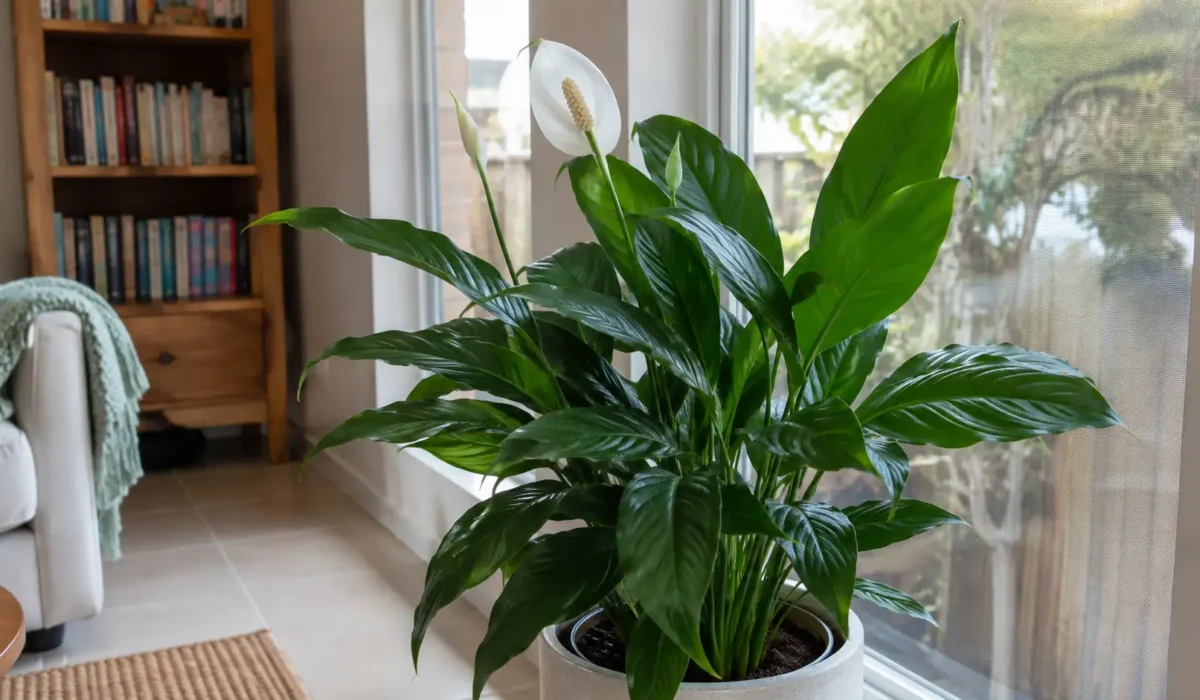
Peace Lily Benefits: What’s Real, What’s Overstated & What Science Says
The most important thing to know about peace lily benefits is that some are real, but several popular claims are larger than the evidence supports. Peace lilies (Spathiphyllum spp.) can remove certain volatile organic compounds under controlled laboratory conditions, and indoor plants can contribute water vapour through transpiration. However, one peace lily in a normally ventilated Australian room should not be treated as an air purifier or humidifier. Evidence for wellbeing is also more convincing for indoor greenery generally than for peace lilies specifically. In practical terms, a peace lily is most useful as a decorative, humidity-loving indoor plant with modest environmental benefits — provided it receives suitable light, moisture and airflow.
Quick Summary
- Air purification: supported in sealed laboratory experiments, but substantially overstated when a single peace lily is marketed as a meaningful whole-room air cleaner.
- Humidity: plausible and supported in real indoor environments when enough plant material is present, but one peace lily is unlikely to transform room humidity.
- Mood and wellbeing: indoor greenery has supporting research, but statistics from workplace studies should not be presented as peace-lily-specific effects.
- Safety: peace lilies contain insoluble calcium oxalate crystals and can cause mouth irritation, swelling, drooling, vomiting or difficulty swallowing if chewed; placement matters around pets and young children.
What Peace Lilies Are Actually Known For
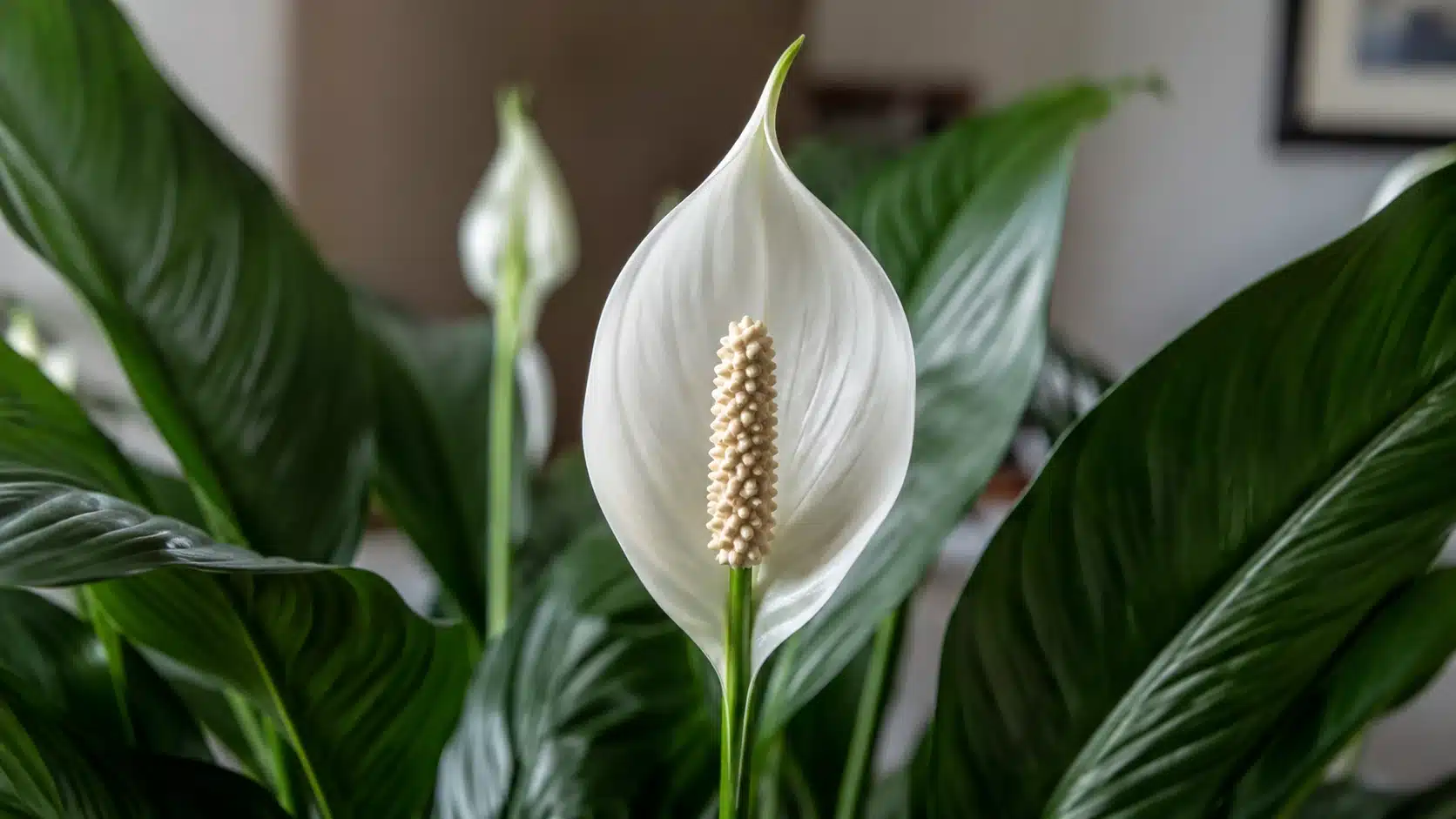
Peace lilies are tropical, evergreen foliage plants in the genus Spathiphyllum. They are widely grown indoors because their glossy foliage tolerates lower indoor light than many flowering plants, while suitable conditions can produce the characteristic white flower structures.
For a more structured reference covering the practical benefits and everyday considerations of growing a peace lily, see this peace lily benefits reference.
Before looking at the evidence, these are the benefits most commonly associated with peace lilies:
- Removing indoor air pollutants or “toxins”
- Increasing indoor humidity through transpiration
- Creating a calmer, greener indoor environment
- Supporting mood, concentration or workplace wellbeing
- Providing attractive foliage and long-lasting white flowering structures
- Being relatively easy to care for compared with many flowering houseplants
- Working well in bathrooms, bedrooms and living areas
The air-purification reputation largely comes from NASA research published in 1989. The NASA study explicitly included Spathiphyllum ‘Mauna Loa’ among the plants tested for removal of compounds such as benzene, trichloroethylene and formaldehyde.
Peace lilies are not the only plants surrounded by broad health and wellness claims. Our guide to curry leaf benefits separates traditional and proposed benefits from what has actually been studied in humans.
For a broader discussion of what indoor plants can and cannot realistically do, see LeafyHeaven’s guide to the benefits of indoor plants. The air-purification reputation largely comes from NASA’s 1989 research on interior landscape plants and indoor air pollution, which tested several houseplants under controlled chamber conditions.
What the Science Actually Says (Evidence-Graded Breakdown)
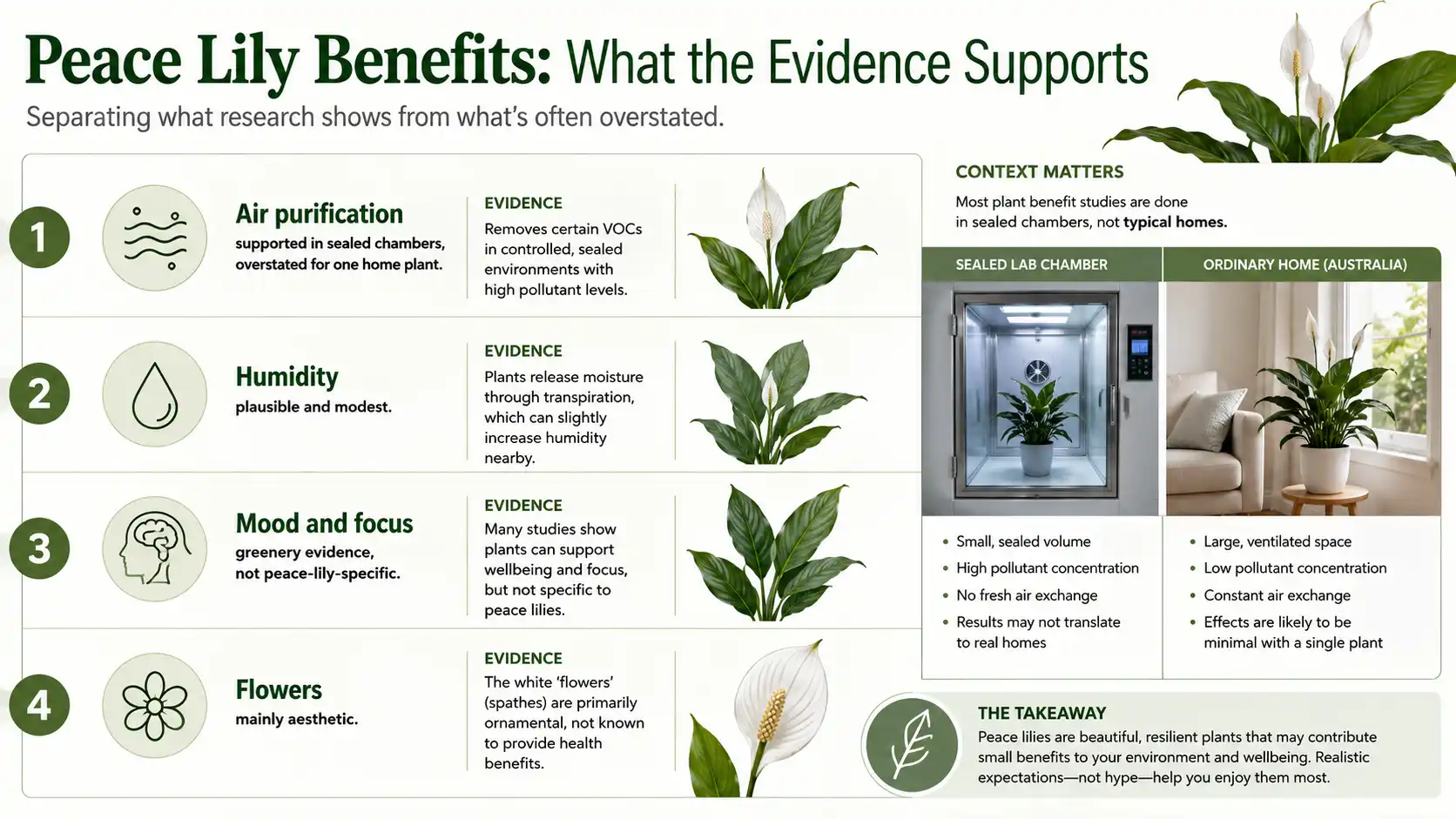
Air Purification — Supported, But Overstated for a Single Plant
Evidence grade: Supported in controlled conditions; overstated for a normal room.
The basic claim is genuine: plants can remove some airborne chemicals under controlled conditions. The important qualification is the environment in which that result was demonstrated.
NASA’s 1989 research used sealed plexiglass chambers. The technical report describes chambers of approximately 0.694 and 0.868 cubic metres, with plants exposed to controlled concentrations of benzene and trichloroethylene for roughly 24 hours. Peace lily was among the plants screened.
That is very different from a ventilated Australian living room.
A later review of 12 chamber studies converted plant pollutant-removal results into clean-air-delivery rates and found a median single-plant rate of only 0.023 m³/hour. The authors calculated that roughly 10–1,000 plants per square metre of floor area would be needed to match the pollutant-removal effect of typical building air exchange, depending on the conditions and assumptions. They concluded that ordinary potted plants do not meaningfully replace ventilation for indoor-air-quality control.
That is why the most accurate wording is not “peace lilies purify your home air”. It is: peace lilies demonstrated pollutant-removal capacity in controlled studies, but the real-world impact of a normal number of houseplants is much smaller.
A plant should therefore complement, not replace, ventilation, source control or appropriate air filtration.
The same evidence distinction matters when evaluating other popular plants: our guide to the benefits of rosemary separates promising human research from laboratory, animal and traditional-use evidence.
A later peer-reviewed review of 12 chamber studies found that the air-cleaning capacity measured in laboratory experiments does not translate directly into the air-exchange effect of typical buildings.
Added Humidity via Transpiration — Plausible, Minor
Evidence grade: Supported in indoor studies; modest at household scale.
Plants release water vapour through transpiration. That mechanism is well established, and indoor experiments show that plant number can affect room humidity.
A 2024 Australian-led office study at the Australian National University found that offices containing five or 18 Boston ferns had higher median relative humidity than offices without plants: approximately 38.9% and 49.2%, respectively, compared with 29.1% without plants. Importantly, the study involved Boston fern rather than peace lily, so its exact numerical results should not be transferred directly to Spathiphyllum.
Another 2024 office study found that plants’ moisture contribution was strongly affected by air exchange, with most emitted moisture lost through ventilation or absorption by building materials. Plant effects were more noticeable in hot, dry indoor environments than in already-humid rooms.
That matters in Australia. A peace lily in an air-conditioned room may contribute some local moisture, but one pot is unlikely to turn a dry room into a tropical environment. In Brisbane or another humid coastal environment, the additional humidity may be even less consequential than in a dry inland room.
An Australian office study published in 2024 measured changes in relative humidity with different numbers of plants, providing useful real-world evidence on indoor plant effects on office humidity.
Mood, Stress, and Focus — Anecdotal/Overstated
Evidence grade: Plausible but overstated when applied specifically to peace lilies.
There is legitimate research suggesting that indoor greenery can influence how people perceive and experience workplaces.
The University of Exeter’s 2014 field research involved real offices in the UK and Netherlands and found that adding plants to previously “lean” workplaces increased measured productivity by 15%. The study concerned office plants and workplace design generally; it did not establish a 15% productivity effect for peace lilies.
The University of Exeter’s 2014 workplace study found higher productivity in offices containing plants, but the research concerned workplace greenery generally rather than peace lilies specifically.
There is another frequently repeated number that requires correction. The 37% reduction in tension/anxiety commonly quoted online is associated with University of Technology Sydney research on indoor plants in office environments, not the Exeter study. The UTS report recorded reductions in several negative mood-state measures after plants were introduced. Again, this was a workplace greenery intervention, not a clinical trial of peace lilies.
The often-repeated 37% figure comes from University of Technology Sydney research on indoor plants and workplace wellbeing, rather than from the University of Exeter study and not from a peace-lily-specific trial.
So a peace lily may contribute to a more pleasant, natural-looking environment, and that can plausibly support subjective wellbeing. But claims such as “this peace lily reduces stress by 37%” are not supported by those studies.
This distinction is important: evidence for greenery is not automatically evidence for one species.
Do the Flowers (Spathe/Spadix) Add Any Benefit?
Evidence grade: Supported aesthetically; no established special health effect.
The white structure commonly called the peace lily flower is actually a spathe, a modified leaf-like bract surrounding the spadix, the spike that bears the tiny flowers. Queensland’s Poisons Information Centre describes the white to cream sheath as a spathe surrounding a spike of closely packed flowers.
Its primary benefit is therefore visual and ornamental. A flowering peace lily can make a room feel greener and more inviting, but there is no good evidence that the white spathe itself provides a separate air-cleaning, sleep-enhancing or medicinal benefit.
Do Peace Lily Benefits Apply to Australian Conditions?
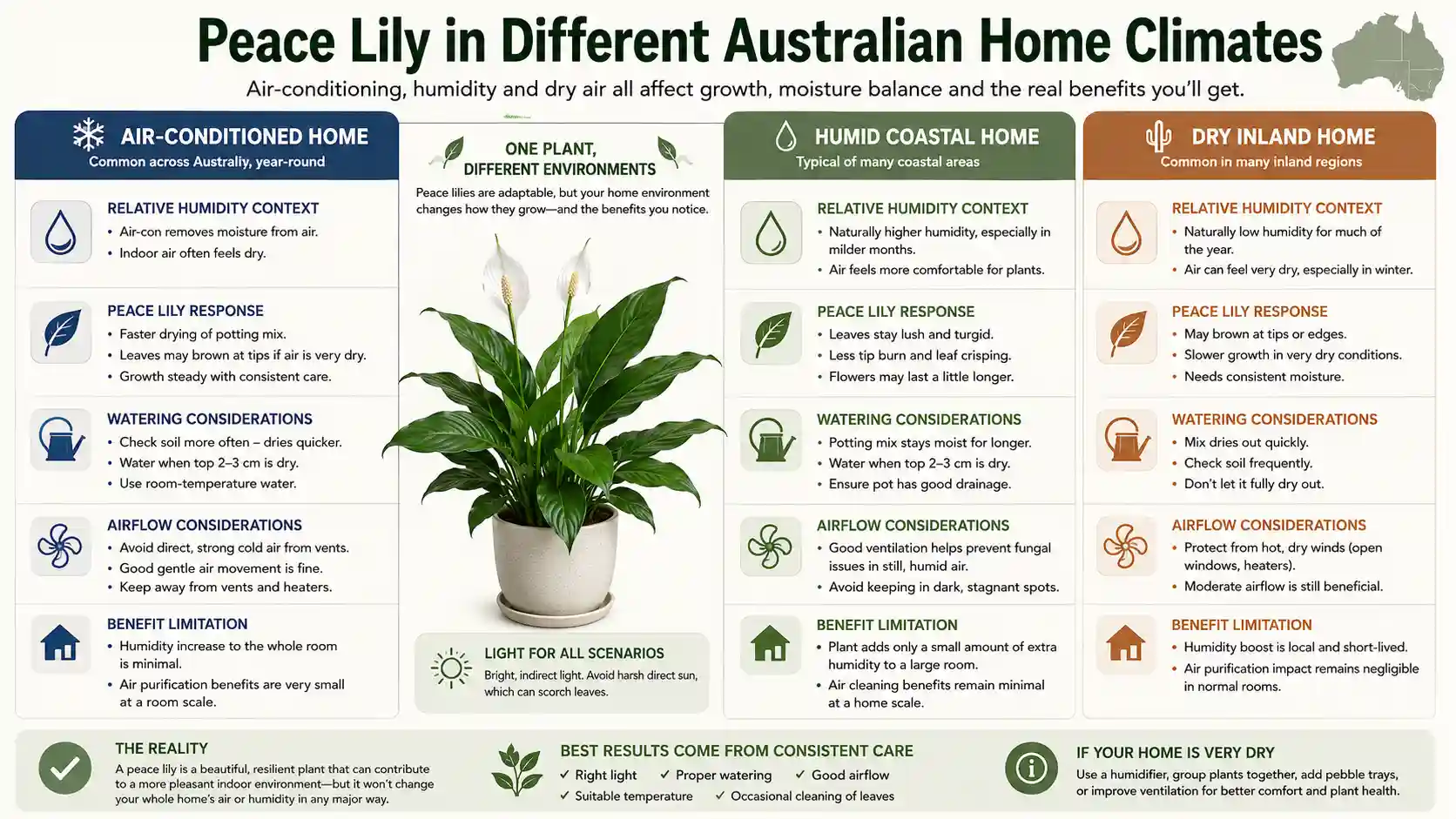
The plant can perform well indoors throughout much of Australia, but the conditions around it change the practical value of the benefits.
| Climate / indoor situation | What changes for the plant | What changes for benefit delivery |
| Air-conditioned home | Drier air and direct cool airflow can stress foliage | Some transpiration may add moisture, but room-wide humidity effects remain modest |
| Humid coastal climate | Ambient humidity is already relatively high | Additional humidity from one plant is less consequential |
| Dry inland climate | Faster moisture loss and lower indoor humidity may occur | Transpiration may be more noticeable locally, but one plant still has limited capacity |
| Naturally ventilated tropical/subtropical home | Higher background humidity and airflow | Humidity contribution is less significant than maintaining healthy growth |
| Dark indoor position | Reduced photosynthesis and often weaker growth | Do not expect strong plant activity simply because the plant survives in low light |
Our Australian indoor houseplant and garden-design guide similarly highlights the importance of matching indoor plants to Australian light, humidity and temperature conditions.
Australian plant-care advice also recommends protecting peace lilies from direct sun and direct air-conditioner or heater airflow.
Australia’s growing conditions can make many non-native plants feel completely at home; aloe vera is a useful example, but it is not actually native to Australia. See our guide on whether aloe vera is native to Australia for the distinction between native, introduced and naturalised plants.
The practical lesson is simple: the Australian room matters as much as the plant.
What Conditions Does a Peace Lily Need to Actually Deliver These Benefits?
A healthy peace lily is a prerequisite for getting the environmental benefits that are biologically plausible. The best approach is to optimise the plant rather than trying to maximise “benefits” with poor placement.
- Indirect light: Bright, filtered or indirect light is generally better than harsh direct sun. Peace lilies tolerate lower light, but they grow and flower better when light is adequate.
- Consistent moisture: Keep the potting mix moist without leaving it permanently waterlogged. Overwatering is a common cause of root problems.
- Reasonable humidity: Moderate to higher humidity suits the plant, particularly in air-conditioned or heated rooms.
- Good drainage: Use a free-draining indoor potting mix and a container with drainage holes.
- Gentle airflow: Humidity is useful, but stagnant wet conditions encourage problems. Avoid placing the plant directly in an air-conditioner stream.
- Occasional feeding: During active growth, modest fertilising can support healthy foliage and flowering rather than trying to force growth with excessive fertiliser.
For broader plant troubleshooting, the LeafyHeaven guide to why an indoor plant is dying explains how watering, light, root health and Australian air-conditioning conditions interact.
One important qualification: there is no established care threshold at which a peace lily suddenly begins “purifying” a room. A poorly maintained plant is simply less healthy and less biologically active than the healthy plants used in controlled studies.
For a more detailed practical reference covering indoor placement, light, moisture, humidity, drainage and general peace lily care, use this peace lily indoor plant reference.
Is a Peace Lily Safe Around Pets and Children?
Peace lilies are not pet-safe plants.
They contain insoluble calcium oxalate crystals. When chewed, these crystals can cause intense irritation of the mouth and lips, drooling, vomiting and difficulty swallowing. ASPCA lists peace lilies as toxic to dogs and cats, although typical exposures involve irritation rather than the type of systemic organ damage associated with some highly poisonous plants.
For humans, Queensland’s Poisons Information Centre classifies peace lily as potentially toxic and notes that eating the plant can cause tingling or burning followed by swelling of the lips, mouth and tongue. Contact dermatitis can also occur in sensitive people.
For Australian guidance on symptoms and first-aid considerations, see the Queensland Poisons Information Centre’s peace lily information.
The safest practical approach is to place the plant where pets and young children cannot chew it.
For Australian households, suspected poisoning can be discussed with the Poisons Information Centre on 13 11 26. Severe swelling or difficulty breathing or swallowing requires urgent medical attention.
Common Problems That Undermine Peace Lily Benefits (Problem–Solution)
Mould around the base or on the potting mix
Why it occurs: Persistently wet potting mix, poor drainage and low airflow create conditions where surface fungal growth is more likely. Bathrooms can make this worse if they are warm and damp but poorly ventilated.
How to fix it: Stop watering automatically, improve drainage, remove obviously mouldy surface material where appropriate and increase gentle airflow. Check the roots if the soil remains wet for long periods.
How to prevent it: Keep the mix moist rather than permanently saturated, empty standing water from saucers and maintain some air movement around the plant.
Peace lilies need moisture, but “humidity-loving” does not mean “waterlogged”.
Drooping and yellowing
Why it occurs: Drooping can follow underwatering, while yellowing can occur with overwatering, poor light, root damage, natural ageing or other stresses. Peace lilies can be particularly dramatic when thirsty, making it easy to respond with repeated watering and accidentally create a root problem.
How to fix it: Check the soil before watering. If it is wet and the plant remains wilted, investigate root health rather than adding more water.
How to prevent it: Avoid a rigid weekly schedule. Our yellow-leaf troubleshooting guide for Australian indoor plants explains why yellowing needs to be diagnosed from the combination of leaf pattern, soil moisture and growing conditions.
Peace Lily vs Other Popular Low-Light Houseplants (Comparison)
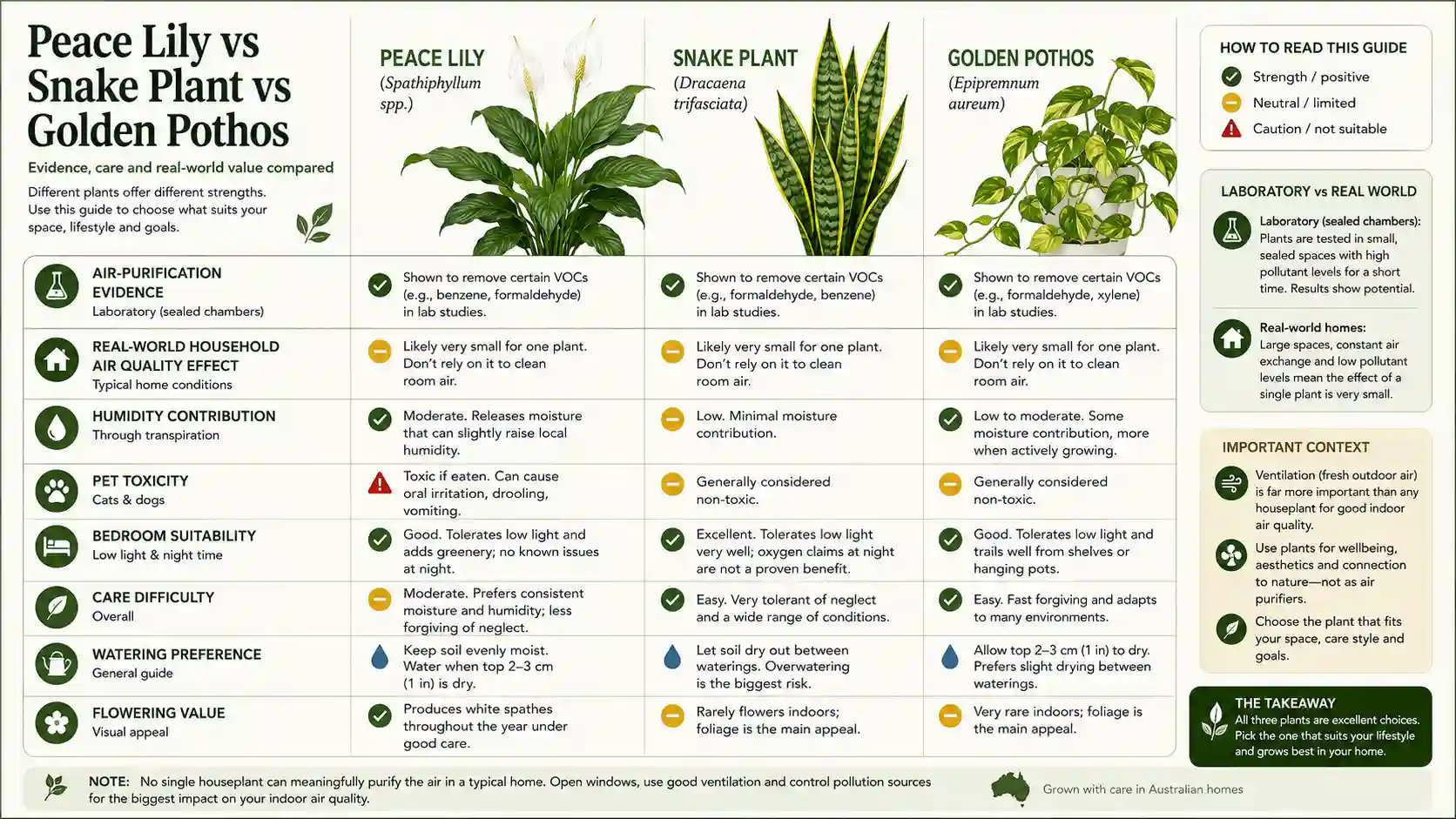
The three plants below have overlapping reputations, but their practical strengths are different.
| Feature | Peace Lily | Snake Plant | Pothos |
| Air-purification claims | Lab evidence; household effect overstated | Lab evidence; household effect overstated | Lab evidence; household effect overstated |
| Humidity contribution | Moderate potential; likes moist conditions | Low | Moderate |
| Pet toxicity | Yes — calcium oxalates | Yes — saponins | Yes — calcium oxalates |
| Bedroom suitability | Suitable if safely placed and adequately lit | Suitable and very tolerant of dry conditions | Suitable if safely placed |
| Care difficulty | Moderate | Low | Low to moderate |
| Main care issue | Inconsistent moisture / overwatering | Overwatering | Underwatering or poor light |
| Flowering value | Yes, under suitable conditions | No comparable flowering display indoors | Not usually the main reason it is grown |
ASPCA lists pothos as containing insoluble calcium oxalates and snake plant as containing saponins; both can cause gastrointestinal or oral symptoms when pets ingest them.
For a deeper look at the snake plant’s commonly advertised benefits and their limitations, see our 10 benefits of the snake plant.
Is a peace lily or snake plant better for a bedroom?
They suit different priorities rather than one being universally better.
A peace lily is a reasonable bedroom plant where you want lush foliage, occasional flowers and a plant that appreciates moderate humidity. A snake plant is better suited to someone who wants very drought-tolerant care and a plant that can tolerate drier indoor conditions. Snake plants also use CAM photosynthesis, so they continue carbon-dioxide uptake at night.
That does not mean a snake plant meaningfully oxygenates a typical bedroom enough to replace ventilation. Human respiration and room ventilation dominate bedroom air exchange.
Our Dracaena plant indoor benefits guide also discusses the wider distinction between laboratory air-quality claims and practical indoor plant use.
For readers who want to compare peace lilies with other indoor plants and check practical care considerations in one place, this peace lily comparison and practical reference provides a useful reference.
Where to Place a Peace Lily for Best Results
Bathroom: Bathrooms can suit peace lilies because humidity is often higher, but good ventilation still matters. A humid bathroom with stagnant, constantly wet conditions is not automatically ideal.
Bedroom: Place the plant where it receives adequate indirect light and where pets or children cannot reach it. Treat any wellbeing or comfort benefit as an environmental and aesthetic effect, not as a sleep-chemistry treatment.
Living area: A living room is often the easiest place to balance light, humidity, appearance and airflow. Keep the plant away from harsh direct sunlight and direct heating or air-conditioning streams.
The best position is therefore not the most fashionable one. It is the location where the peace lily can remain healthy, adequately lit, consistently moist and safely out of reach.
Conclusion
Peace lily benefits are real, but the evidence is much narrower than many online lists suggest.
The strongest evidence concerns controlled pollutant removal and the general biological ability of plants to transpire water vapour. The NASA research that made peace lilies famous used sealed laboratory chambers, not ordinary homes, and later analysis suggests that very large numbers of potted plants would be required to reproduce the air-cleaning effect of normal building air exchange.
Humidity benefits are plausible and supported by real indoor research, but they are generally modest at household scale. Evidence for mood and productivity is promising for indoor greenery generally, yet the frequently repeated 37% figure belongs to UTS workplace research, not the University of Exeter study, and neither establishes a peace-lily-specific percentage effect.
For an Australian gardener, the practical verdict is straightforward: grow a peace lily for its attractive foliage, flowering potential and modest environmental contribution — not as a replacement for ventilation or an air purifier. Give it suitable indirect light, consistent but not excessive moisture, appropriate humidity and safe placement, and the plant can perform well without relying on inflated marketing claims.
FAQs
What are the disadvantages of peace lilies?
The main disadvantages are their sensitivity to watering mistakes, dislike of harsh direct sunlight, need for reasonably consistent moisture, and toxicity if chewed. They can also become stressed in very dry air or when placed directly in heating or air-conditioning streams.
Which is better, snake plant or peace lily?
They serve different needs. Snake plants are more tolerant of drought and neglect, while peace lilies prefer more consistent moisture and generally benefit from higher humidity. Both have laboratory-based air-quality reputations, but neither should be treated as a substitute for ventilation.
Is it okay to have a peace lily in your bedroom?
Yes, provided the plant has enough indirect light and is kept away from pets and young children who might chew it. There is no strong evidence that a single peace lily changes bedroom oxygen or sleep chemistry in a meaningful way.
What happens if you touch a peace lily?
Handling an intact plant is not the same as chewing it. However, the sap can irritate skin or eyes, and sensitive people can develop contact dermatitis. Wash exposed skin with water, and avoid touching the eyes after handling the plant.
Are peace lilies poisonous to babies or pets?
They can be harmful if chewed or swallowed. The insoluble calcium oxalate crystals can produce burning and swelling of the mouth and tongue, drooling, vomiting and difficulty swallowing. Keep peace lilies inaccessible to pets and babies, and contact the Australian Poisons Information Centre on 13 11 26 for exposure advice.
Does a peace lily like humidity?
Yes. Peace lilies generally perform better with moderate to higher humidity than in very dry indoor air. However, humidity around the plant and humidity throughout the room are different things: one peace lily may appreciate humid air without materially humidifying an entire Australian house.
1 Comment