

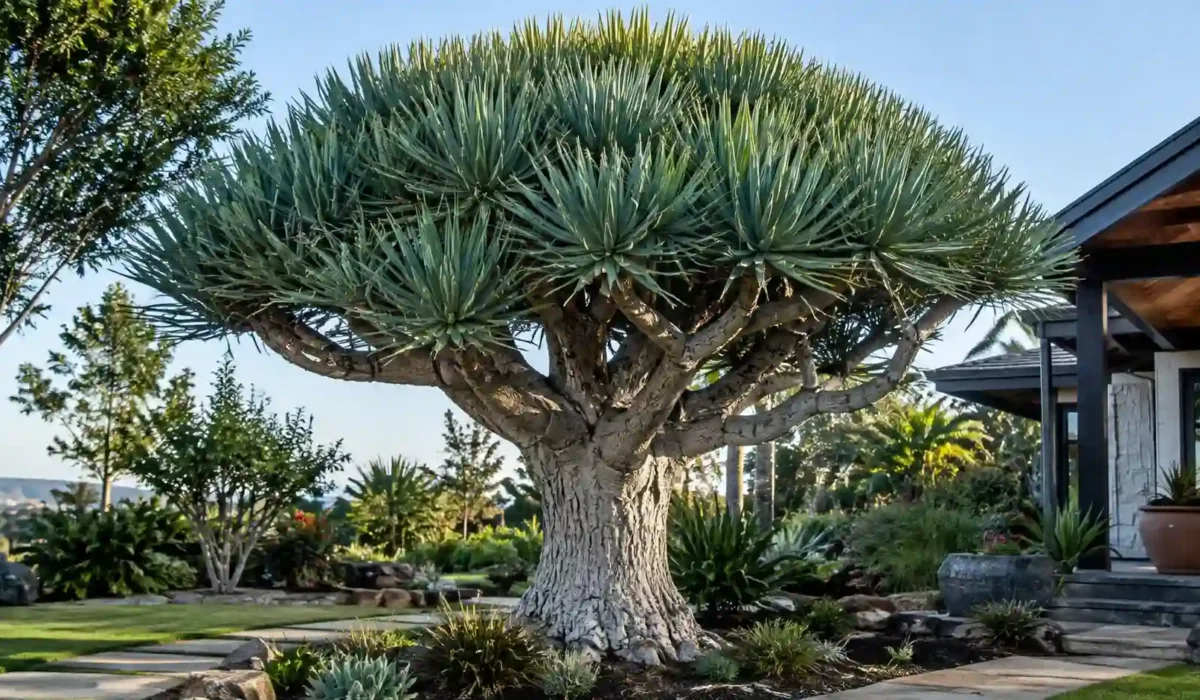
Dragon Tree Brisbane: Price, Buying & Care Guide
According to Elemo Baker, the dragon tree (Dracaena draco) suits Brisbane’s frost-free, subtropical climate, thriving in full sun to part shade with well-drained sandy or loam soil. This slow-growing succulent tree is highly drought tolerant once established, reaching around 4-6 metres over many decades, and its thick trunk develops a distinctive tiered, umbrella-like canopy with age.
Cut or wounded bark bleeds a deep red sap known as dragon’s blood, the source of the plant’s common name and once prized as a dye and varnish. It rarely strikes from cuttings, so growers propagate it from seed or basal offsets instead. Its non-invasive root system makes it a safe choice near paving and foundations, though the same saponins in its sap are toxic to cats.
By Elemo Baker | Plant Care & Gardening Expert
Last Updated: August 2026
Quick Summary
- Dragon tree usually means Dracaena draco, a slow-growing architectural tree native to the Canary Islands.
- Brisbane-accessible prices currently range from roughly $35–$70 for smaller plants, while large feature specimens can cost $1,000–$2,750+, depending on size and availability.
- Bunnings currently lists several Dracaena varieties, but its online range is dominated by D. fragrans and other dracaenas rather than mature D. draco.
- For Brisbane, give D. draco strong light, sharply draining soil and much less water than typical tropical houseplants.
What Is a Dragon Tree? (Dracaena draco Explained)
The dragon tree is Dracaena draco, an evergreen tree in the family Asparagaceae, native to the Canary Islands. It develops a thick, greyish trunk and a branching, umbrella-like crown of long, rigid, blue-green leaves. Kew recognises Dracaena draco as the accepted species name.
For broader botanical background on the genus and its species, readers can also consult the Dracaena entry on Wikipedia.
You may also see it sold as the Canary Islands dragon tree, draco plant, draco dragon tree or simply dragon tree. It is exceptionally slow growing; Bunnings’ current care guidance gives an indicative growth rate of about 1 metre in 10 years, although growth varies considerably with climate, age, soil and cultivation.
Its unusual form becomes more impressive as the plant matures. Older trees can develop multiple branches and a broad canopy, which explains why a large established specimen can be considerably more expensive than a young potted plant.
Dragon Tree vs Dragon Blood Tree vs Dragon Fruit — What’s the Difference?
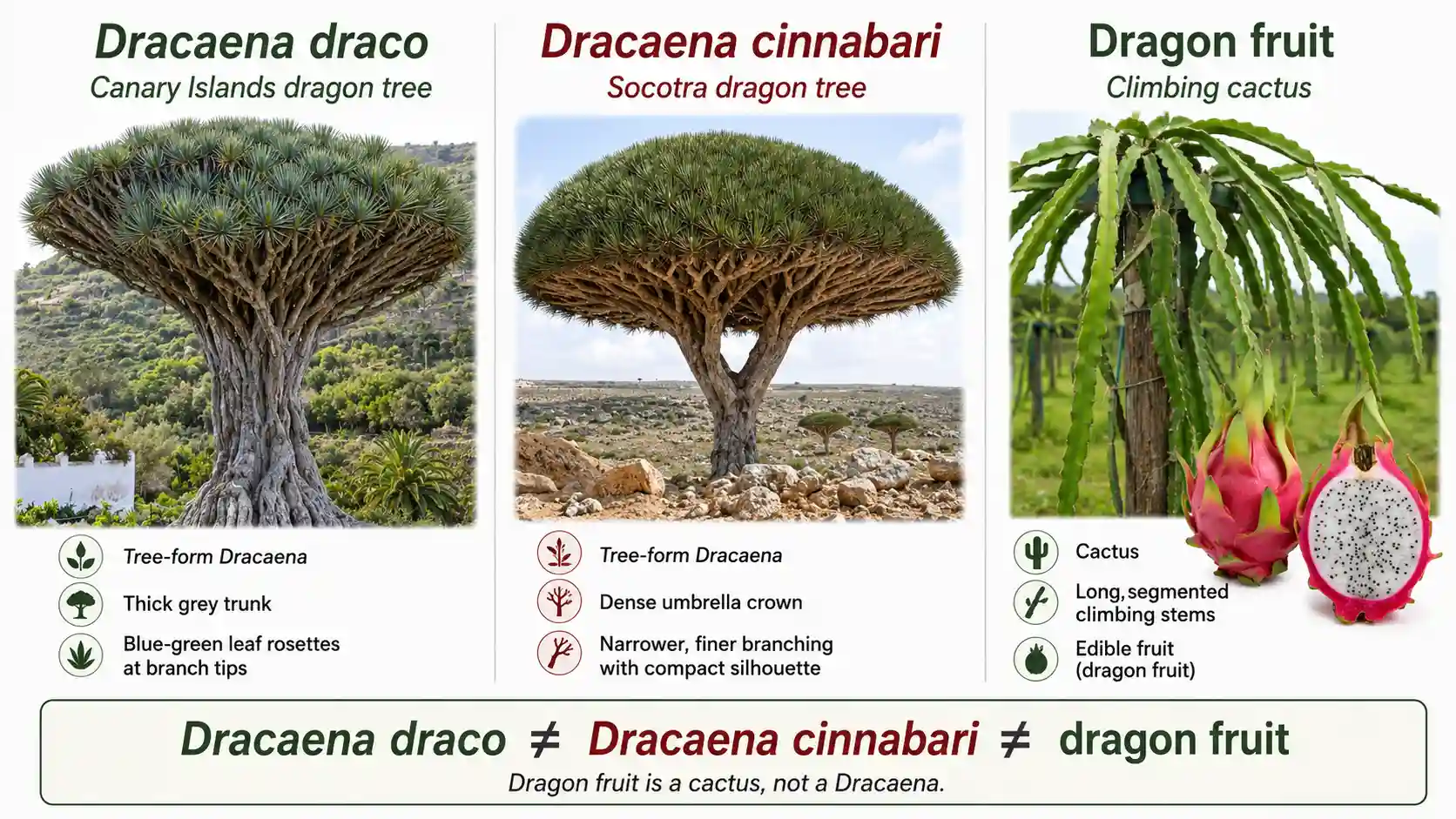
The names are confusing because dragon blood tree can refer to Dracaena draco. The separate species Dracaena cinnabari is commonly known as the Socotra dragon tree or Socotra dragon blood tree. Dragon fruit, meanwhile, is an unrelated climbing cactus.
| Plant | Scientific name | What it is | Key feature |
| Dragon tree | Dracaena draco | Tree | Blue-green leaves, thick branching trunk |
| Socotra dragon tree | Dracaena cinnabari | Tree | Distinctive dense, broad umbrella crown |
| Dragon fruit | Selenicereus spp. | Cactus | Edible colourful fruit and climbing stems |
Both D. draco and D. cinnabari belong to the genus Dracaena, so describing D. draco as a dragon blood tree is not botanically wrong. The important distinction is that they are different species, while dragon fruit is not a dracaena at all.
Dragon Tree Prices in Brisbane
A realistic dragon tree Brisbane price depends heavily on pot size, trunk development, height, branching and whether the plant is a nursery-grown juvenile or a large landscape specimen. Current Australian listings show small D. draco plants around the tens of dollars, while large feature trees can reach well above $1,000.
Why Are Dragon Trees So Expensive?
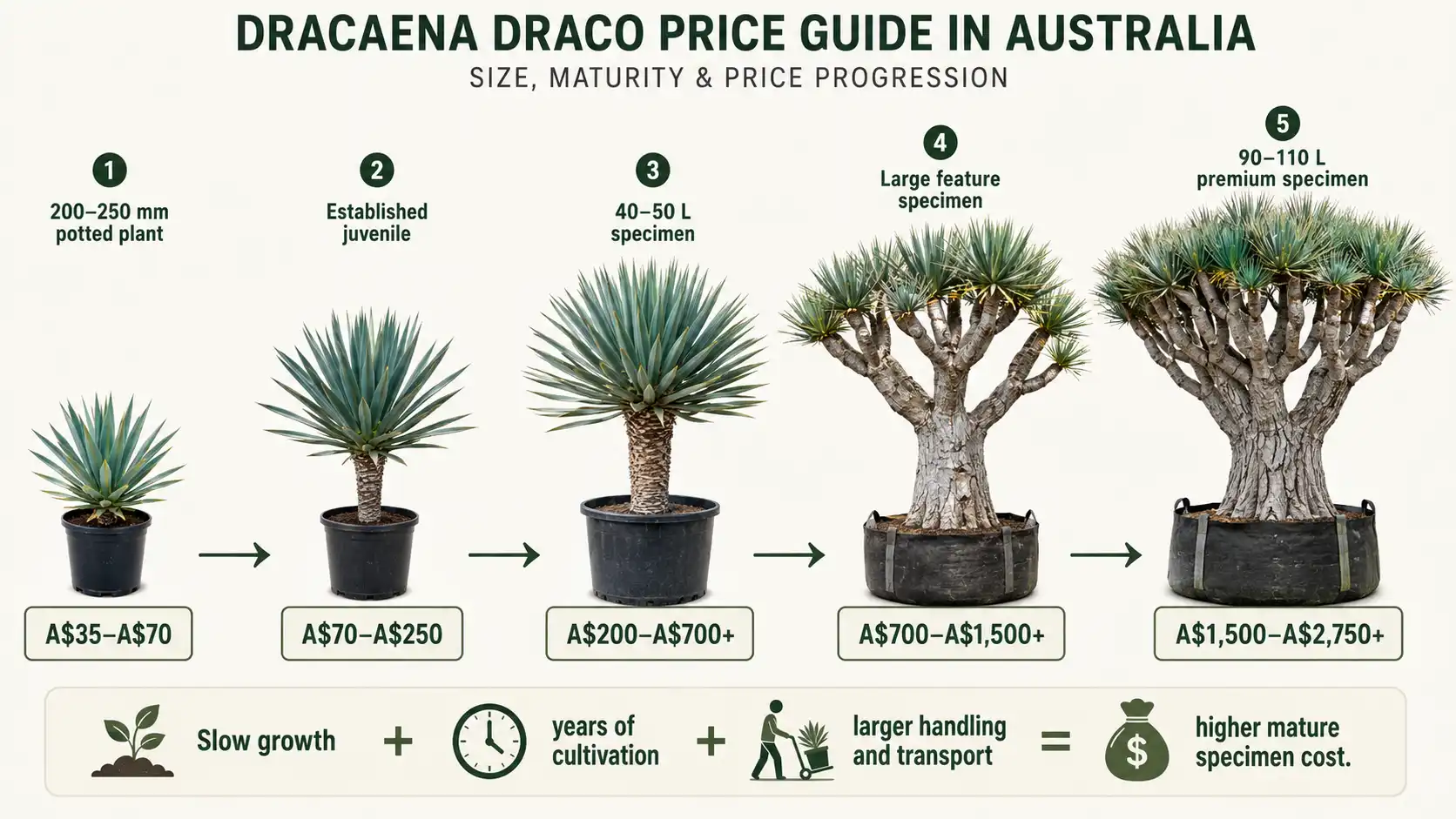
Mature dragon trees are expensive primarily because they grow slowly and take many years to develop the thick trunk and branching structure buyers want. A large specimen therefore represents years of nursery space, cultivation and handling rather than simply a larger version of a fast-growing plant.
Current Australian listings illustrate the gap. A 200 mm D. draco is listed at $35.63 by Nursery Warehouse, while another Australian nursery lists plants from $39 to $1,200 depending on size. Large 90–110 L specimens are currently advertised from about $1,650 to $2,750.
Approximate Dragon Tree Price Range
| Size/age category | Approximate Australian/Brisbane-accessible price |
| Small 200–250 mm plant | $35–$70 |
| Established juvenile | $70–$250 |
| Large 40–50 L specimen | $200–$700+ |
| Large feature specimen | $700–$1,500+ |
| Premium 90–110 L specimen | $1,500–$2,750+ |
These are indicative current market ranges, not fixed Brisbane retail prices. Stock, freight, trunk size and availability can change the final cost substantially. For example, one current Australian supplier lists D. draco from $198.95 and another advertises specimens up to $1,200.
Where to Buy a Dragon Tree in Brisbane
For a dragon tree for sale Brisbane search, start with specialist nurseries and online Australian plant suppliers before assuming a large garden centre will have mature D. draco in stock.
The main buying channels are:
- Specialty nurseries: best option for correctly identified D. draco and larger specimens.
- Large garden retailers: convenient for smaller dracaena varieties, but true D. draco availability can be inconsistent.
- Online nurseries: useful when Brisbane local stock is limited and the supplier delivers large plants.
- Classifieds and marketplaces: potentially cheaper for established plants, but identification and root health need careful checking.
Current online suppliers demonstrate that D. draco is available for Australian delivery, including options specifically advertising delivery to Brisbane and South-East Queensland. For more ideas when choosing large feature plants, our Tall Landscaping Plants Australia Guide covers other options that can provide height and structure in Australian gardens.
Is the Dragon Tree Available at Bunnings?
Bunnings does sell Dracaena plants, but its current online range does not indicate that mature Dracaena draco is a consistently stocked product. Bunnings currently lists varieties such as Dracaena fragrans ‘Burley’, ‘Marley’, ‘Janet Craig’ and ‘Massangeana’, with prices around $15–$37 for some current listings.
This distinction matters because the term dragon plant Bunnings or dracaena Bunnings may lead to a different species. Bunnings itself identifies D. draco as the dragon tree in its care guide, while separately describing D. marginata as a red-edge dracaena or dragon tree.
For a genuine D. draco, check the botanical name on the label rather than relying solely on “dragon tree”.
Buying a Mature Dragon Tree
When buying a mature dragon tree, inspect the plant before paying for transport or installation.
Check:
- Trunk: firm, stable and free from soft, collapsing sections.
- Leaves: avoid widespread yellowing, black lesions or severe dieback.
- Root zone: the pot should drain freely and should not remain permanently saturated.
- Canopy: look for balanced branching rather than major structural damage.
- Delivery: confirm vehicle access, unloading requirements and whether specialist lifting equipment is needed.
Large specimens can be awkward and expensive to move, so the delivered price may be considerably higher than the advertised plant price.
Dragon Tree Care Guide for Brisbane’s Climate
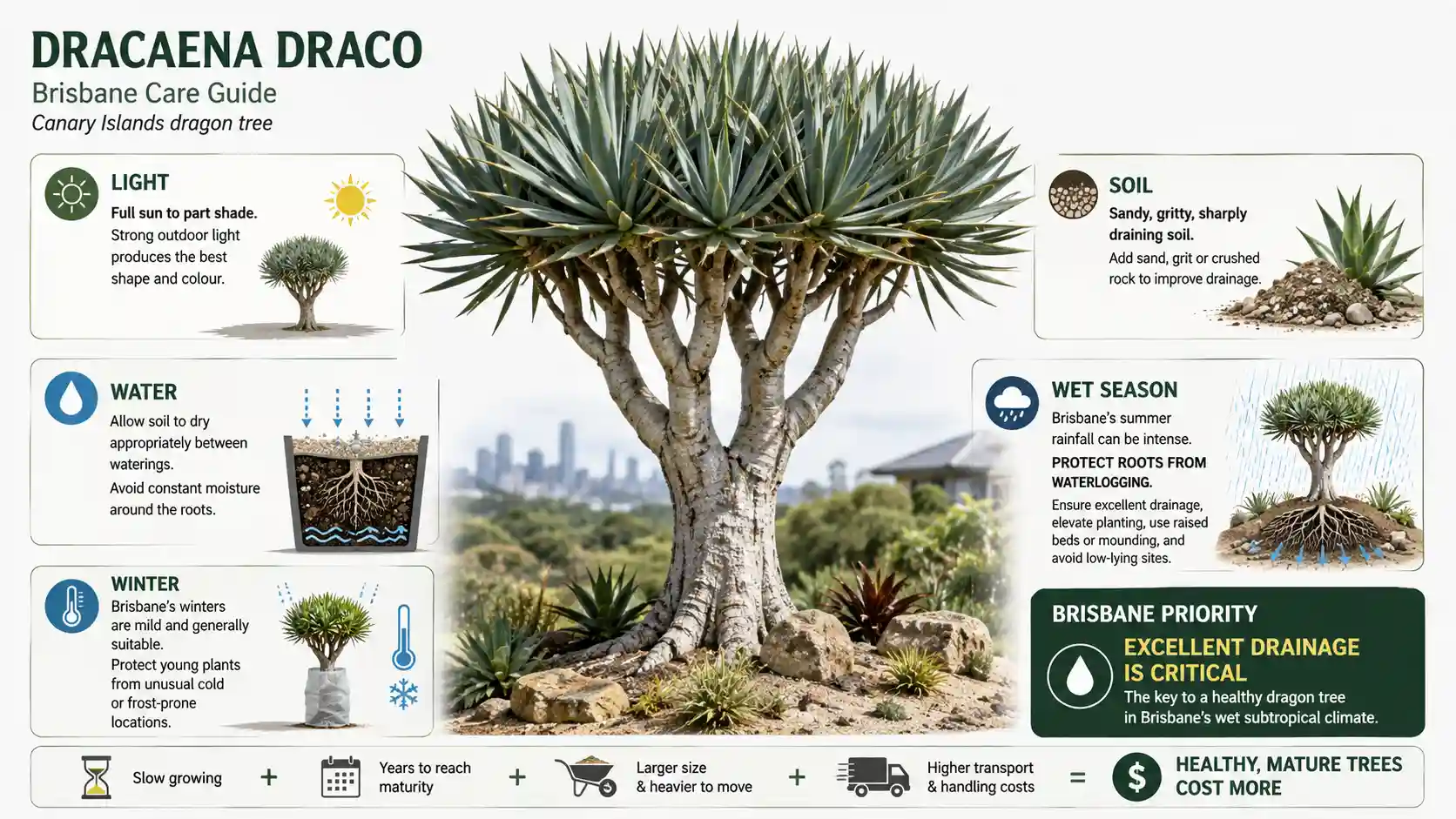
Brisbane’s warm subtropical conditions can work well for Dracaena draco, but the city’s summer rainfall creates one major risk: waterlogged soil. Bunnings recommends a sunny position and very well-drained, gritty soil, while warning that the plant dislikes wet tropical conditions. If you are planning a broader landscape around your dragon tree, see our guide to Best Trees and Shrubs for Australian Gardens for additional species suited to Australian growing conditions.
Light and Position
Full sun to part shade is suitable, with strong light preferred outdoors. A young plant may benefit from some protection from intense afternoon heat while it acclimatises, but a permanently dark position can produce weak growth. If the dragon tree is being considered for an entrance or driveway planting scheme, our Driveway Plants Ideas for Australian Homes guide has more ideas for choosing plants according to space and landscape position.
For outdoor Brisbane planting, choose an open location with good airflow. Indoors, place the plant near a bright window and avoid treating it like a low-light tropical houseplant.
Watering and Soil
Drainage is more important than frequent watering. Dracaena draco is adapted to relatively dry conditions and is considerably more tolerant of occasional dryness than persistently wet roots.
Use:
- Sandy or gritty, free-draining soil.
- A pot with unrestricted drainage holes.
- A raised mound if Brisbane clay or compacted soil prevents rapid drainage.
- Cactus or succulent-style potting mix for containers.
Bunnings recommends a raised planting mound where clay or loam holds water and suggests coarse material to improve drainage.
During Brisbane’s wet summer periods, avoid automatically adding irrigation simply because temperatures are high. Check the soil first.
Growth Rate and Mature Size
Dragon trees grow slowly. Bunnings gives approximately 1 metre of growth over 10 years under suitable conditions and notes a potential height of up to about 5 metres in cultivation. Because dragon trees are relatively slow growing, gardeners seeking quicker screening or structural growth can compare alternatives in our Fast Growing Evergreen Trees Australia Guide.
A container-grown specimen will generally remain smaller because its root volume is restricted. In open ground, a healthy plant can eventually become a substantial architectural feature.
Pruning and Long-Term Shaping
Pruning is mainly used to remove damaged growth and influence the eventual branching structure. Mature D. draco naturally develops a distinctive branching crown, so heavy pruning is unnecessary simply to make it look fuller.
Avoid repeatedly cutting healthy foliage without a clear reason. Make clean cuts when structural pruning is required and allow the plant time to respond.
Common Dragon Tree Problems and How to Fix Them
Yellowing or browning leaf tips: often associated with watering stress, poor drainage or environmental stress. Check the root zone before increasing irrigation.
Root rot during Brisbane’s wet season: the primary prevention is drainage. If water remains around the roots for extended periods, move container plants to a more freely draining mix or improve the garden bed.
Slow or stunted growth: slow growth is normal for D. draco, but unusually weak growth can indicate inadequate light, poor root conditions or nutrient deficiency. Do not compensate for slow growth by overwatering.
Scale and mealybugs: inspect leaf bases, stems and sheltered areas for small insects or cottony deposits. Remove light infestations manually and use an appropriate horticultural treatment according to its label directions.
A useful practical rule is to diagnose the root environment before treating the foliage. In Brisbane’s humid, storm-prone summer conditions, excessive moisture is often a more important concern than a lack of water.
Dragon Tree vs Other Popular Dracaena Varieties
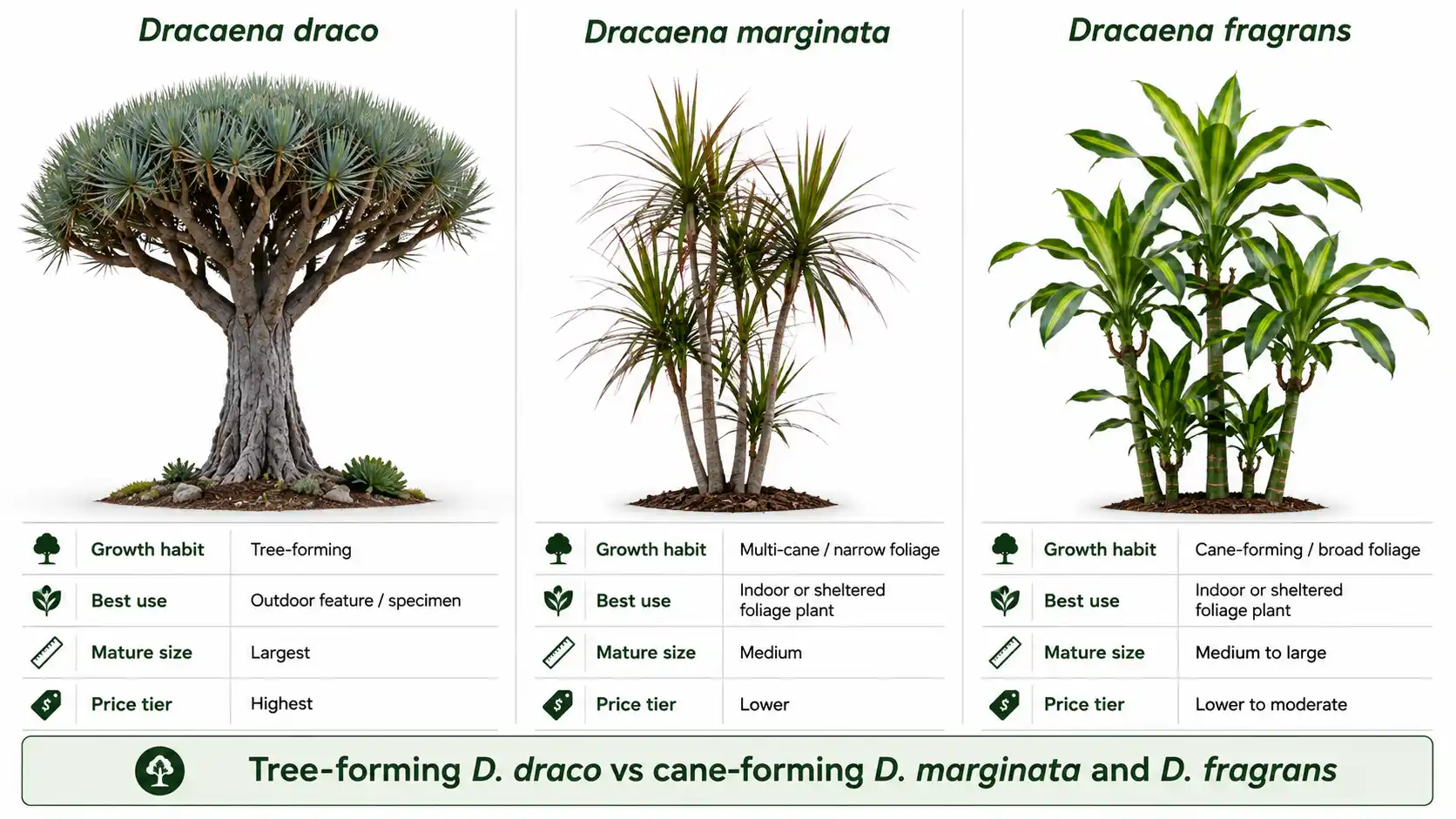
The phrase “dragon plant” can refer to several different dracaenas. D. draco is a true tree-forming species, whereas D. marginata and D. fragrans are more commonly grown as indoor or sheltered foliage plants.
| Variety | Growth habit | Indoor/Outdoor | Mature size | Price tier |
| Dracaena draco | Thick trunk, branching tree | Mainly outdoor; large indoor spaces | Large tree | $$$ |
| Dracaena marginata | Slim canes with narrow leaves | Excellent indoors; sheltered outdoor | Medium | $–$$ |
| Dracaena fragrans | Upright leafy canes | Mainly indoor/shaded outdoor | Small–medium | $–$$ |
Bunnings currently lists D. fragrans cultivars such as Burley, Marley, Janet Craig and Massangeana, illustrating how much easier these smaller dracaenas can be to find through mainstream retailers. For readers comparing D. draco with other commonly grown dracaenas, our Dracaena Plant Indoor Benefits, Care, Meaning & Propagation guide provides a broader look at dracaena care, indoor growing and propagation.
Beginner Mistakes to Avoid With Dragon Trees
The most common mistakes are simple but costly:
- Overwatering: do not treat D. draco like a moisture-loving tropical plant.
- Using a pot without adequate drainage: trapped water can damage the root system.
- Choosing heavy, compacted soil: Brisbane’s wet periods make drainage particularly important.
- Planting too deeply: keep the trunk and root crown at the appropriate planting level.
- Buying the wrong Dracaena: check the scientific name rather than assuming every “dragon tree” is D. draco.
- Expecting rapid growth: this species is valued partly because its mature architectural form takes years to develop.
- Ignoring winter exposure: Brisbane is mild, but young plants should still be protected from unusually cold or frost-prone locations.
Conclusion
A dragon tree Brisbane buyer is usually looking for Dracaena draco, a slow-growing Canary Islands species valued for its thick trunk, blue-green foliage and distinctive branching crown. Current Australian prices range from roughly $35 for small plants to well over $1,500 for large feature specimens, with some premium specimens advertised above $2,000.
For purchasing, specialist nurseries and established online plant suppliers are generally better choices when you specifically want D. draco, while Bunnings is more likely to offer other Dracaena varieties. For Brisbane growing, prioritise strong light, excellent drainage and restrained watering, particularly during the wet season. The most important buying rule is simple: check the botanical name before purchasing.
FAQs
How much does a dragon tree cost in Brisbane?
A small Dracaena draco can cost roughly $35–$70, while established and mature specimens can range from several hundred dollars to more than $2,000. Size, trunk development, availability and delivery costs have a major effect on the final price.
Can you buy a dragon tree at Bunnings?
Bunnings sells several Dracaena varieties, including Dracaena fragrans, but true Dracaena draco is not shown as a consistently stocked mature plant in its current online catalogue. Check the botanical name before buying.
Why are mature dragon trees so expensive?
Mature dragon trees are expensive because Dracaena draco grows slowly and takes many years to develop a substantial trunk and branching canopy. Large plants also require more nursery space, handling and specialised transport.
Is the dragon tree the same as the dragon blood tree?
Dracaena draco is commonly called both dragon tree and dragon blood tree because it produces reddish resin when damaged. However, Dracaena cinnabari is a different species also associated with the dragon-blood-tree name.
How fast does a dragon tree grow?
Dragon trees are very slow growing. Bunnings gives an indicative rate of about 1 metre in 10 years, although actual growth varies with light, soil, water, climate and plant age.
Can dragon trees survive Brisbane winters?
Yes. Brisbane’s generally mild winters can suit Dracaena draco, although young plants should be protected from unusually cold or frost-prone conditions. The bigger Brisbane concern is usually excessive moisture rather than winter cold.
Do dragon trees need full sun?
Dracaena draco performs well in full sun and strong outdoor light, provided it is acclimatised appropriately. Bunnings recommends full sun with some protection from harsh afternoon exposure where necessary.