

Driveway Plants Ideas for Australian Homes
Introduction
Choosing the right driveway plants ideas is about more than improving street appeal. The best plants create a welcoming entrance while remaining practical, easy to maintain, and suitable for Australia’s diverse climates. A well-planned driveway landscape considers plant size, root behaviour, drought tolerance, and long-term maintenance requirements. Whether you’re creating a modern entrance, refreshing an existing border, or landscaping a new driveway, selecting climate-appropriate plants helps ensure healthy growth without damaging paving or requiring constant upkeep. This guide explains which plants perform best around Australian driveways and how to choose them for lasting results. If you’re planning a complete front garden makeover, you may also like our guide to All Year Round Flowering Plants Australia Guide for plants that provide colour throughout every season.
Quick Summary
- Choose driveway plants with non-invasive roots, manageable mature sizes, and good drought tolerance.
- Low-growing border plants provide neat edges while reducing weeds and ongoing maintenance.
- Australian native plants are often the best choice for water efficiency and long-term performance.
- Modern driveway landscapes usually rely on evergreen plants with structured, repeated planting designs.
What Are the Best Plants for Driveways in Australia?
The best plants for Australian driveways combine attractive appearance with practical performance. They should tolerate reflected heat from concrete or asphalt, require minimal maintenance once established, and have root systems that are unlikely to damage paving. Many homeowners also combine driveway borders with Fast Growing Evergreen Trees Australia Guide to add privacy and long-term structure.
Plant selection should also take your local climate zone into account, as temperature, rainfall, and seasonal conditions greatly influence long-term performance. Learn more about Australia’s climate classifications on Wikipedia’s Climate of Australia page.
Australia’s climate ranges from tropical and subtropical regions to temperate and arid zones, making climate suitability one of the most important considerations. Plants that thrive in one region may struggle in another, so selecting species adapted to local conditions leads to healthier growth and lower maintenance.
When evaluating plants for driveways, consider:
- Root behaviour and potential impact on concrete or asphalt
- Mature height and width
- Drought tolerance
- Sun and shade requirements
- Maintenance needs
- Compatibility with your local climate zone
- Growth habit and long-term appearance
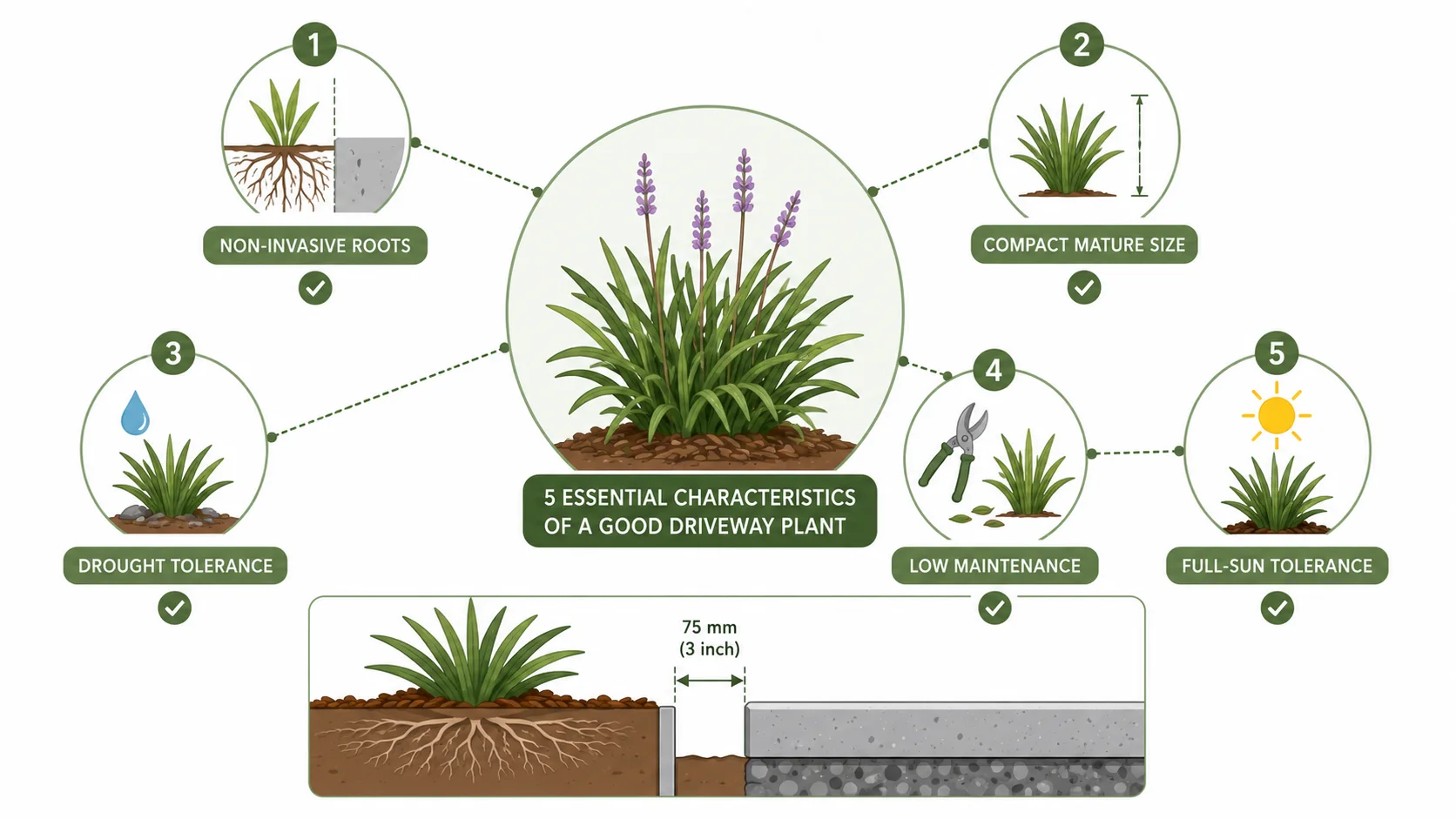
Plants that remain compact and have fibrous, non-aggressive root systems generally perform best around residential driveways.
What Makes a Plant Suitable for a Driveway?
A good driveway plant balances visual appeal with practical performance. Because driveways experience vehicle traffic, reflected heat, and limited planting space, suitable plants must tolerate these conditions without creating future maintenance problems.
Key characteristics include:
- Non-invasive roots that are unlikely to lift or crack paving.
- Controlled mature spread to prevent plants from growing into vehicle access areas.
- Drought tolerance for Australian summers and reduced irrigation needs.
- Low maintenance requirements, including limited pruning.
- Compatibility with concrete and asphalt, especially where heat reflection is significant.
A practical guideline often used in landscape design is the 3-inch (approximately 75 mm) edging rule. Maintaining a clear gap between the driveway edge and surrounding vegetation helps prevent grass and plant growth from encroaching onto hard surfaces. This small separation improves drainage, protects driveway edges, simplifies mowing, and reduces weed invasion.
In our experience growing and maintaining driveway borders, allowing plants to mature naturally while preserving this clearance creates a tidier landscape that requires less trimming throughout the year.
Best Driveway Plants for Australian Conditions
Australia offers many reliable driveway plants, including both native species and carefully selected exotics. The following plants are widely recognised for their durability, attractive appearance, and suitability for residential landscapes. For boundary planting beyond the driveway, see our Low-Maintenance Plants for Fence Line in Australia guide.
| Plant | Best Features | Root Safety | Maintenance |
| Lomandra | Tough native with strappy foliage | Excellent | Very low |
| Liriope | Dense evergreen border plant | Excellent | Low |
| Westringia | Compact native shrub with long flowering season | Excellent | Low |
| Agapanthus | Bold flowers and architectural foliage | Generally good when properly spaced | Moderate |
| Buxus | Formal evergreen hedge | Excellent | Moderate |
| Dwarf Gardenias | Fragrant flowers and glossy foliage | Excellent | Moderate |
| Dwarf Callistemon varieties | Native flowers that attract pollinators | Excellent | Low |
For sealed driveways, prioritise plants with fibrous root systems rather than vigorous woody roots. Lomandra, Liriope, Westringia, and dwarf Callistemon cultivars are among the safest options for planting close to concrete or asphalt.
Elemo Baker recommends selecting plants based on their mature size rather than their nursery pot size. Many homeowners unintentionally overcrowd driveway borders because newly purchased plants appear much smaller than they will become after several years of growth.
As of 2026, Australian landscape designers continue to favour drought-tolerant natives for driveway planting because they generally require less irrigation and adapt well to increasingly variable weather conditions.
Driveway Border Plants — Edging Ideas That Actually Work
Driveway border plants define the edge of the driveway, soften hard surfaces, and create a finished appearance. Beyond aesthetics, well-designed borders help suppress weeds, reduce soil erosion, and provide a clear separation between lawns, gardens, and paved areas.
The most effective edging plants remain compact, maintain an orderly shape, and tolerate regular exposure to sun, reflected heat, and occasional foot traffic.
Low-Growing Edging Plants for Neat Driveway Borders
Low-growing plants are ideal for creating clean, attractive driveway edges without obstructing visibility or requiring constant trimming.
Recommended options include:
- Liriope ‘Evergreen Giant’ – Dense evergreen foliage that forms tidy clumps and tolerates both sun and partial shade.
- Mondo Grass – Excellent for narrow edging strips and shaded driveways where turf struggles.
- Lomandra ‘Tanika’ – One of Australia’s most reliable native edging plants, offering excellent drought tolerance and minimal maintenance.
- Dwarf Agapanthus – Provides attractive seasonal flowers while remaining more compact than standard varieties.
These plants offer several advantages:
- Clearly define driveway borders.
- Suppress weeds once established.
- Require infrequent pruning.
- Tolerate dry conditions.
- Maintain attractive year-round foliage.
In our experience, applying approximately 75 mm of quality mulch around edging plants significantly reduces weed growth while helping retain soil moisture during Australia’s warmer months.
What Can I Plant in a Narrow Strip Next to My Driveway?
For planting strips narrower than 40 cm, choose upright plants with restrained growth habits and non-invasive roots. Compact spaces leave little room for spreading shrubs, making careful plant selection essential.
Suitable choices include:
- Columnar forms of Westringia
- Lomandra ‘LM300’
- Liriope varieties
- Mondo Grass
- Compact ornamental grasses
- Narrow-growing native shrubs
Avoid planting species that develop aggressive roots or spread rapidly across the border. Large bamboo species, vigorous running ground covers, and oversized shrubs often become difficult to manage in confined spaces and may eventually interfere with vehicles or paved surfaces.
When designing narrow driveway borders, spacing is just as important as plant selection. Position plants according to their mature width rather than their initial nursery size to avoid overcrowding later. A simple repeating pattern using one or two complementary species generally produces a cleaner and more contemporary appearance than mixing numerous plant varieties.
Elemo Baker recommends leaving sufficient access for future maintenance, including mulching, pruning, and irrigation checks. Even low-maintenance plants benefit from occasional care, and planning for that access during installation makes long-term maintenance considerably easier.
Low Maintenance Driveway Plants — Best Options for Busy Homeowners
Most homeowners want a driveway that looks neat throughout the year without requiring constant watering, pruning, or replanting. The best low maintenance driveway plants are drought-tolerant, slow to moderate growing, and well suited to local climate conditions. Once established, these plants typically require only occasional watering, seasonal pruning, and annual fertilising.
Selecting the right species from the beginning also reduces long-term maintenance costs and helps create a landscape that remains attractive with minimal effort.
Low Maintenance Native Options
Australian native plants are among the most dependable choices for low-maintenance driveway landscaping. They are naturally adapted to local conditions and generally require less water than many exotic species once fully established.
Recommended native options include:
| Plant | Key Benefits | Maintenance Level |
| Westringia | Evergreen shrub with extended flowering | Very low |
| Grevillea ‘Prostrate’ | Colourful flowers and spreading habit | Low |
| Lomandra varieties | Excellent drought tolerance and tidy foliage | Very low |
| Myoporum | Fast ground cover for larger areas | Low |
Most Australian natives require one full growing season to establish healthy root systems. During this period, regular watering is important, especially through dry weather. Once established, many species become highly drought tolerant and need only occasional deep watering during prolonged dry periods.
Elemo Baker recommends applying a native-specific mulch around newly planted natives to conserve moisture and moderate soil temperatures. Avoid piling mulch directly against stems, as this can encourage fungal problems.
As of the 2026 growing season, many Australian gardeners continue to favour native planting because it reduces irrigation requirements while supporting local birds, bees, and beneficial insects.
Low Maintenance Exotic Options
Several non-native plants also perform exceptionally well in Australian driveway landscapes, particularly where formal gardens or evergreen structure are desired.
Reliable exotic choices include:
- Liriope
- Buxus (best suited to cooler climates)
- Duranta repens hedge
- Viburnum tinus
These plants provide dependable structure while requiring relatively little maintenance.
To keep exotic species performing well:
- Apply slow-release fertiliser once or twice each year.
- Refresh mulch annually to suppress weeds.
- Water deeply during prolonged dry periods.
- Prune lightly to maintain their natural shape rather than heavy clipping.
In our experience, homeowners often over-prune formal shrubs. Light, regular trimming produces healthier plants and reduces stress compared with infrequent heavy pruning.
Driveway Trees — Adding Height and Structure
Trees provide vertical interest, shade, and a sense of maturity that smaller plants cannot achieve. Well-positioned driveway trees enhance kerb appeal, frame the entrance to a property, and can increase the overall visual value of the landscape. If you’re considering evergreen feature trees, our Teddy Bear Magnolia Landscaping Guide for Australian Gardens explains how to use this popular variety effectively.
However, trees require more planning than shrubs or ground covers. Their mature height, canopy spread, and root systems must all be considered before planting near driveways.
When deciding whether to plant trees, consider:
- Vehicle clearance beneath mature canopies
- Root behaviour
- Available planting space
- Distance from buildings
- Long-term maintenance
- Local climate conditions
Proper placement helps prevent future conflicts with driveways, footpaths, fences, and underground services.
Small Driveway Trees for Residential Properties
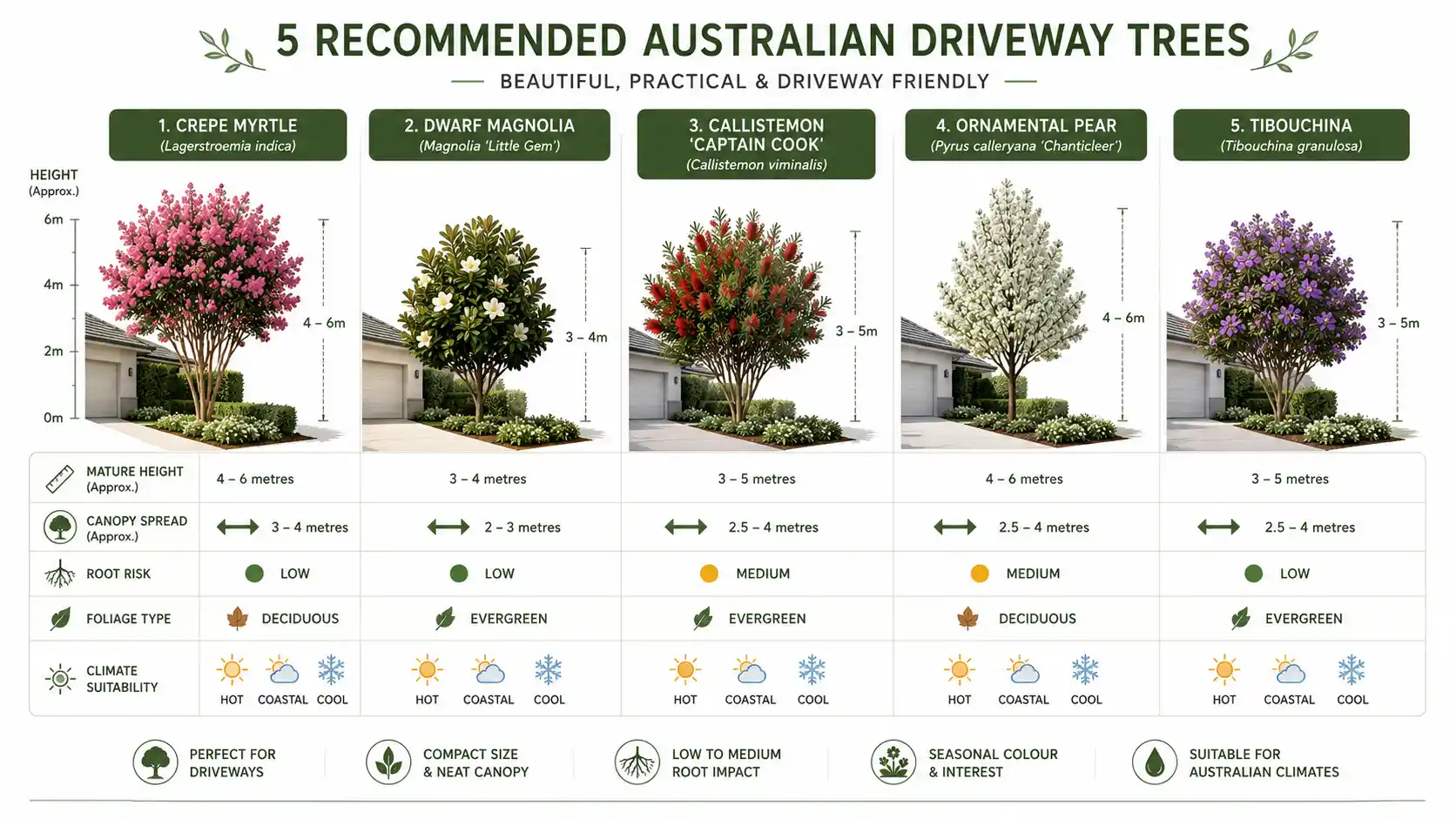
Small ornamental trees are often the safest and most practical choice for suburban driveways. They provide seasonal colour and structure without overwhelming the landscape. Crepe Myrtles are a popular choice, and understanding their roots is important before planting. Read How Deep Are Crepe Myrtle Roots? Root Depth Guide for more information.
| Tree | Mature Height | Root Risk | Deciduous / Evergreen | Best Climate Zone |
| Crepe Myrtle | 3–6 m | Low | Deciduous | Warm and subtropical |
| Dwarf Magnolia | 3–4 m | Low | Evergreen | Temperate to subtropical |
| Callistemon ‘Captain Cook’ | 2–3 m | Low | Evergreen | Most Australian zones |
| Ornamental Pear | 4–6 m | Medium | Deciduous | Temperate |
| Tibouchina | 3–5 m | Low | Semi-evergreen | Subtropical to tropical |
These trees offer a balance between ornamental value and manageable growth. Their relatively compact size makes them suitable for most residential driveways when planted with adequate spacing.
Elemo Baker recommends checking the mature canopy width before planting rather than focusing only on height. A broad canopy may eventually interfere with vehicle access even if the tree remains relatively short.
What to Consider Before Planting Driveway Trees
Choosing the right tree involves more than selecting an attractive species. Proper planning helps prevent costly problems as trees mature.
Consider the following:
- Leave sufficient clearance between tree roots and driveway edges.
- Ensure mature branches provide adequate clearance for vehicles.
- Check for overhead powerlines before selecting taller species.
- Confirm local council regulations regarding street trees or verge planting.
- Space trees evenly when creating a formal avenue effect.
Root-safe species should still be planted with adequate distance from paving to allow healthy root development. Even trees with relatively non-invasive roots perform better when given sufficient soil volume. Understanding root behaviour is essential before selecting any tree. Our Gum Tree Root System: Root Spread, Problems & Safe Distances guide explains how roots can affect nearby structures.
In our experience, allowing for mature growth rather than current nursery size produces a more balanced landscape that requires fewer corrective measures in later years.
Modern Driveway Plant Ideas — Clean Lines and Contemporary Style
Modern driveway landscaping focuses on simplicity, repetition, and strong architectural form. Rather than using numerous plant varieties, contemporary designs often repeat a small number of carefully selected species to create a clean, cohesive appearance. For homeowners creating formal evergreen screening, Ficus Hillii ‘Flash’ Care, Growth & Hedge Guide provides another excellent landscaping option.
Evergreen foliage, structured planting patterns, and restrained colour palettes are common characteristics of modern Australian driveways.
Key design principles include:
- Repeating plant species consistently
- Using evergreen foliage for year-round structure
- Maintaining defined planting lines
- Minimising visual clutter
- Combining plants with gravel, stone, steel edging, or decorative mulch
These principles create landscapes that remain attractive throughout the year while requiring relatively little maintenance.
Plants That Suit a Modern Driveway Look
Plants with tidy forms and architectural foliage are particularly well suited to contemporary landscapes.
Recommended choices include:
- Lomandra ‘LM300’
- Agave attenuata
- Buxus topiary balls
- Festuca glauca
- Nandina domestica ‘Nana’
- Dwarf Gardenias
Repeating a single species along both sides of a driveway creates rhythm and visual balance. This approach often appears more sophisticated than combining numerous unrelated plants.
In our experience growing contemporary landscapes, limiting the planting palette to two or three complementary species produces the cleanest long-term result while simplifying maintenance.
Evergreen Driveway Plants for Year-Round Colour and Structure
Evergreen plants maintain their foliage throughout the year, ensuring driveways remain attractive during every season.
Popular flowering evergreen choices include:
| Plant | Flower Colour | Flowering Habit |
| Westringia | White | Extended flowering throughout much of the year |
| Grevillea cultivars | Red, orange or pink | Multiple flowering flushes depending on climate |
| Dwarf Gardenia | White | Heavy flowering during warmer months with repeat blooms |
| Salvia varieties | Purple, blue, red or pink | Long flowering season in suitable climates |
Although some plants appear to flower continuously, most experience distinct seasonal peaks. In warmer Australian regions, species such as Grevillea and Salvia often bloom across much of the year, while cooler climates generally produce more concentrated flowering periods.
Choosing a combination of evergreen foliage plants and long-flowering shrubs helps maintain colour and structure regardless of season.
How to Landscape Around a Driveway — A Practical Approach
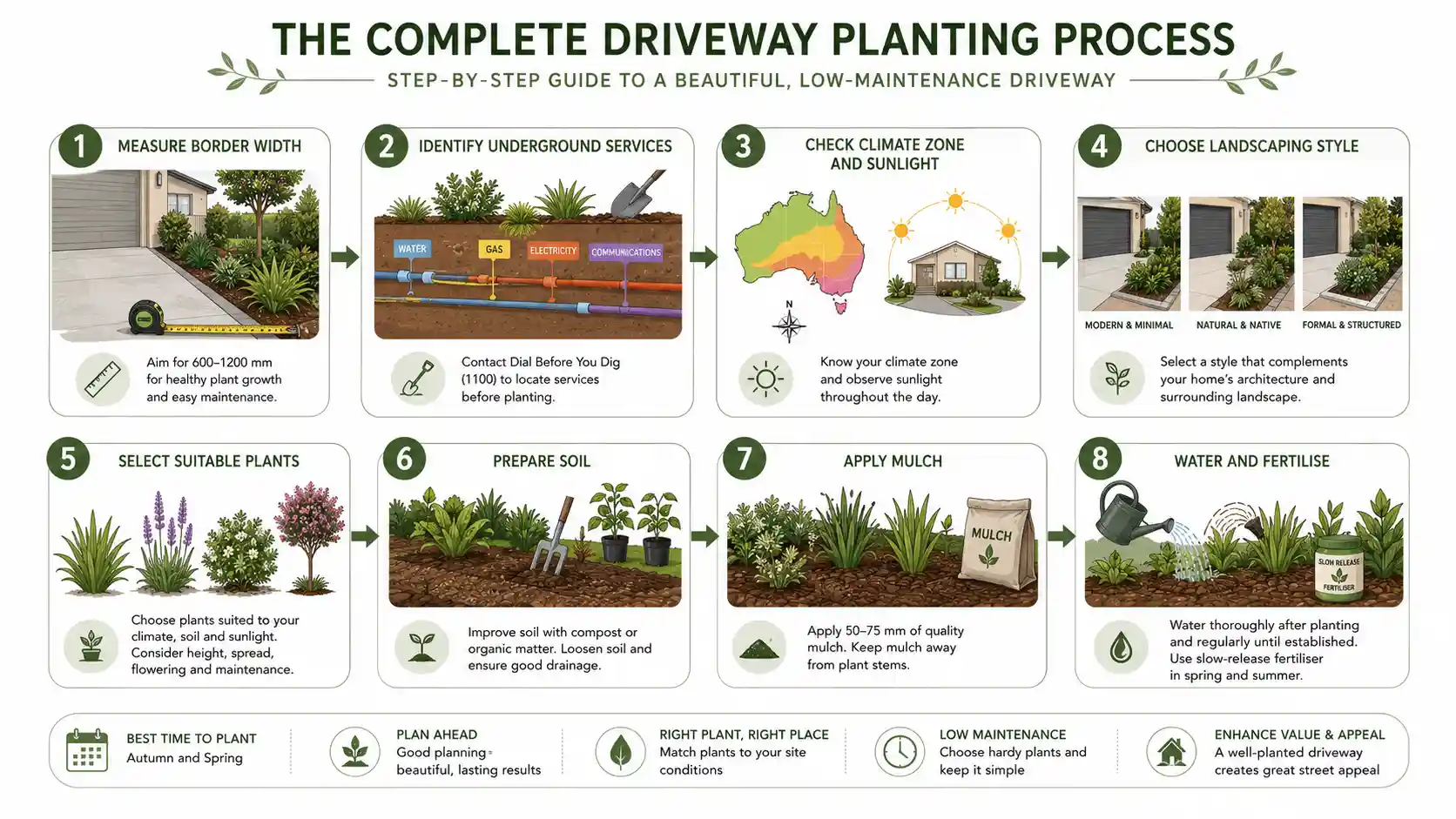
Landscaping around a driveway begins with careful planning rather than simply choosing attractive plants. The most successful driveway landscapes balance aesthetics, plant health, maintenance requirements, and the available space. By selecting plants that suit your climate, soil, and driveway dimensions, you can create a landscape that remains attractive for many years with minimal upkeep.
Step-by-Step Driveway Landscaping Guide
Follow these practical steps to create a functional and visually appealing driveway landscape.
- Measure the available border width and locate underground services.
Before planting, measure the width of the planting strip and identify any underground utilities, irrigation pipes, drainage systems, or electrical cables. This prevents future damage during planting and helps determine which plants are suitable for the available space. - Identify your climate zone and sun exposure.
Australian growing conditions vary significantly between regions. Observe whether your driveway receives:- Full sun
- Partial shade
- Full shade
- Plants that thrive in full sun may struggle beneath established trees or on shaded southern sides of the home.
- Choose a landscaping style.
Select a consistent design style that complements your home’s architecture.
Common options include:- Formal gardens
- Contemporary landscapes
- Native Australian gardens
- Cottage-style planting
- Minimalist designs
- Choose plants based on mature size and root behaviour.
Always design according to the plant’s mature height and spread rather than its nursery size. Select species with non-invasive root systems, particularly near concrete or asphalt driveways. - Prepare the soil properly.
Improve planting areas by incorporating organic matter into the existing soil. Where appropriate, install a quality weed mat before applying mulch to reduce future weed growth. - Plant in staggered rows where space allows.
Staggering plants creates a fuller appearance more quickly than planting in perfectly straight lines while allowing each specimen sufficient room to mature. - Apply approximately 75 mm of mulch.
Organic mulch helps:- Retain soil moisture
- Suppress weeds
- Moderate soil temperatures
- Improve soil health as it decomposes
- Water thoroughly after planting.
Water deeply immediately after planting and apply a slow-release fertiliser suitable for the selected plant species. Continue watering regularly during the establishment period.
Elemo Baker recommends resisting the temptation to overfill new planting beds. Although young plants may initially appear sparse, proper spacing allows healthier growth and prevents expensive thinning or transplanting later.
What Is the Fastest Growing Ground Cover in Australia?
Some of Australia’s fastest-growing ground covers establish quickly and help suppress weeds around driveway borders.
Recommended species include:
| Ground Cover | Best Growing Conditions | Features |
| Myoporum parvifolium | Full sun to part shade | Fast-growing native with excellent drought tolerance |
| Dichondra | Sun or light shade | Dense green carpet suitable for softer landscapes |
| Scaevola aemula | Full sun | Native flowering ground cover with long blooming season |
| Pratia pedunculata | Partial shade | Compact spreading ground cover suited to cooler, moist locations |
When selecting a ground cover, consider the amount of sunlight available. Myoporum and Scaevola perform particularly well in sunny positions, while Dichondra and Pratia tolerate greater shade.
Ground covers work best where wider planting areas exist alongside the driveway, helping reduce exposed soil and minimise ongoing weed management.
Common Driveway Plant Mistakes and How to Avoid Them
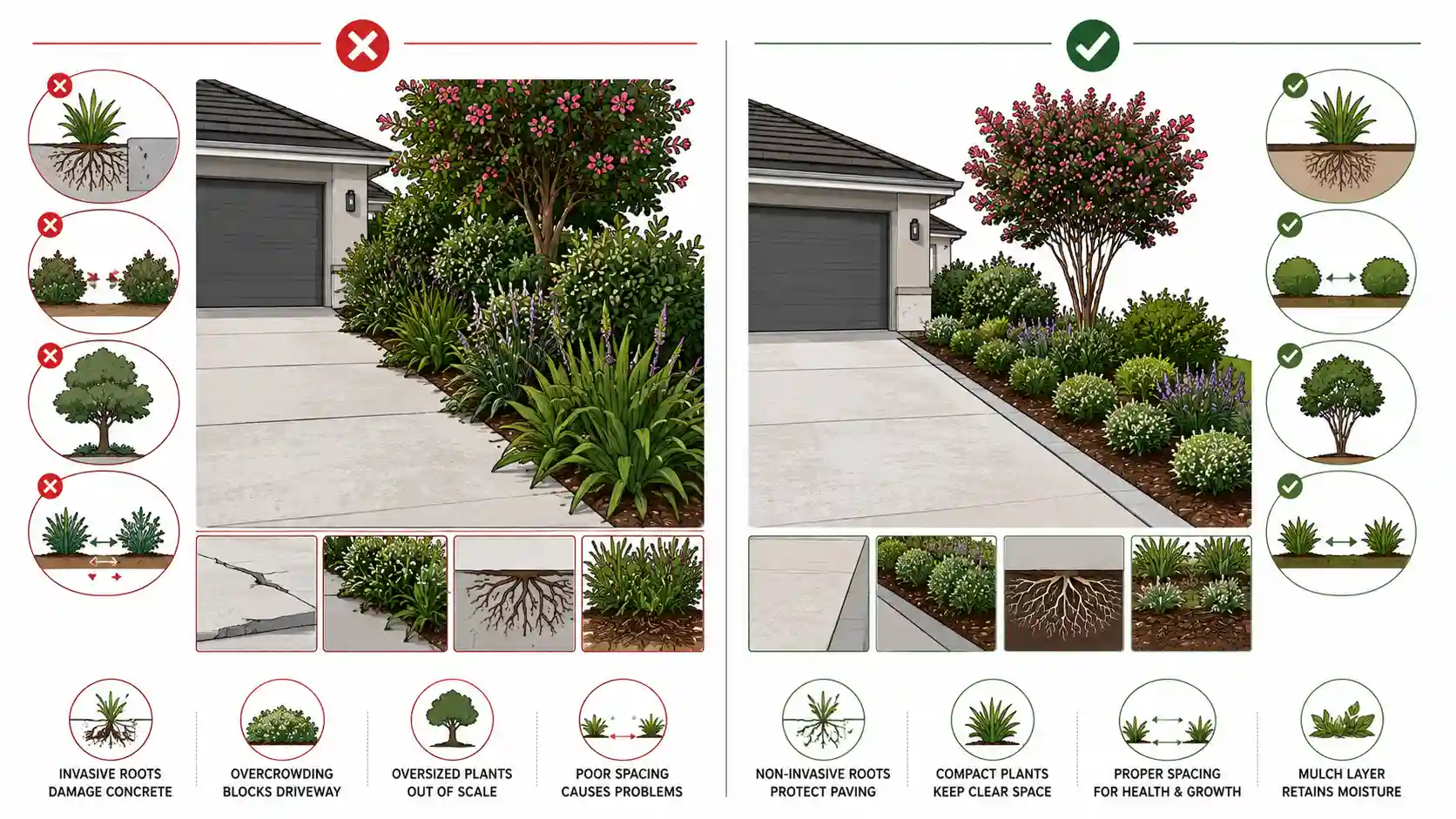
Many driveway landscaping problems develop several years after planting rather than immediately. Most are caused by selecting unsuitable species, planting too closely together, or failing to consider mature growth.
Understanding these common mistakes helps homeowners create landscapes that remain attractive and functional over the long term.
Plants with Invasive Roots — What to Avoid Near Driveways
Avoid planting species with aggressive or invasive root systems close to concrete or asphalt surfaces. Over time, expanding roots can lift paving, crack edging, and create uneven surfaces.
Plants commonly avoided near residential driveways include:
- Large bamboo species with running rhizomes
- Robinia species
- Cotoneaster where unrestricted growth is likely
- Overcrowded Agapanthus plantings that develop dense root masses
Although Agapanthus generally has non-woody roots, neglected clumps can become extremely dense over many years, making removal difficult and placing pressure on surrounding landscape features.
Where possible, choose plants with fibrous, compact root systems that remain well behaved throughout their lifespan.
Overcrowding and Wrong Plant Scale
One of the most common landscaping mistakes is planting according to the size of nursery stock instead of the mature plant.
For example:
- A shrub purchased at 200 mm tall may eventually grow 2 metres wide.
- A compact ornamental grass may double or triple in width within several growing seasons.
- Closely spaced hedging plants often require continual pruning to prevent overcrowding.
Designing for mature size provides several benefits:
- Better air circulation
- Healthier plant growth
- Reduced pruning requirements
- Improved visual balance
- Lower long-term maintenance costs
In our experience, leaving slightly more space between plants at installation almost always produces a more attractive landscape after three to five years than planting densely from the outset.
Timing — Is October Too Late to Plant?
No. October is an excellent time to plant driveway plants across most Australian regions.
Spring provides warming soil temperatures that encourage rapid root development before the heat of summer arrives. Most shrubs, ground covers, and ornamental grasses establish well during this period when provided with adequate watering.
Regional considerations include:
- Temperate regions: October is one of the best planting months.
- Subtropical Queensland: October remains suitable, but consistent watering becomes increasingly important as temperatures rise.
- Hot inland areas: Newly planted specimens may benefit from temporary shade cloth during periods of extreme heat.
As of the 2026 growing season, many horticultural professionals continue to recommend spring and early autumn as the most reliable planting windows for establishing ornamental landscape plants across much of Australia.
Driveway Plants Available at Bunnings — What to Look For
Many Australian homeowners purchase driveway plants from Bunnings because of its wide availability and seasonal plant range. Rather than focusing on where to buy plants, it is more important to evaluate whether individual plants are suitable for your landscape.
When selecting driveway plants, carefully read the plant label and check:
- Mature height
- Mature width
- Sun or shade requirements
- Water requirements
- Frost tolerance
- Recommended climate
- Botanical name for accurate identification
Common driveway-suitable plants frequently stocked include:
- Liriope
- Lomandra
- Westringia
- Buxus
- Agapanthus
- Dwarf Gardenias
Always inspect plants before purchasing. Healthy specimens should have:
- Even green foliage
- Strong stems
- Moist but not waterlogged potting mix
- No obvious pests or disease symptoms
- Well-developed but not root-bound root systems
Selecting healthy plants at the beginning greatly improves establishment success and reduces replacement costs later.
Plant Size
Typical Sizes for Driveway Border Plants
Selecting plants according to mature size helps maintain clear access while preventing overcrowding.
| Plant Category | Typical Mature Size | Best Use |
| Compact ground covers | 10–30 cm | Driveway edging and wide border strips |
| Mounding shrubs | 40 cm–1 m | Feature planting and low borders |
| Upright screening plants | 1–3 m | Privacy and vertical structure |
| Small driveway trees | 2–6 m | Framing entrances and providing shade |
Match the plant size to the available border width whenever possible. Narrow strips generally suit compact plants, while wider landscapes can accommodate shrubs and small ornamental trees without creating congestion.
Care Guide for Driveway Plants
Watering
Most suitable driveway plants become drought tolerant once established. During prolonged dry periods, deep watering approximately every fortnight encourages deeper root growth and improves drought resilience. Newly planted specimens require more frequent watering during their establishment period.
Light Requirements
Most residential driveways receive full sun for much of the day. Select plants that tolerate intense sunlight and reflected heat where appropriate. If the driveway sits beneath mature trees or beside tall buildings, choose shade-tolerant species suited to reduced light conditions.
Soil Preparation
Driveway soils often become compacted during construction.
- Sandy coastal soils: Incorporate compost or well-rotted organic matter to improve moisture retention.
- Clay soils: Improve drainage by adding gypsum where appropriate and blending organic material into the planting area.
Healthy soil promotes stronger root development and more vigorous plant growth. Healthy soil and proper plant care also reduce the risk of common landscape issues covered in our Garden Pest Identification Guide for Australian Gardens.
Pruning
Pruning frequency depends on the species.
- Lomandra: Rarely requires pruning beyond removing old foliage.
- Buxus: Usually benefits from trimming two or three times each year.
- Westringia: Light pruning after flowering encourages dense, compact growth.
Avoid excessive pruning during periods of extreme heat or frost.
Fertilising
Apply a slow-release granular fertiliser when planting to encourage healthy establishment.
For Australian native species, use a low-phosphorus native fertiliser, as excessive phosphorus can damage phosphorus-sensitive native plants. Annual fertilising is generally sufficient for most established driveway plantings when combined with regular mulching and healthy soil management.
Conclusion
Choosing the right driveway plants ideas is about creating a landscape that is both attractive and practical for Australian conditions. The best driveway plantings combine climate-appropriate species, non-invasive root systems, manageable mature sizes, and low maintenance requirements. By planning for a plant’s mature growth rather than its size at purchase, homeowners can avoid overcrowding, reduce ongoing maintenance, and protect driveway surfaces from root damage.
Australian native plants such as Lomandra, Westringia, and Grevillea remain some of the smartest choices because they are drought-tolerant, adaptable, and well suited to local conditions. Hardy exotic plants, including Liriope, Buxus, and Dwarf Gardenias, also provide reliable structure and year-round visual appeal when matched to the appropriate climate.
Whether you prefer a formal entrance, a contemporary landscape, or a natural native garden, the most successful driveway designs begin with careful planning. Consider your available space, climate, sunlight, and long-term maintenance before selecting plants. A well-designed driveway landscape not only improves kerb appeal but also creates a welcoming entrance that continues to perform well for many years.
Frequently Asked Questions
1: What is the best plant for driveway edging?
The best plants for driveway edging in Australia include Liriope, Lomandra ‘Tanika’, and Westringia. These species remain relatively compact, tolerate drought once established, and have non-invasive root systems that make them suitable for planting alongside concrete and asphalt driveways. They also require minimal pruning and provide attractive year-round foliage.
2: What are the best low maintenance driveway plants in Australia?
Some of the best low maintenance driveway plants include Lomandra, Liriope, Westringia, and Dwarf Grevillea. These plants are well adapted to Australian conditions, require relatively little watering after establishment, and need only occasional pruning to maintain their appearance. Their durability makes them excellent choices for busy homeowners seeking attractive landscaping with minimal upkeep.
3: What is the 3-inch edging rule for driveways?
The 3-inch edging rule refers to maintaining approximately 75 mm of clear space between the driveway edge and surrounding lawn or garden plantings. This gap helps prevent grass and plants from growing onto the driveway, reduces weed invasion, improves drainage, and protects the edges of concrete or asphalt from moisture-related deterioration. It also makes mowing and routine maintenance much easier.
4: What can I plant in a narrow strip next to my driveway?
For planting strips less than 40 cm wide, select upright, compact plants with restrained root systems. Excellent options include Liriope, Mondo Grass, columnar Westringia, and Lomandra ‘LM300’. These plants provide structure without spreading excessively and are well suited to narrow spaces beside residential driveways.
5: What outdoor plants flower all year-round in Australia?
Several plants flower across much of the year in suitable Australian climates. Westringia, Dwarf Gardenias, Salvia varieties, and many Grevillea cultivars produce extended flowering displays, particularly in warmer regions. While flowering usually reaches seasonal peaks during spring and summer, these plants often continue producing blooms for much of the year under favourable growing conditions.
6: How do I landscape the sides of my driveway on a budget?
One of the most cost-effective approaches is to use mass planting with a single affordable, low-maintenance species such as Liriope or Lomandra. Repeating one plant variety creates a clean, professional appearance while reducing plant costs. Adding quality mulch and installing simple steel or timber edging further improves the finished look, suppresses weeds, and reduces long-term maintenance without significantly increasing the budget.
3 Comments