

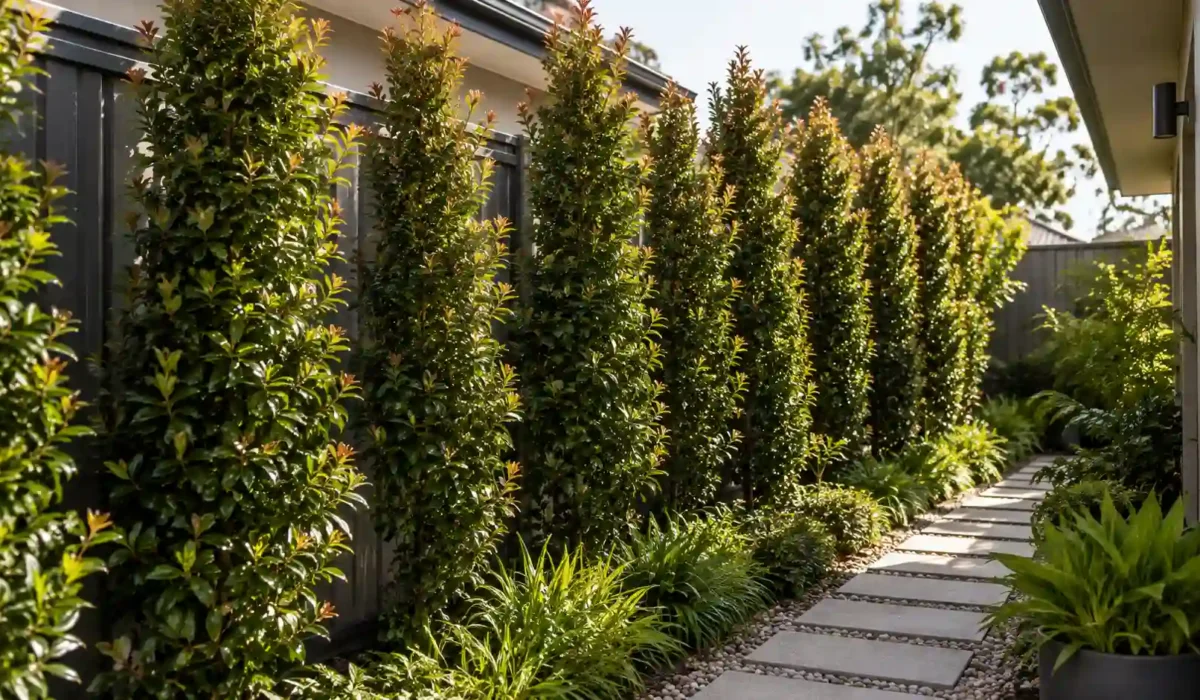
Syzygium Up and Away Growth Rate, Height & Care
According to Elemo Baker, Syzygium australe ‘Up and Away’ is a fast-growing, columnar lilly pilly cultivar that reaches up to 8 metres if left unpruned, valued for its narrow, upright habit suited to tight-space hedging and screening. It features glossy green foliage with bronze-red new growth, summer white flowers, and edible purple berries, and shows strong psyllid resistance.
Growth is rapid, typically 60–90 cm per year, though its height is easily controlled through pruning without losing its slender profile. Once established, the cultivar tolerates both drought and light frost and adapts to a wide range of well-drained soils in full sun or part shade. As a plant breeder’s rights (PBR) protected variety, propagation is restricted to licensed growers.
By Elemo Baker | Plant Care & Gardening Expert
Last Updated: August 2026
Quick Summary
- Syzygium ‘Up and Away’ is a fast-growing columnar lilly pilly that typically produces 60–90cm of new growth annually under ideal conditions.
- Mature plants usually reach 5–8 metres tall while remaining only 1–2 metres wide, making them ideal for narrow spaces.
- It offers improved resistance to lilly pilly psyllids, although no cultivar is completely immune.
- The upright growth habit makes it one of the best choices for privacy hedges, boundary planting and screening where garden width is limited.
What Is Syzygium ‘Up and Away’?
Syzygium ‘Up and Away’ is a cultivated selection of Syzygium australe, an evergreen Australian rainforest species belonging to the Myrtaceae family. Sometimes referred to as a brush cherry cultivar, it has been bred to develop a naturally upright, columnar form that requires less trimming than broader-growing lilly pilly varieties. Since Syzygium ‘Up and Away’ is a selected form of Syzygium australe, understanding the broader Lilly Pilly Australe care requirements can help gardeners provide the correct growing conditions.
Unlike traditional lilly pillys that spread widely as they mature, ‘Up and Away’ maintains a relatively slim profile. This makes it particularly valuable for suburban gardens where fences, driveways or neighbouring buildings leave little room for wide shrubs.
New growth emerges in attractive bronze to reddish tones before maturing into glossy deep green foliage. During summer, mature plants produce clusters of small white flowers that attract pollinating insects. These flowers are followed by pink to purple edible berries, although heavily clipped hedges generally produce fewer flowers and fruit.
As a Plant Breeder’s Rights (PBR) protected cultivar, commercial propagation is controlled to preserve its unique characteristics.
Is Syzygium a Tree or Shrub?
Syzygium can be either an evergreen shrub or a small tree depending on how it is grown and maintained. When regularly pruned, Syzygium ‘Up and Away’ forms a dense screening hedge with foliage extending close to the ground.
If left unpruned, it gradually develops into a narrow small tree with a distinct trunk and upright canopy. Although it has a naturally compact shape, it should not be considered a true dwarf variety because it can eventually reach several metres in height.
Is Syzygium Native to Australia?
The cultivar itself was developed through plant breeding, but the parent species, Syzygium australe, is native to eastern Australia. It naturally occurs in subtropical and warm temperate rainforests from New South Wales into Queensland.
This distinction is important. While ‘Up and Away’ is a cultivated selection, it retains the hardiness, evergreen foliage and climate adaptability of its Australian native parent. That native heritage contributes to its excellent performance across many Australian gardens.
How Tall Does Syzygium ‘Up and Away’ Grow?
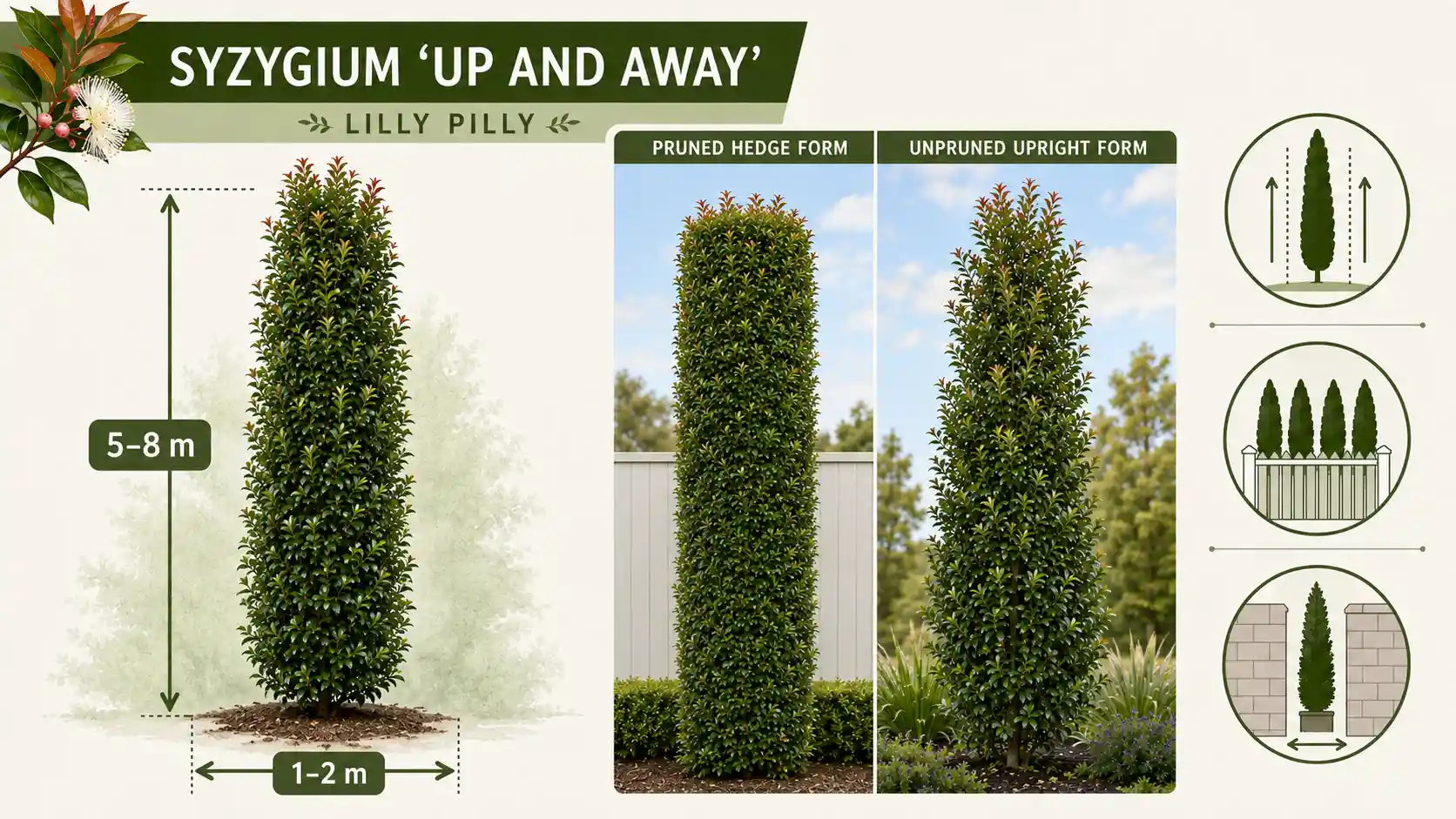
Syzygium ‘Up and Away’ generally grows between 5 and 8 metres tall if left unpruned. Most home gardeners, however, maintain it at 2–4 metres through occasional trimming to create an attractive privacy hedge.
Its naturally upright habit allows significant height without excessive width, making it ideal where space is limited.
| Growth Habit | Typical Size |
| Regularly clipped hedge | 2–4m tall × 1–2m wide |
| Lightly pruned screen | 4–6m tall × 1–2m wide |
| Unpruned specimen | 5–8m tall × 1.5–2m wide |
Actual mature size depends on several factors, including:
- Soil fertility
- Available moisture
- Sunlight exposure
- Climate
- Pruning frequency
In fertile soil with consistent watering, mature plants often achieve their maximum height more quickly than those growing in dry or nutrient-poor locations.
Indoor vs Outdoor Size
Syzygium ‘Up and Away’ is an outdoor landscape plant rather than an indoor plant.
Its eventual height, vigorous root system and requirement for natural sunlight make it unsuitable as a long-term indoor specimen. Although young nursery plants can temporarily grow in large containers on patios or balconies, they eventually require outdoor planting to achieve healthy growth.
For gardeners searching whether Syzygium is indoor or outdoor, the answer is clear: this cultivar performs best outdoors in gardens, screening hedges and landscape plantings.
How Fast Does Syzygium ‘Up and Away’ Grow? (Growth Rate)
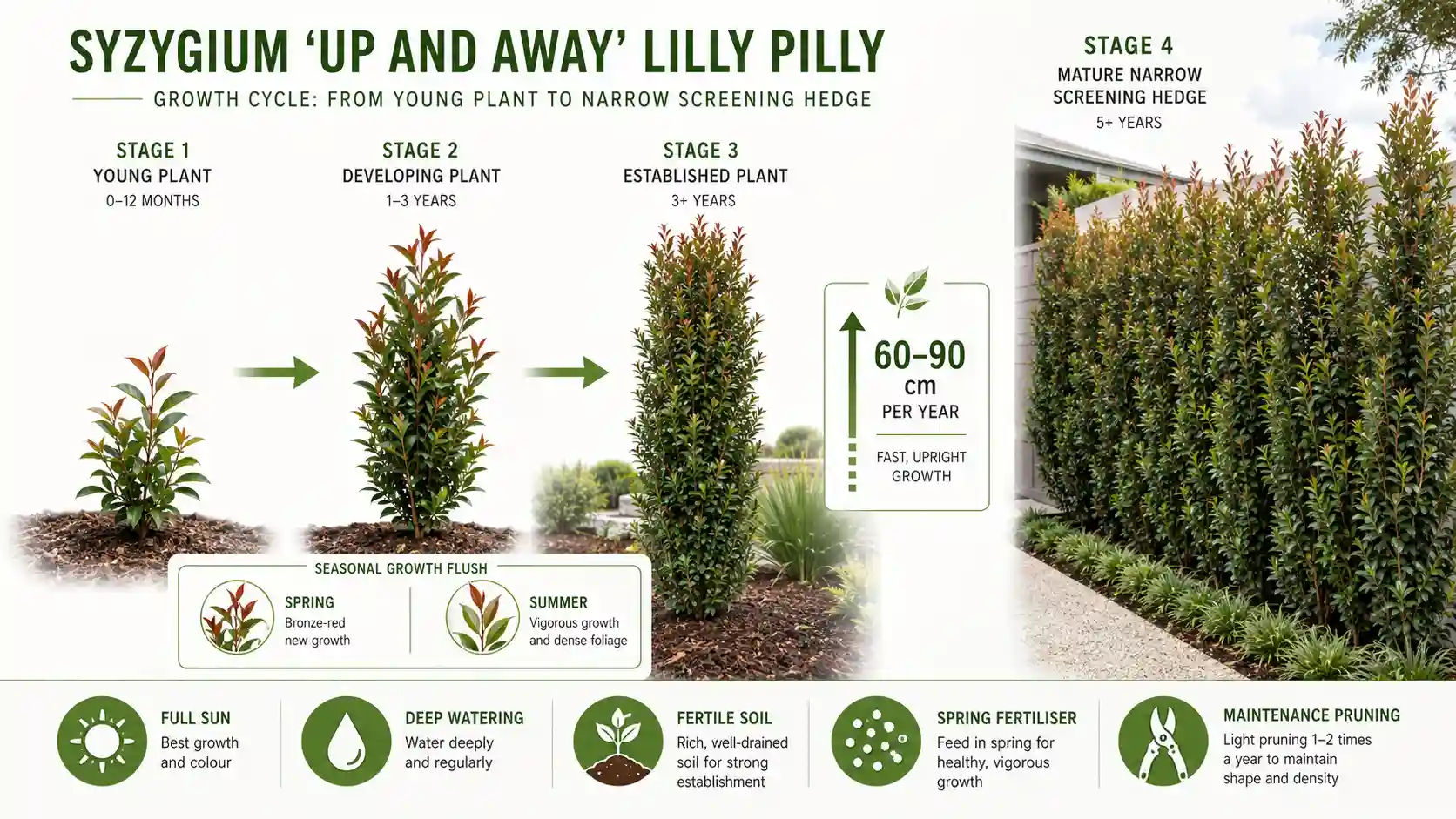
Syzygium ‘Up and Away’ is considered a fast-growing screening plant, producing approximately 60–90cm of new growth each year under favourable conditions. Growth is most vigorous during spring and summer when temperatures are warm and soil moisture is consistent.
Young plants establish quickly during their first two years, after which growth becomes more vigorous as the root system expands. Once established, regular seasonal flushes of fresh foliage create dense, attractive screening.
Compared with Syzygium ‘Straight and Narrow’, growth rates are broadly similar under equivalent conditions. Minor differences are usually influenced more by site conditions than by genetics alone.
Several environmental factors influence growth speed:
- Rich, well-drained soil supports stronger annual growth.
- Consistent watering during establishment encourages faster root development.
- Full sun promotes denser foliage and more vigorous extension growth.
- Regular spring fertilising supplies nutrients needed for rapid leafy growth.
- Good air circulation helps reduce stress and maintain healthy foliage.
Practical tips to maximise growth
- Water deeply rather than lightly and frequently.
- Apply a balanced slow-release fertiliser each spring.
- Maintain organic mulch around the base while keeping it clear of the trunk.
- Avoid prolonged drought during the first two growing seasons.
- Lightly tip-prune young plants to encourage branching and denser screening.
In our experience growing lilly pilly hedges, the strongest annual growth usually occurs once plants are well established and receive consistent moisture throughout spring. Plants exposed to repeated dry periods often grow much more slowly despite having good soil.
Comparison Table — Syzygium ‘Up and Away’ vs Other Lilly Pilly Varieties
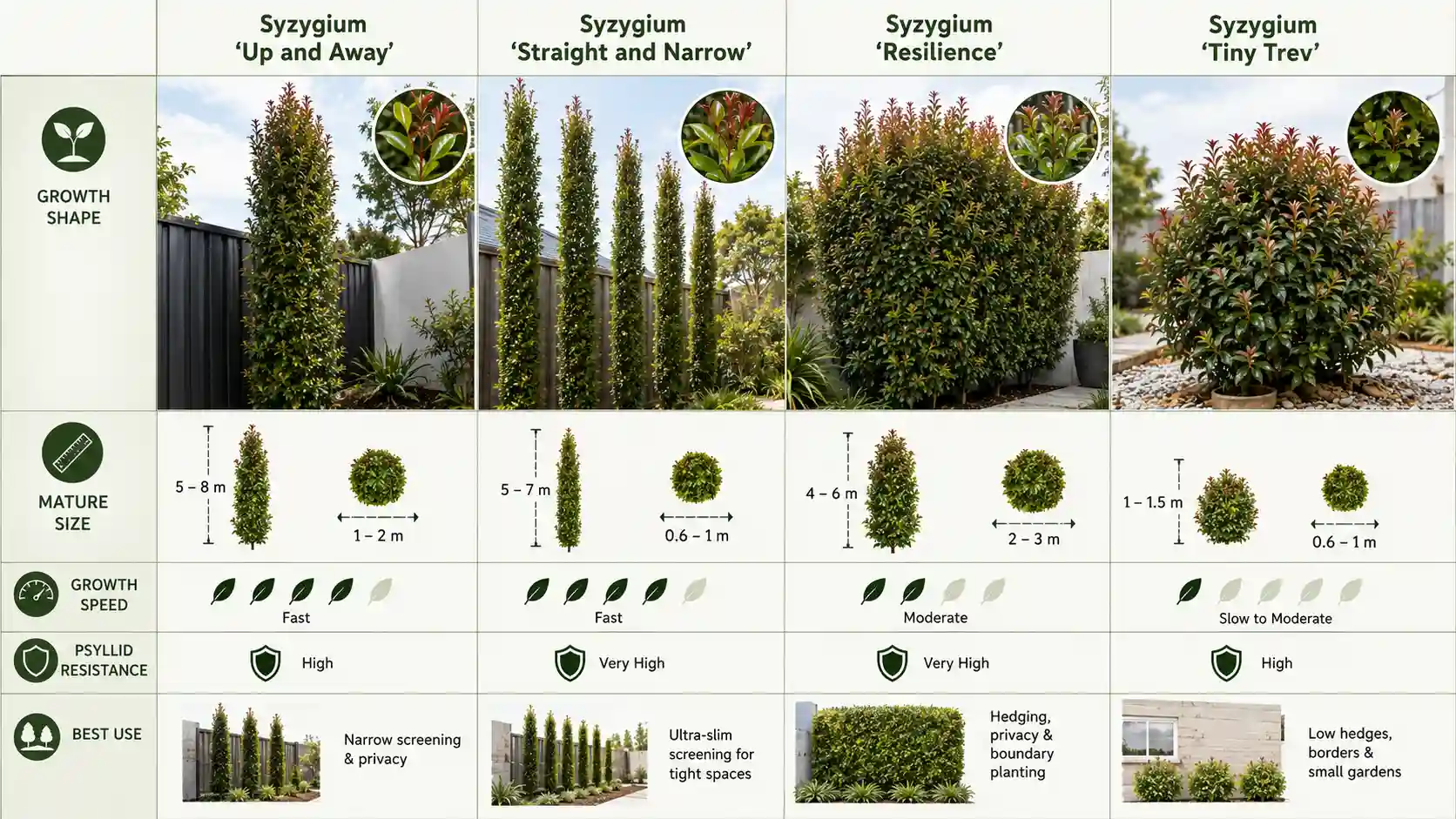
| Variety | Mature Height × Width | Growth Rate | Psyllid Resistance | Best Use |
| Up and Away | 5–8m × 1–2m | Fast | Improved | Narrow privacy hedges and screening |
| Straight and Narrow | 6–8m × 1–1.5m | Fast | Good | Very narrow boundary planting |
| Resilience | 4–8m × 2–4m | Fast | Excellent | Larger hedges and broad screening |
| Tiny Trev | 1–2m × 1–1.5m | Moderate | Good | Low hedges, borders and compact gardens |
Each cultivar serves a different landscaping purpose.
- Up and Away offers an excellent balance of height and narrow width.
- Straight and Narrow is slightly slimmer, making it suitable for extremely restricted spaces.
- Resilience develops a much broader hedge, making it better suited to larger gardens.
- Tiny Trev remains compact and works well where a low hedge is preferred.
Choosing the right variety depends more on the available planting space than on growth rate alone. Gardeners with extremely limited planting space may also want to compare Lilly Pilly Straight and Narrow, another narrow Syzygium option designed for compact privacy screens.
Is Syzygium ‘Up and Away’ Good for Screening and Hedging?
Yes. Syzygium ‘Up and Away’ is one of the best lilly pilly cultivars for screening and hedging where garden width is limited. Its naturally upright growth habit creates dense evergreen privacy without occupying excessive space. For gardeners comparing different privacy options, other fast growing trees for screening in Australia can also provide effective solutions depending on available space, mature height requirements and climate conditions.
Unlike wider-growing hedging shrubs, it maintains a relatively slim profile while still providing excellent visual screening. For narrow boundaries where maintenance is a priority, exploring other low-maintenance plants for fence lines in Australia can help create a balanced privacy planting design.
This makes it particularly suitable for:
- Boundary fences
- Side access paths
- Narrow suburban gardens
- Pool privacy planting
- Driveway screening
- Modern landscape designs
Because the foliage responds well to pruning, gardeners can maintain either a formal clipped hedge or a softer, more natural screen depending on their preferred landscape style.
Elemo Baker recommends allowing young plants to establish before carrying out heavy shaping. Light tip-pruning during the first few years usually produces a denser hedge than waiting until plants become tall and sparse.
How Far Apart Should You Plant Syzygium for a Hedge?
For a dense hedge, plant Syzygium ‘Up and Away’ approximately 60cm to 1 metre apart, depending on how quickly you want the hedge to fill in.
General spacing guidelines include:
- 60cm apart – fastest hedge formation and maximum privacy.
- 75cm apart – balanced growth with good air circulation.
- 1 metre apart – suitable when immediate screening is less important or where long-term maintenance access is preferred.
Closer spacing creates a fuller hedge sooner but may require slightly more pruning as plants mature. Conversely, wider spacing reduces competition between plants but takes longer to form a continuous screen.
How to Care for Syzygium ‘Up and Away’
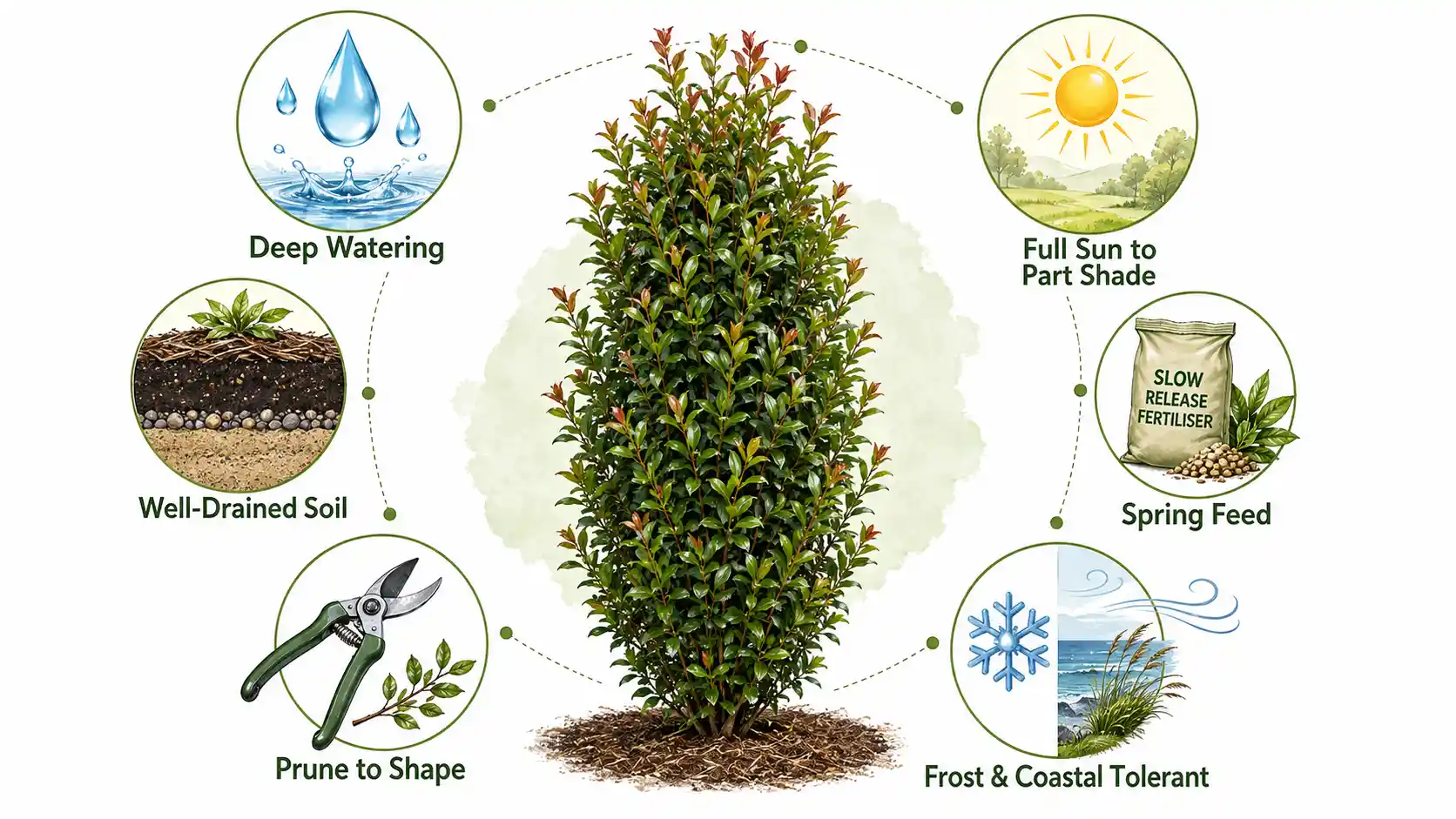
Syzygium ‘Up and Away’ is a relatively low-maintenance native screening plant when grown in suitable conditions. Like most lilly pillys, it performs best with adequate moisture, good soil preparation and regular light maintenance during establishment. Once established, it tolerates a range of Australian conditions, including coastal exposure and moderate drought.
A consistent care routine helps maintain dense foliage, healthy growth and better resistance against common problems such as psyllid damage and nutrient deficiencies.
Watering Needs
Newly planted Syzygium ‘Up and Away’ requires regular deep watering while its root system develops. During the first 12 months, deep watering approximately twice per week is recommended during dry periods.
Once established, watering can usually be reduced to around once weekly, depending on rainfall, soil type and climate.
Best watering practices include:
- Water deeply to encourage roots to grow downwards.
- Avoid frequent shallow watering, which encourages surface roots.
- Increase watering during hot, dry summers.
- Reduce watering during periods of heavy rainfall.
Do lilly pillys need a lot of water? Young plants do require consistent moisture, but established plants are much more resilient and can tolerate short dry periods.
Light Requirements
Syzygium ‘Up and Away’ grows best in full sun to part shade.
Full sun generally produces:
- Denser foliage growth
- Stronger upright structure
- Better bronze-red new growth colour
- More compact hedge formation
Plants grown in partial shade can still perform well but may become slightly less dense and grow more slowly.
For screening purposes, planting in a position receiving at least several hours of direct sunlight each day usually gives the best results.
Soil Preferences
This cultivar adapts well to most Australian garden soils provided they are well-drained.
Ideal soil conditions include:
- Fertile loam soil
- Good drainage
- Organic matter enrichment
- Slightly acidic to neutral soil conditions
Heavy clay soils may require improvement with compost and organic matter to improve drainage. Poor drainage can lead to root stress, yellowing leaves and reduced growth.
Fertilising
A balanced slow-release fertiliser applied in spring supports healthy foliage production and steady growth.
Suitable options include:
- Native plant fertilisers
- Balanced slow-release fertilisers
- Organic compost additions
Do lilly pillys like cow manure? They can benefit from well-aged organic manure because it improves soil structure and adds nutrients. However, fresh manure should be avoided because it can damage roots and create nutrient imbalances.
Pruning
Syzygium ‘Up and Away’ responds well to pruning and generally requires only light maintenance.
Recommended pruning approach:
- Tip-prune young plants to encourage branching.
- Trim annually to maintain hedge shape.
- Remove damaged or overcrowded branches when required.
Avoid excessive pruning into old woody sections unless necessary, as maintaining leafy growth improves the plant’s appearance and screening ability.
Climate Tolerance
Syzygium ‘Up and Away’ suits a wide range of Australian climates.
It is generally:
- Frost tolerant once established
- Suitable for coastal gardens
- Adaptable to humid and subtropical regions
- Moderately drought tolerant after establishment
Extreme drought, prolonged frost or poor soil conditions can still reduce performance, so selecting the correct planting position remains important.
As of 2026, Australian gardeners continue to favour improved lilly pilly cultivars because breeding programs have focused on stronger foliage quality and better tolerance against common landscape challenges.
How to Grow Syzygium from Seed or Cutting
Syzygium ‘Up and Away’ is normally propagated by cuttings rather than seed because it is a selected cultivar with specific characteristics.
Growing from seed may not produce a plant identical to the parent because seedlings can vary genetically. Commercial growers typically use vegetative propagation methods to maintain the cultivar’s narrow growth habit, foliage quality and performance.
General propagation methods for Syzygium include:
- Semi-hardwood cuttings taken from healthy growth.
- Rooting cuttings in a controlled propagation environment.
- Transplanting established young plants once roots develop.
Because ‘Up and Away’ is a PBR-protected cultivar, commercial propagation is restricted. Home gardeners generally purchase established nursery plants rather than attempting large-scale propagation.
Does Syzygium ‘Up and Away’ Drop Leaves or Get Messy?
Syzygium ‘Up and Away’ is an evergreen plant and does not normally lose its leaves seasonally like deciduous trees.
However, minor natural leaf drop is normal throughout the year as older leaves age and are replaced by new growth.
Potential sources of garden litter include:
- Small amounts of fallen leaves
- Spent flowers after flowering
- Dropped berries from mature plants
Compared with many deciduous screening trees, lilly pillys are considered relatively tidy evergreen options.
Heavy pruning can reduce flowering and fruiting, which may also reduce berry drop. For gardeners wanting a low-maintenance privacy screen, this makes ‘Up and Away’ a practical choice.
Common Problems With Syzygium ‘Up and Away’
Although Syzygium ‘Up and Away’ is a hardy cultivar, it can still experience problems caused by environmental stress, pests or incorrect planting conditions.
Psyllid Damage
Lilly pilly psyllids are one of the most recognised issues affecting Syzygium plants.
Symptoms include:
- Distorted new leaves
- Puckered foliage
- Reduced appearance of fresh growth
‘Up and Away’ has improved resistance compared with many older lilly pilly varieties, but resistance does not mean complete immunity. Pest pressure can vary depending on climate, location and seasonal conditions.
Management options include:
- Monitoring new growth regularly.
- Encouraging beneficial insects.
- Removing heavily damaged growth.
- Using horticultural oils or products such as neem oil where appropriate.
Healthy plants grown in suitable conditions generally recover better from pest pressure.
Yellowing Leaves
Yellow leaves can indicate several issues, including:
- Poor drainage
- Overwatering
- Nutrient deficiencies
- Root stress
Before adding fertiliser, check soil moisture and drainage. Overcorrecting nutrient problems without identifying the cause can sometimes worsen plant stress.
Slow or Stunted Growth
Slow growth is often caused by:
- Insufficient watering during establishment
- Root competition from nearby plants
- Poor sunlight exposure
- Compacted soil
- Lack of nutrients
In our experience with screening plants, the first two years after planting are the most important. Plants that receive consistent moisture during establishment usually develop stronger root systems and faster long-term growth.
Are Syzygium Roots Invasive?
Syzygium roots are generally not considered aggressively invasive, but like any vigorous plant, they can spread where conditions allow.
Most lilly pilly root systems are:
- Fibrous and spreading
- Designed to capture surface moisture
- Usually manageable with appropriate planting distances
Avoid planting large specimens directly against buildings, drainage systems or paved areas without considering mature size.
Correct placement, root barriers where needed and regular maintenance help minimise potential problems.
Can You Eat Syzygium Fruit?
Yes, the berries produced by many Syzygium australe plants are edible when correctly identified and grown in suitable conditions.
The fruit is generally described as:
- Small and rounded
- Pink to purple in colour
- Mildly sweet to slightly tart
The berries can be eaten fresh or used in jams and preserves. However, fruit production varies depending on pruning, climate and plant maturity.
For heavily maintained hedges, flowering and fruiting are often reduced because regular trimming removes developing flowers.
As with any edible plant, consume only correctly identified fruit and follow normal food safety practices.
What Climate Suits a Lilly Pilly Hedge Best?
Lilly pillys perform best in Australian climates with warm growing seasons, adequate rainfall and protection from extreme conditions.
Syzygium ‘Up and Away’ suits:
- Temperate climates
- Subtropical regions
- Coastal gardens
- Mild inland areas
It handles coastal winds better than many ornamental shrubs and tolerates moderate frost once established.
The best performance usually occurs where plants receive:
- Regular moisture
- Good sunlight
- Protection from extreme environmental stress
Choosing plants that match Australian climate conditions is essential for long-term success, and our guide to the best trees and shrubs for Australian gardens covers a wider range of reliable landscape options.
What Is the Lifespan of a Syzygium?
A healthy Syzygium can be a long-lived garden plant, often surviving for several decades with proper care.
Factors that influence lifespan include:
- Soil quality
- Water availability
- Pest management
- Pruning practices
- Climate suitability
Well-maintained lilly pillys can remain productive screening plants for many years, making them a reliable long-term landscaping investment.
Beginner Mistakes to Avoid With Syzygium ‘Up and Away’
Even hardy plants can struggle when basic planting mistakes occur.
Common mistakes include:
- Under-watering after planting: New plants need consistent moisture while roots establish.
- Planting too closely: Excessive competition can reduce airflow and increase maintenance.
- Ignoring psyllid monitoring: Early detection prevents severe foliage damage.
- Choosing the wrong cultivar: ‘Up and Away’ is excellent for narrow spaces, but wider areas may benefit from broader lilly pilly varieties such as ‘Resilience’.
Selecting the right plant for the available space is often more important than choosing the fastest-growing option.
Conclusion
Syzygium ‘Up and Away’ is a fast-growing, narrow lilly pilly cultivar ideal for Australian privacy screening and hedging. Its upright growth habit allows gardeners to achieve significant height without requiring excessive garden width.
With a mature height of around 5–8 metres, a narrow spread of approximately 1–2 metres, and a growth rate of 60–90cm per year under good conditions, it provides an effective solution for tight spaces.
Its evergreen foliage, Australian native background, improved psyllid resistance and simple care requirements make it a reliable choice for modern gardens. For homeowners needing a low-maintenance screening plant, Syzygium ‘Up and Away’ offers a strong balance of appearance, performance and space efficiency.
Frequently Asked Questions
How fast does Syzygium ‘Up and Away’ grow?
Syzygium ‘Up and Away’ grows approximately 60–90cm per year under good conditions. Growth speed depends on sunlight, soil quality, watering and fertilising practices.
How tall does Syzygium ‘Up and Away’ get if left unpruned?
If left unpruned, Syzygium ‘Up and Away’ can typically reach around 5–8 metres tall with a narrow spread of approximately 1–2 metres.
Is Syzygium ‘Up and Away’ psyllid resistant?
Syzygium ‘Up and Away’ has improved resistance to lilly pilly psyllids compared with older varieties, but it is not completely immune. Monitoring and good plant health remain important.
How far apart should I plant Syzygium ‘Up and Away’ for a hedge?
For a dense privacy hedge, plant Syzygium ‘Up and Away’ approximately 60cm to 1 metre apart. Closer spacing creates faster screening, while wider spacing allows more airflow and root space.
Can you eat Syzygium ‘Up and Away’ fruit?
Yes, the berries produced by Syzygium australe cultivars are generally edible when correctly identified. Fruit production is usually lower in regularly pruned hedges.
Is Syzygium ‘Up and Away’ the same as Syzygium australe?
No. Syzygium ‘Up and Away’ is a cultivar of Syzygium australe. The species is the original Australian native plant, while ‘Up and Away’ is a selected form bred for its narrow growth habit.
1 Comment