

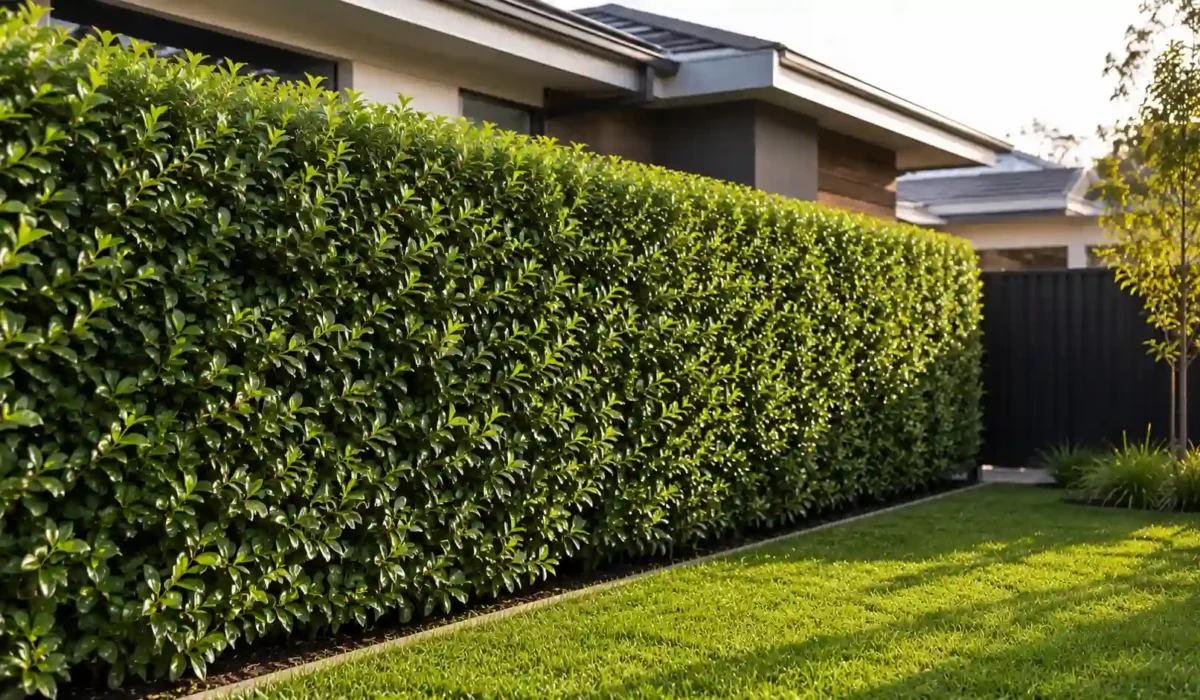
Ficus Hillii ‘Flash’ Care, Growth & Hedge Guide
Introduction
Ficus hillii ‘Flash’ is a popular Australian hedging plant valued for its dense, glossy foliage, rapid growth, and excellent response to pruning. A cultivated form of the Hills fig (Ficus microcarpa var. hillii), this variety was selected for its compact growth habit, making it especially suitable for privacy screens, formal hedges, and topiary. Compared with standard Ficus hillii, Ficus hillii ‘Flash’ develops a fuller canopy with tighter foliage, allowing gardeners to create attractive green boundaries with relatively low maintenance. Whether you’re planning a backyard screen or a feature hedge, understanding its growth, care requirements, and root behaviour helps ensure long-term success. If you’re comparing screening options, our Fast Growing Evergreen Trees Australia Guide explores other popular evergreen trees suitable for Australian gardens.
Quick Summary
- Ficus hillii ‘Flash’ is a compact, fast-growing hedging cultivar of the Hills fig with dense, glossy emerald foliage.
- It typically grows 3–6 metres tall if left untrimmed but can be maintained as a formal hedge between 1–2 metres.
- It is widely available through Australian nurseries and commonly compared with lilly pilly varieties for privacy screening.
- Under favourable conditions, it can grow more than 60 cm annually, making it an excellent choice for fast privacy hedges.
What Is Ficus Hillii ‘Flash’?
Ficus hillii ‘Flash’ is a cultivated selection of Ficus microcarpa var. hillii, commonly known as the Hills fig. It was developed to provide denser foliage and a more compact growth habit than the standard species, making it particularly suitable for ornamental hedging and screening. Ficus hillii ‘Flash’ belongs to the Ficus genus, a diverse group of fig trees widely grown throughout tropical and subtropical regions. For more botanical information, see the Wikipedia article on Ficus.
Botanically, the plant belongs to the Moraceae family, which includes many fig species grown throughout tropical and subtropical regions. Although many gardeners still refer to it simply as Ficus hillii, modern botanical classification generally places Hills fig within Ficus microcarpa var. hillii. As a result, the names Ficus hillii, Ficus microcarpa hillii, Hills fig, and Ficus hillii ‘Flash’ are often used interchangeably, even though ‘Flash’ specifically refers to the selected cultivar.
Its naturally dense foliage, glossy green leaves, and strong branching make it ideal for formal landscapes where year-round privacy is desired.
How Ficus Hillii Flash Differs From Standard Ficus Hillii
The primary difference lies in its growth habit.
Standard Ficus hillii tends to produce a slightly more open canopy with wider branch spacing, while Ficus hillii ‘Flash’ develops tighter leaf spacing and a naturally fuller appearance.
Key differences include:
- Denser foliage for improved screening
- More compact branching
- Better suited to formal hedging
- Easier to maintain crisp hedge lines
- Strong response to regular pruning
For homeowners seeking a neat, formal hedge, Ficus hillii ‘Flash’ generally requires less effort to achieve a dense finish.
Ficus Hillii Flash Size and Growth Habit
Ficus hillii ‘Flash’ is considered a medium to large evergreen tree if left unpruned, but it is highly adaptable and responds exceptionally well to clipping.
Typical mature sizes include:
- Formal hedge: 1–2 metres tall
- Privacy screen: 3–5 metres
- Unpruned specimen: 3–6 metres or more
- Indoor container: Usually 1–2 metres depending on pot size
When grown outdoors in the ground, warm temperatures, fertile soil, and regular moisture encourage vigorous growth. Plants grown in containers remain considerably smaller due to root restriction.
Environmental factors affecting size include:
- Sunlight availability
- Soil fertility
- Water supply
- Climate
- Root space
- Pruning frequency
In our experience growing Ficus hillii ‘Flash’, regular light trimming from an early stage encourages denser branching than allowing plants to become overgrown before cutting them back.
How Fast Does Ficus Hillii Flash Grow?
Ficus hillii ‘Flash’ is a fast-growing hedge plant capable of producing more than 60 cm of new growth annually under ideal conditions.
Most growth occurs during spring and summer when temperatures are warm and soil moisture is consistent. Growth naturally slows during winter in cooler parts of Australia.
Growth speed depends on:
- Full sun or partial shade
- Well-drained fertile soil
- Regular watering
- Seasonal fertilising
- Mild frost-free conditions
Because of its rapid establishment, many gardeners use it when quick privacy screening is required. A properly maintained hedge often becomes dense within only a few growing seasons.
Ficus Hillii Flash Hedge: Spacing, Planting and Pleaching

Correct spacing determines how quickly a hedge fills in.
General planting recommendations include:
- 80–100 cm spacing for dense formal hedges
- 1–1.5 metres for larger screening hedges
- Allow wider spacing where trees will mature naturally
Many Australian nurseries and retailers offer Ficus hillii ‘Flash’ in both standard tree form and hedge-ready forms. Standard plants are suitable for shaping into individual specimens, while hedge forms have already been trained for screening. For another popular Australian screening plant, see our Pittosporum Silver Sheen Growth Rate Guide to compare growth speed and hedge performance.
Pleached Ficus hillii ‘Flash’ has become increasingly popular for modern landscapes. Pleaching involves training the upper branches along a frame to create elevated living screens while leaving clear trunks beneath. Another excellent evergreen hedge worth considering is Photinia Fraseri Robusta, which offers colourful new growth and responds well to regular clipping.
How to Prune Ficus Hillii Flash
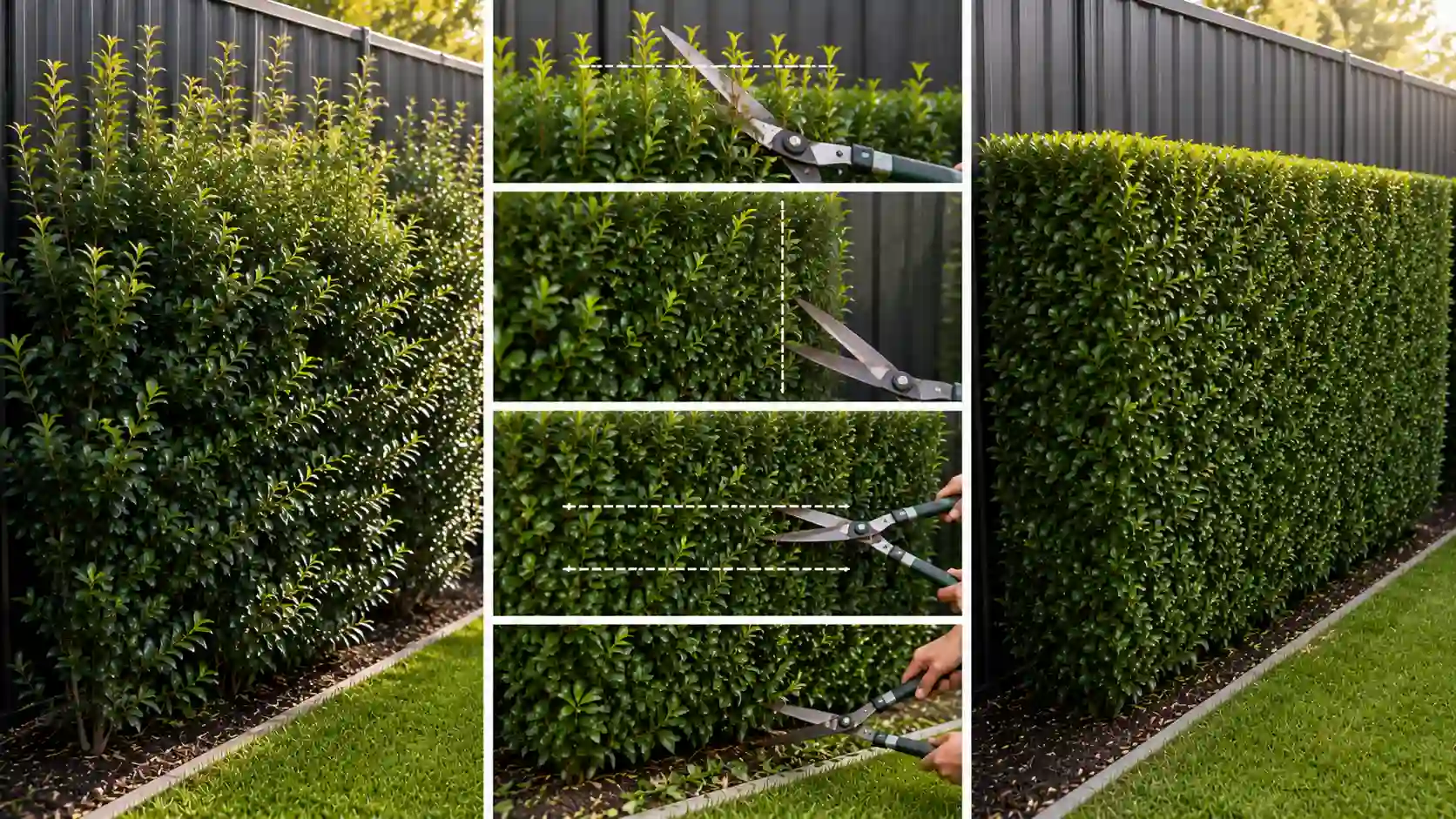
Regular pruning keeps Ficus hillii ‘Flash’ compact and attractive.
Best practices include:
- Trim two to four times during the active growing season.
- Light pruning encourages dense branching.
- Remove damaged or crossing branches.
- Shape the hedge slightly wider at the base than the top.
- Use clean, sharp hedge trimmers or secateurs.
Elemo Baker recommends avoiding heavy pruning during cold weather because recovery is much faster during active spring and summer growth.
Caring for Ficus Hillii Flash

Ficus hillii ‘Flash’ is relatively easy to maintain once established.
| Care Factor | Recommendation |
| Watering | Water regularly during establishment; mature plants tolerate short dry periods. |
| Light | Full sun to partial shade. |
| Soil | Well-drained soil with moderate fertility. |
| Fertiliser | Apply a balanced slow-release fertiliser during spring and again in summer if needed. |
| Pruning | Maintain shape through regular trimming. |
| Climate | Suitable across much of Australia, including many coastal and inland regions with protection from severe frost. |
Young plants require consistent watering while establishing. Mature specimens become considerably more drought tolerant but still benefit from deep watering during prolonged dry weather. If you’re looking for another low-maintenance Australian landscaping tree, our Tuckeroo Tree Growth Rate: Size, Height & Care Guide provides useful comparisons.
As of the 2026 growing season, Australian growers continue recommending regular feeding during spring to maintain vigorous hedge density, especially where frequent clipping removes substantial new growth.
Ficus Hillii Flash Root System: What to Know Before Planting

Like other ficus species, Ficus hillii ‘Flash’ develops a vigorous root system that seeks moisture and available growing space. Understanding tree roots before planting is important. Our Gum Tree Root System: Root Spread, Problems & Safe Distances explains how root systems differ between common Australian trees.
Although roots are not inherently destructive, problems may occur if trees are planted too close to buildings, swimming pools, retaining walls, or underground plumbing. You may also find our Poinciana Tree Root System: Growth, Problems & Care Guide useful when comparing root behaviour among large landscape trees.
Growing plants in large containers can help restrict root spread while still providing an attractive screening option.
Recommended Minimum Planting Distances
| Structure | Recommended Minimum Distance |
| House foundations | 4–6 metres |
| Swimming pools | 4–6 metres |
| Underground pipes | 3–5 metres |
| Paved paths | 2–3 metres |
| Property boundaries | Allow adequate room for mature hedge width |
Proper planning before planting significantly reduces future maintenance issues.
Common Ficus Hillii Flash Problems
If you’re unsure which insects are affecting your hedge, see our Garden Pest Identification Guide for Australian Gardens for identification and treatment advice.
Yellowing Leaves
Why it happens
Yellow leaves commonly result from overwatering, poor drainage, nutrient deficiencies, or temporary transplant stress.
How to fix
- Improve drainage.
- Reduce watering frequency.
- Apply a balanced fertiliser if nutrient deficiency is suspected.
- Allow recently transplanted plants time to establish.
How to prevent
Maintain consistent watering without waterlogging the soil.
Slow or Patchy Growth
Why it happens
Poor light, heavy root competition, nutrient deficiencies, or compacted soil can reduce growth.
How to fix
Improve sunlight exposure where possible, feed during the growing season, and water deeply during dry periods.
How to prevent
Provide fertile, well-drained soil and sufficient spacing.
Pest Issues
Common pests include:
- Scale insects
- Mealybugs
- Aphids
- Spider mites
Most infestations can be controlled through early monitoring, horticultural oils, or appropriate insecticidal treatments.
Leaf Drop After Planting
Why it happens
Leaf drop often occurs following transplant shock as plants adjust to their new environment.
How to fix
Maintain even soil moisture, avoid overwatering, and minimise additional stress.
How to prevent
Plant during mild weather and avoid disturbing roots unnecessarily.
Ficus Hillii Flash vs Lilly Pilly: Which Hedge Plant Is Better?
Both are excellent Australian hedge plants, but each offers different advantages.
| Feature | Ficus Hillii ‘Flash’ | Lilly Pilly (Backyard Bliss) |
| Growth rate | Very fast | Moderate to fast |
| Mature size | Larger | Medium |
| Root system | More vigorous | Less vigorous |
| Psyllid resistance | Not applicable | Excellent in resistant cultivars |
| Maintenance | Regular trimming | Moderate trimming |
| Best use | Large privacy screens | Smaller residential hedges |
Choose Ficus hillii ‘Flash’ when rapid screening and dense evergreen foliage are the priority. Lilly pilly is often preferred where smaller root systems or colourful new growth are desired.
Growing Ficus Hillii Flash in Pots
Ficus hillii ‘Flash’ performs well in large containers provided its growing conditions are managed carefully.
Choose a pot with excellent drainage and sufficient room for root development. Container-grown plants require more frequent watering than garden specimens because potting mix dries out more quickly.
Indoor plants should receive:
- Bright indirect light
- Consistent watering
- Moderate humidity
- Occasional repotting every few years
Container growing naturally limits plant size, making it suitable for courtyards, patios, balconies, and indoor feature plants. For more inspiration on selecting Australian-friendly plants for different garden settings, visit our Australian Plants Guide: Indoor Houseplants & Garden Design.
Where to Buy Ficus Hillii Flash
Ficus hillii ‘Flash’ is commonly available through specialist plant nurseries and major Australian garden retailers.
When selecting a plant, look for:
- Dense, healthy foliage
- Strong upright branching
- No visible pest damage
- Healthy root development
- Even growth without sparse sections
Garden centres may stock both standard tree forms and hedge-trained plants. Selecting the appropriate form depends on whether you intend to create a formal hedge, pleached screen, or individual specimen.
Conclusion
Ficus hillii ‘Flash’ is one of Australia’s most reliable fast-growing hedge plants thanks to its dense evergreen foliage, excellent pruning response, and adaptability to a wide range of landscapes. Whether used as a formal hedge, privacy screen, pleached feature, or container specimen, it provides year-round greenery with relatively straightforward care. By understanding its mature size, growth rate, spacing requirements, root behaviour, and ongoing maintenance needs, gardeners can establish a healthy, attractive hedge that performs well for many years. Before planting, assess your available space, local climate, and proximity to buildings so the plant can thrive in the most suitable location. Before selecting any hedge or feature tree, it’s also worth comparing other Australian landscaping species in our Tree With Pink Flowers Australia: Identification Guide. Before selecting any hedge or feature tree, explore our guide to Australian flowering trees for more options suitable for colourful Australian landscapes.
FAQs
How tall does Ficus hillii Flash grow?
If left unpruned, Ficus hillii ‘Flash’ typically reaches 3–6 metres tall. When regularly clipped, it can be maintained as a hedge between 1 and 2 metres.
How far apart should you plant Ficus hillii Flash for a hedge?
Most formal hedges are planted approximately 80–100 cm apart to create a dense screen. Wider spacing may be suitable for larger privacy plantings.
Is Ficus hillii Flash the same as regular Ficus hillii?
No. Ficus hillii ‘Flash’ is a selected cultivar of Hills fig that has denser foliage and a more compact growth habit than standard Ficus hillii.
Does Ficus hillii Flash have an invasive root system?
Like many ficus species, it develops a vigorous root system. Planting an appropriate distance from buildings, pools, and underground services helps minimise potential problems.
Is Ficus hillii Flash better than lilly pilly for hedging?
It depends on your goals. Ficus hillii ‘Flash’ generally grows faster and forms very dense screens, while lilly pilly varieties often have less vigorous roots and excellent psyllid-resistant cultivars.
Can Ficus hillii Flash be grown indoors or in pots?
Yes. It grows well in large containers indoors or outdoors. Container growth naturally limits its mature size and makes root management easier.
Why are my Ficus hillii Flash leaves turning yellow?
Yellow leaves are commonly caused by overwatering, poor drainage, nutrient deficiencies, or transplant stress. Checking watering practices and improving drainage usually resolves the issue.
5 Comments