
Flowering Trees Australia: Best Species Guide
Introduction
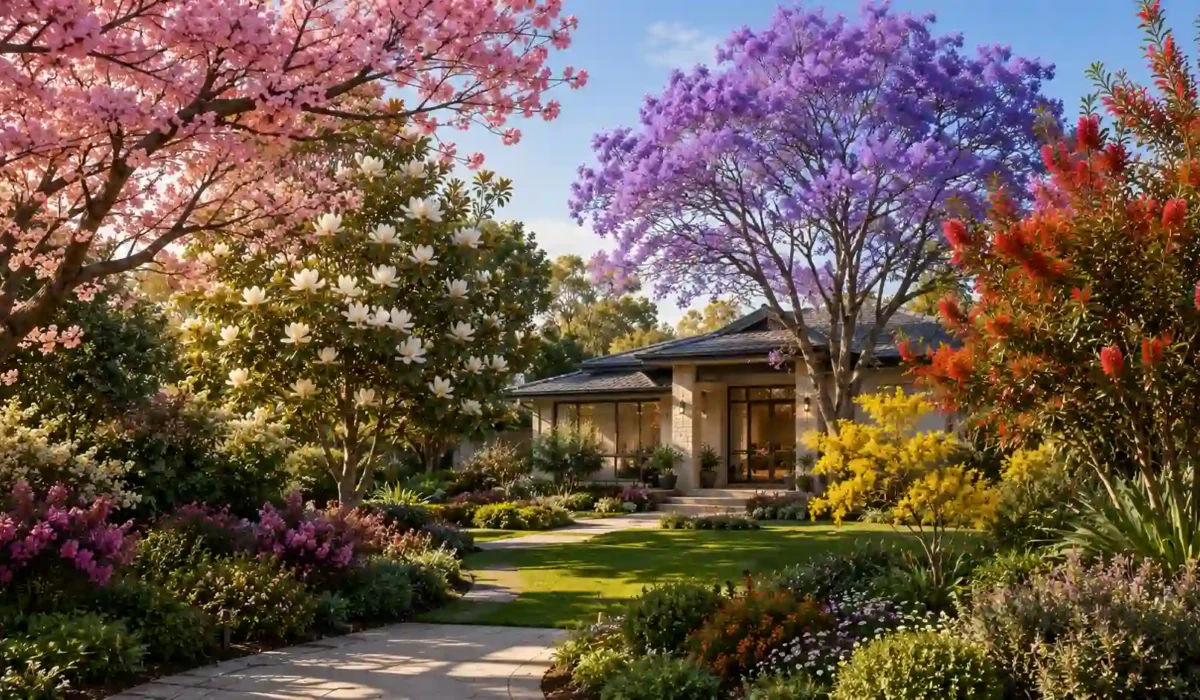
Australia has extraordinary diversity in flowering trees Australia, but choosing the wrong species for your climate, soil type, or garden size is one of the most common — and costly — mistakes home gardeners make. Flowering trees Australia range from iconic native wattles and bottlebrushes to exotic jacarandas, magnolias, and crepe myrtles that define suburban streetscapes.
This guide explains how to choose Australian native flowering trees and ornamental flowering evergreen trees based on colour, size, function, and climate suitability. Whether you’re designing a front yard feature tree, a flowering hedge, or selecting screening plants for narrow spaces, the right choice determines long-term success.
By Elemo Baker | Plant Care & Gardening Expert
Last Updated: June 2026
Quick Summary: Flowering Trees Australia
- Australia supports both native flowering trees (wattles, grevilleas, banksias, bottlebrush) and popular exotics (magnolia, jacaranda, crepe myrtle), with performance strongly tied to climate zone.
- The best flowering trees combine seasonal colour, low maintenance needs, evergreen structure, and strong wildlife value.
- Narrow spaces and fence lines require upright screening species, many of which double as flowering hedge plants Australia.
- Compact cultivars make flowering trees suitable for pots when paired with correct potting mix and watering practices.
What Are Flowering Trees and Why Do Australians Love Them?
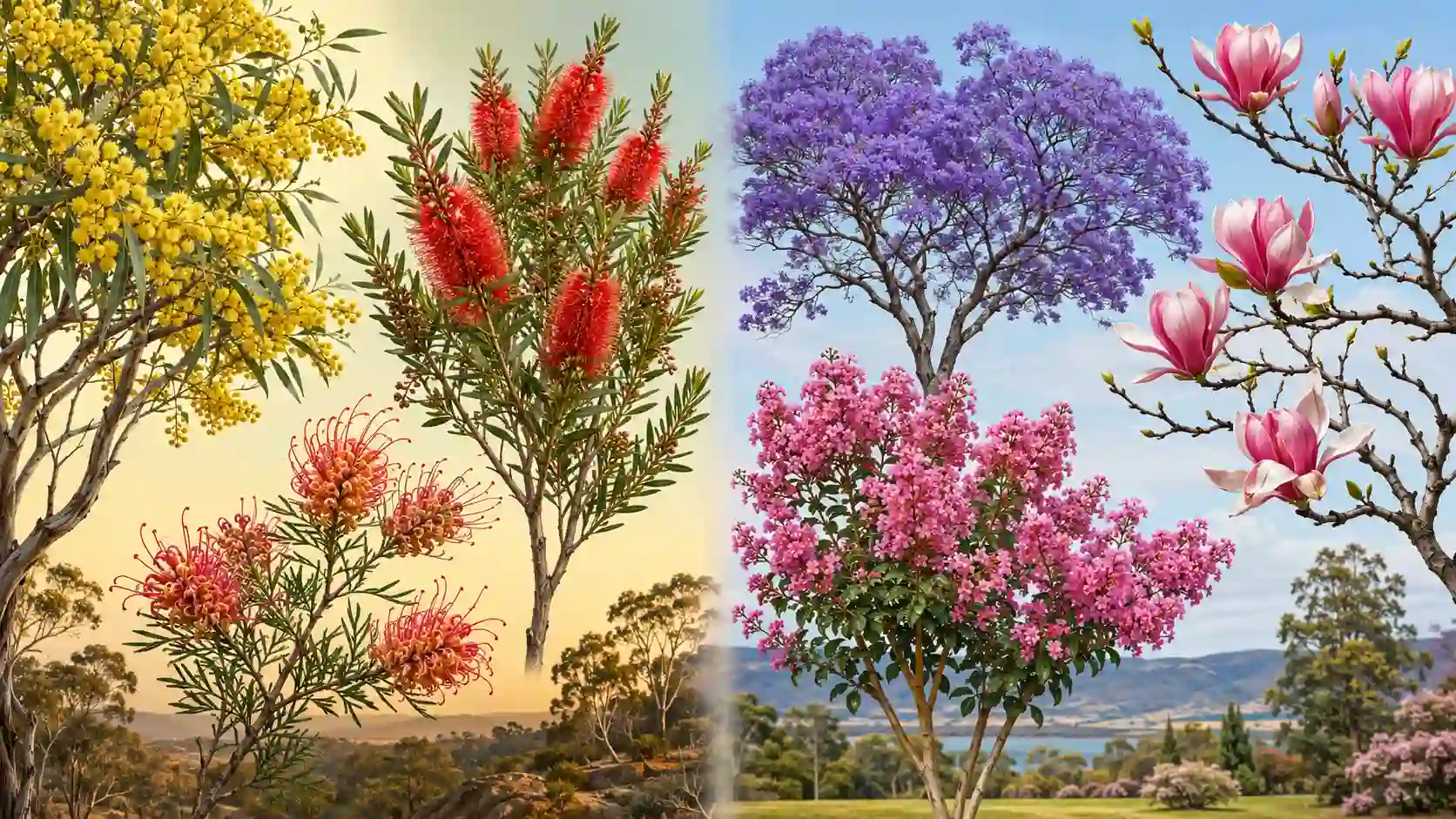
Flowering trees are woody perennial plants that produce visible blooms during part of their growth cycle, ranging from small clustered flowers to large showy blossoms. Unlike shrubs, flowering trees typically develop a single or multi-stem trunk structure and reach greater height, making them ideal for shade, screening, and landscape structure. Australia is one of the world’s richest regions for flowering plant diversity, and this is well documented by institutions such as the Australian National Botanic Gardens plant information resources.
In Australian gardens, flowering trees are valued for biodiversity support, seasonal colour, and climate resilience. Many australian native flowering trees evolved to tolerate drought, poor soils, and fire-prone environments, making them highly practical for low-maintenance landscaping. Australia is also one of the world’s richest regions for flowering plant diversity, with thousands of eucalyptus species and hundreds of banksias and acacias forming the backbone of native landscapes.
Across this article, flowering trees Australia are grouped into two categories: australian native trees and exotic ornamental flowering trees. This structure helps gardeners match aesthetic goals with environmental performance.
Australian Native Flowering Trees — The Best Species by Colour
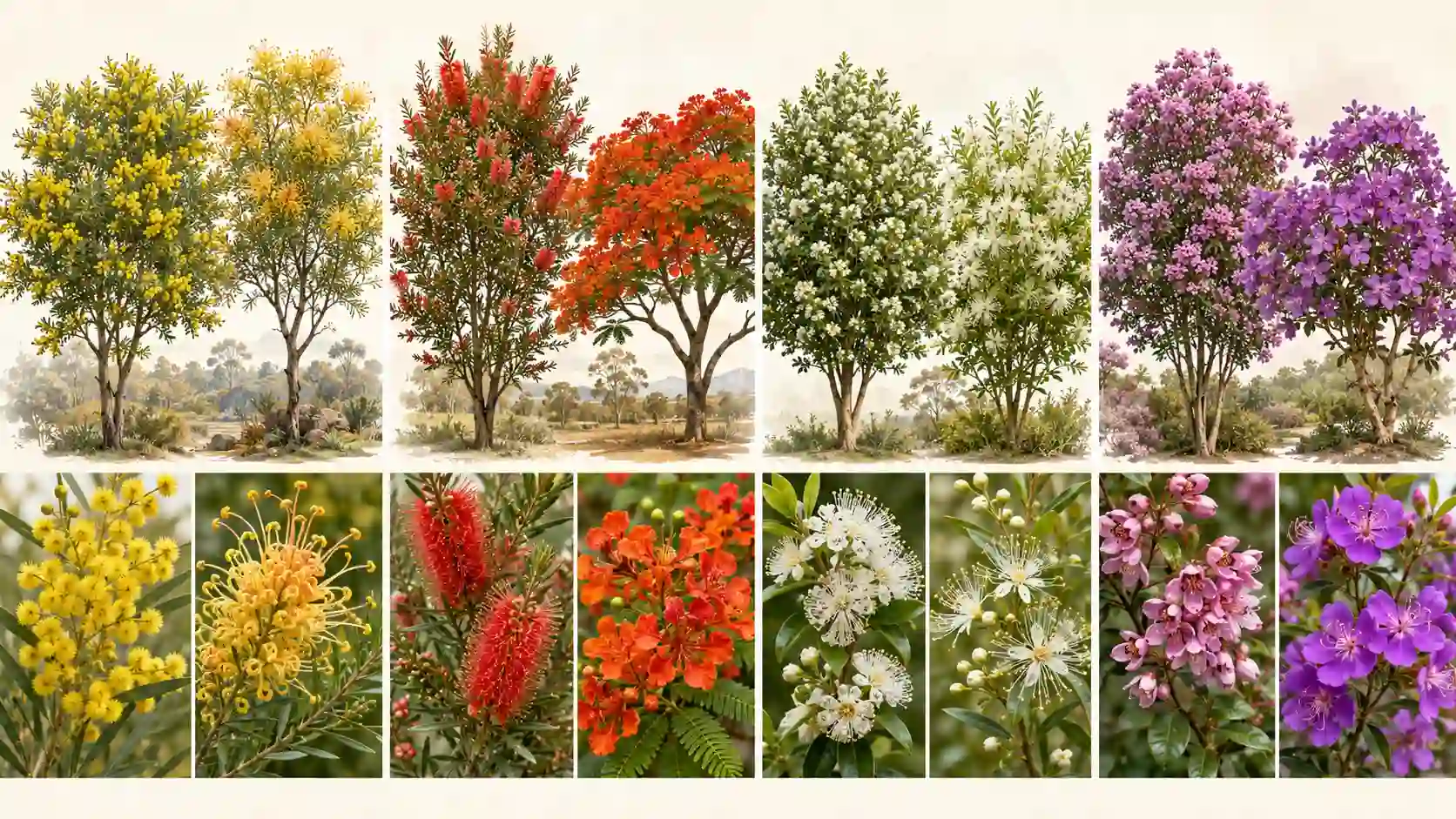
Australian native flowering trees are the most reliable choice for long-term sustainability, drought tolerance, and wildlife support. They also form the foundation of low-maintenance flowering australian trees in modern landscaping.
Australian Native Trees With Yellow Flowers
Yellow flowering natives are among the most iconic in Australia, especially in late winter and early spring.
Wattle (Acacia spp.) produces bright golden puffball flowers and is Australia’s floral emblem, with over 1,000 species adapted to nearly every climate zone. In our experience, wattles establish quickly but perform best when not overwatered once mature.
Grevillea ‘Moonlight’ features creamy-yellow flower clusters that attract nectar-feeding birds year-round in warmer regions.
Native frangipani (Hymenosporum flavum) produces fragrant cream-to-yellow blooms and performs strongly in subtropical climates.
These species represent the core of australian tree with yellow flowers searches and are widely used in native garden design.
Native Trees With Red and Orange Flowers
Red and orange flowering trees are essential for bird attraction and bold landscape impact.
Bottlebrush (Callistemon / Melaleuca) is one of the most versatile flowering evergreen trees Australia offers. Its cylindrical red blooms appear repeatedly from spring to autumn. It is also widely used as a hedge plant.
Illawarra Flame Tree (Brachychiton acerifolius) produces dramatic red bell-shaped flowers in summer but requires space due to its large mature size.
Silky Oak (Grevillea robusta) develops golden-orange flower spikes and grows into a tall structural canopy tree.
Bottlebrushes also vary considerably in form, size, flowering period and growing requirements, so choosing the right type matters. See our bottlebrush tree varieties and care guide for a closer look at types, flowering, climate and maintenance.
Native Trees With White Flowers
White flowering trees Australia provide elegance and contrast in mixed planting designs.
Lemon Myrtle (Backhousia citriodora) produces fragrant white summer flowers and dense evergreen foliage suitable for screening.
Lilly Pilly (Syzygium spp.) produces fluffy white flowers followed by colourful berries and is widely used in hedging.
Ivory Curl Tree (Buckinghamia celsissima) produces cascading cream flower spikes and thrives in warm climates.
Native Trees With Pink and Purple Flowers
Pink-flowering natives are increasingly popular in ornamental gardens. Blueberry Ash (Elaeocarpus reticulatus) produces delicate pink-white flowers and has a naturally narrow growth habit ideal for screening plants narrow space designs. Tibouchina is one of the most striking purple flowering trees Australia, and for deeper examples see our guide on purple flower tree varieties.
Tibouchina (Princess Flower) offers vivid purple blooms and performs best in subtropical climates. For more options of pink flowering trees Australia, explore common ornamental varieties used in home gardens.
If you’d rather filter by colour, size, or climate zone interactively instead of scrolling, our Australian flowering trees lookup tool lets you search native species by exact bloom colour and region.
It’s built specifically to complement the species breakdown above, so you can cross-check a tree before adding it to your planting list.
Popular Exotic Flowering Trees in Australia — Colour and Season Guide
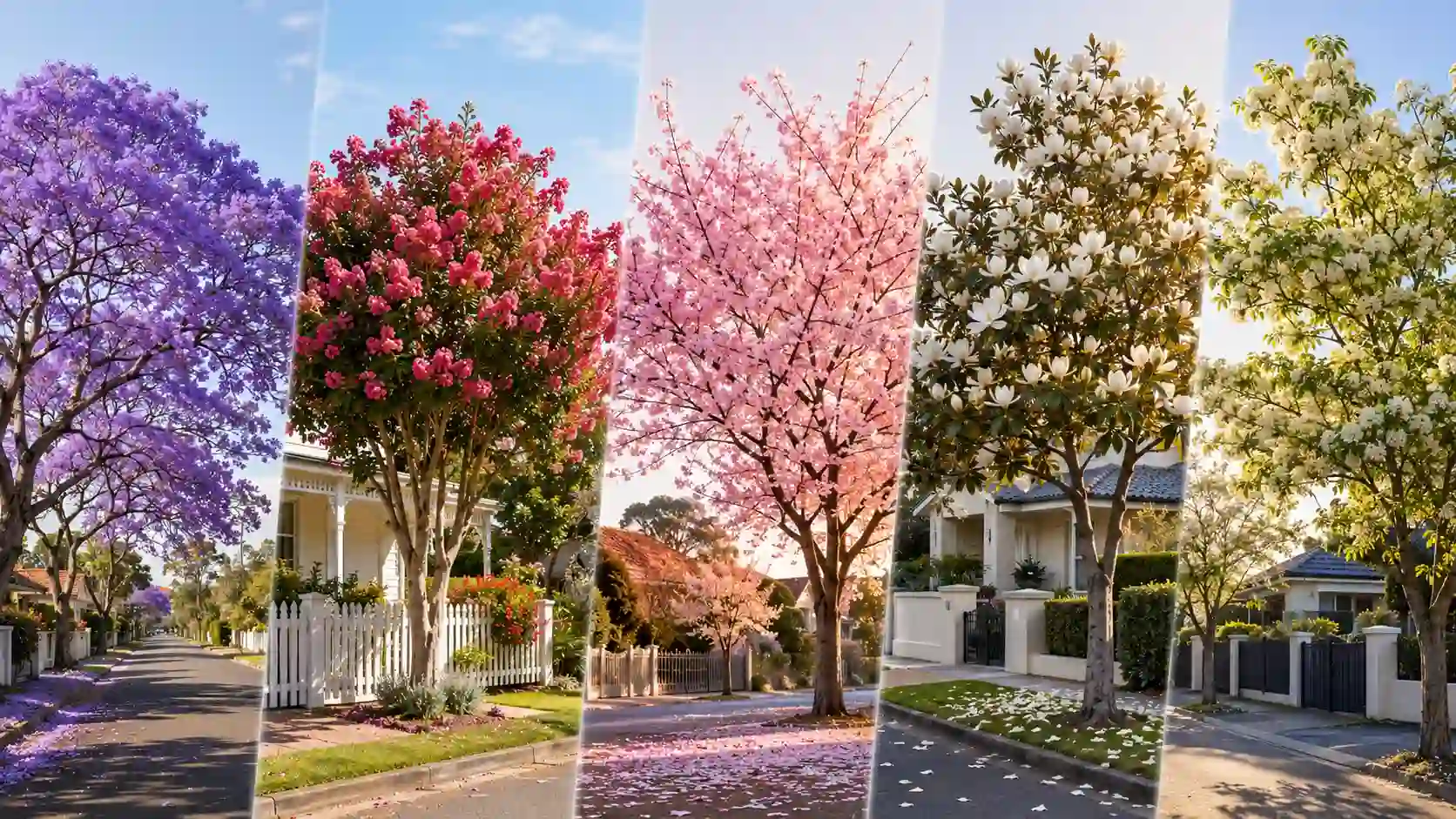
Exotic flowering trees play a major role in Australian suburban landscapes. While not native, many are well adapted and widely planted. Despite its beauty, there are known limitations — see flowering ash tree problems Australia for maintenance considerations.
Jacaranda produces purple flowers in late spring and summer, creating iconic streetscapes in warm regions. Magnolia grandiflora is valued for large white blooms and evergreen structure. Crepe myrtle offers long flowering periods across multiple colours and adapts to most climates.
Jacarandas are particularly well known across Australia’s warmer regions, but their performance depends on climate, available space and planting conditions. Our guide to the jacaranda tree in Australia covers climate suitability, flowering time, growth, roots and common problems.
| Tree | Flower Colour | Season | Climate Suitability | Evergreen? | Size |
| Jacaranda | Purple | Spring–Summer | Warm temperate | No | 8–15m |
| Magnolia grandiflora | White | Spring–Summer | Warm–subtropical | Yes | 10–20m |
| Crepe Myrtle | Mixed | Summer–Autumn | Wide range | No | 3–10m |
| Cherry Blossom | Pink/White | Spring | Cool climates | No | 3–10m |
| Flowering Ash | White | Spring | Temperate | No | 5–12m |
These flowering trees Australia selections dominate ornamental landscaping due to visual impact and seasonal variation. For a deeper side-by-side comparison than the table above allows — including growth rate, root behaviour, and maintenance notes — see our full Australian Flowering Trees Master Comparison Database.
It’s the most detailed resource we maintain for comparing jacaranda, magnolia, and crepe myrtle against native alternatives at a glance.
Flowering Trees for Every Australian Climate Zone
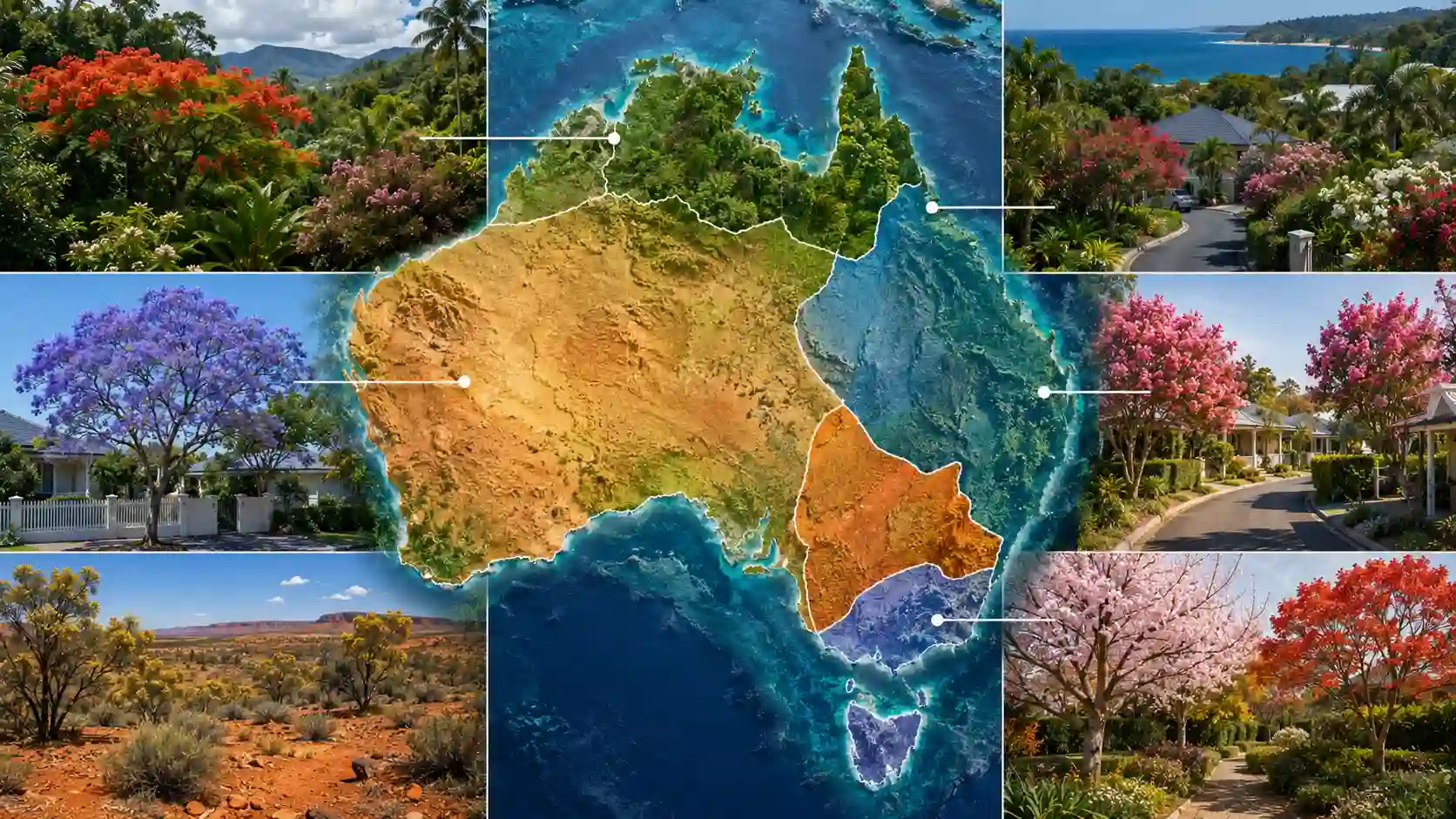
Climate suitability is the single most important factor in flowering tree success.
Tropical (QLD, NT coast): Poinciana, Illawarra Flame Tree, Native Frangipani
Subtropical (SE QLD, coastal NSW): Jacaranda, Magnolia, Tibouchina, Lemon Myrtle
Warm Temperate (Sydney, Perth coastal): Crepe Myrtle, Grevillea, Magnolia Teddy Bear
Cool Temperate (Melbourne, Canberra): Cherry Blossom, Camellia, Flowering Ash
Mediterranean / Dry (WA, SA inland): Wattle, Hakea, Grevillea
Choosing the wrong zone is the most common reason flowering trees fail to bloom or survive. Frangipani is particularly suited to warm Australian gardens, although flowering and overall performance depend on sun, drainage and seasonal conditions. For practical growing advice, see our guide to frangipani tree care in Australia.
Flowering Evergreen Trees Australia — Year-Round Foliage With Seasonal Blooms
Evergreen flowering trees retain foliage year-round while producing seasonal blooms. This makes them ideal for privacy and low-maintenance landscapes.
Magnolia grandiflora, Lilly Pilly, Lemon Myrtle, Bottlebrush, and Grevillea are key flowering evergreen trees Australia options. Many homeowners prefer them because they reduce leaf litter and maintain structure in winter.
Evergreen species are especially valuable as tall landscaping plants evergreen and tall hedging plants Australia solutions for suburban gardens.
Flowering Trees for Screening, Hedging, and Fence Lines in Australia
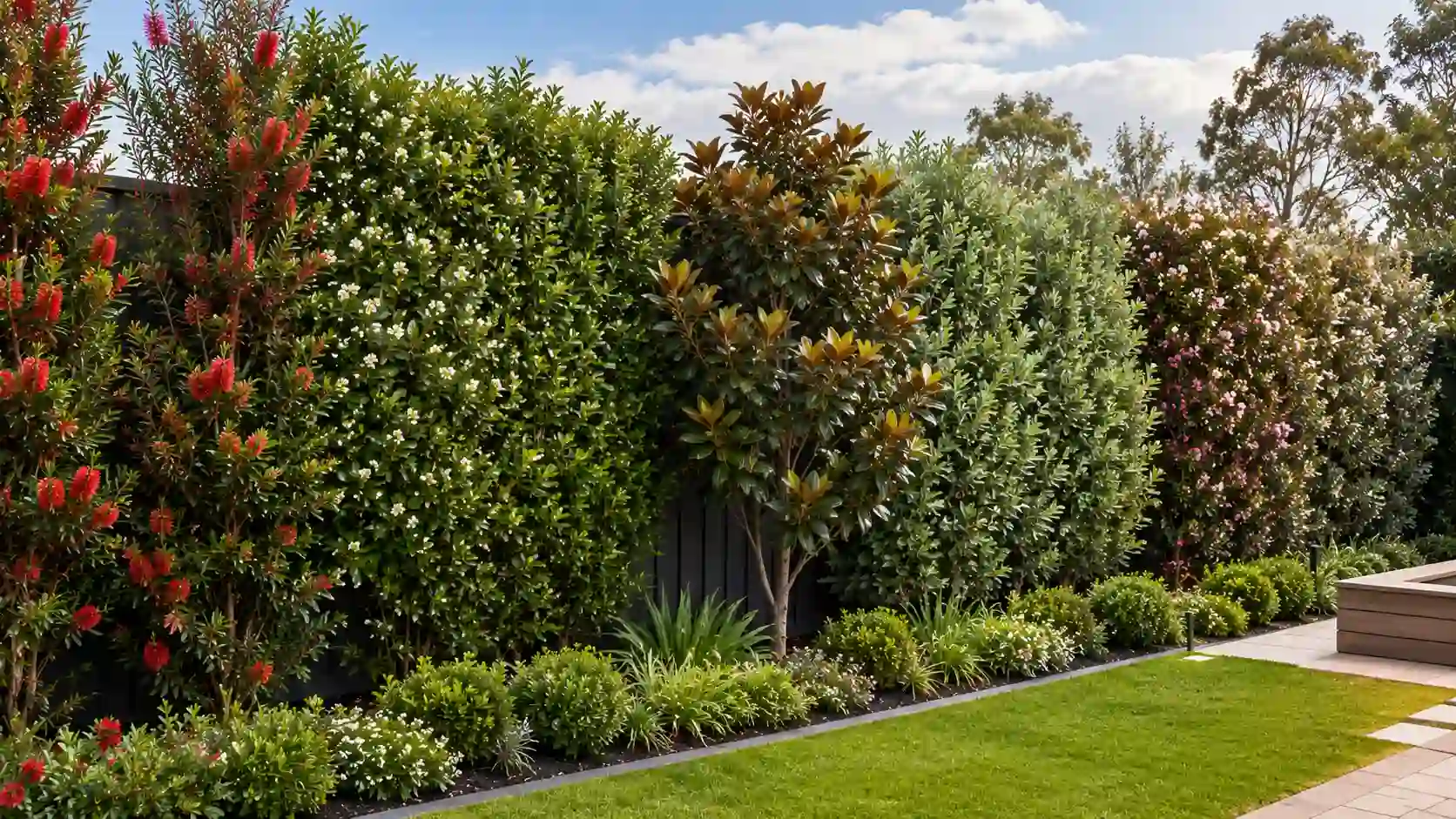
Flowering trees can function as both ornamental features and practical screening plants Australia solutions.
Best Flowering Trees for Narrow Spaces and Fence Lines
Bottlebrush ‘Slim™’, Lemon Myrtle, Blueberry Ash, Leptospermum, and Photinia are ideal narrow screening plants Australia choices.
These species are widely used as fence line screening plants for narrow spaces and tall thin screening plants. Photinia fraseri is a popular hedge option for colour contrast — especially as a Photinia robusta hedge plant in narrow spaces.
Tall Flowering Trees for Privacy and Structure
Magnolia Teddy Bear, Pittosporum Silver Sheen, Ficus Hillii Flash, Waterhousea, and Tuckeroo are reliable tall hedge plants Australia selections.
These are commonly used as hedging trees Australia in front yards and boundary planting.
Fast-Growing Flowering Screening Plants
Fast growth typically means 0.5–1.5m per year.
Crepe Myrtle, Bottlebrush, Lilly Pilly, and Acacia are widely used fast-growing narrow screening plants. Proper spacing ensures dense hedge formation without overcrowding. Unlike large natives, Crepe Myrtles are generally safer — see how deep are crepe myrtle roots for structural guidance.
Flowering Trees Suitable for Pots in Australia
Many flowering trees Australia can succeed in pots when dwarf cultivars are selected. Large species often fail due to root restriction and nutrient imbalance.
Best options include dwarf Crepe Myrtle, compact Grevillea, Camellia, Dwarf Cherry Blossom, and Leptospermum. Magnolia Teddy Bear is generally too large long-term but performs well in early stages. Compact cultivars such as the dwarf cherry blossom tree are ideal for containers and small gardens.
Use low-phosphorus native potting mix for australian native trees suitable for pots and ensure full sun exposure where possible.
Flowering Tree Sizes — Small, Medium, and Large for Every Garden
| Size | Height | Best Species | Use |
| Small | 1–4m | Dwarf Crepe Myrtle, Leptospermum | Pots, small gardens |
| Medium | 4–8m | Magnolia Teddy Bear, Blueberry Ash | Screening, feature trees |
| Large | 8m+ | Jacaranda, Lemon Myrtle, Magnolia grandiflora | Shade, statement trees |
Size selection is critical for long-term garden success. Want the raw sizing and species data behind this table? Our flowering tree sizes spreadsheet is downloadable and sortable by height, use case, and species name.
It’s especially handy if you’re comparing multiple trees for a landscaping plan rather than picking just one.
Seasonal Flowering Calendar — When Do Australian Trees Bloom?
Spring: Wattle, Cherry Blossom, Jacaranda, Grevillea
Summer: Crepe Myrtle, Illawarra Flame, Lemon Myrtle, Poinciana
Autumn: Crepe Myrtle, Tibouchina
Winter: Banksia, Camellia, Wattle
This seasonal structure ensures year-round flowering trees Australia interest in landscape design.
Root Systems — What to Know Before You Plant a Flowering Tree
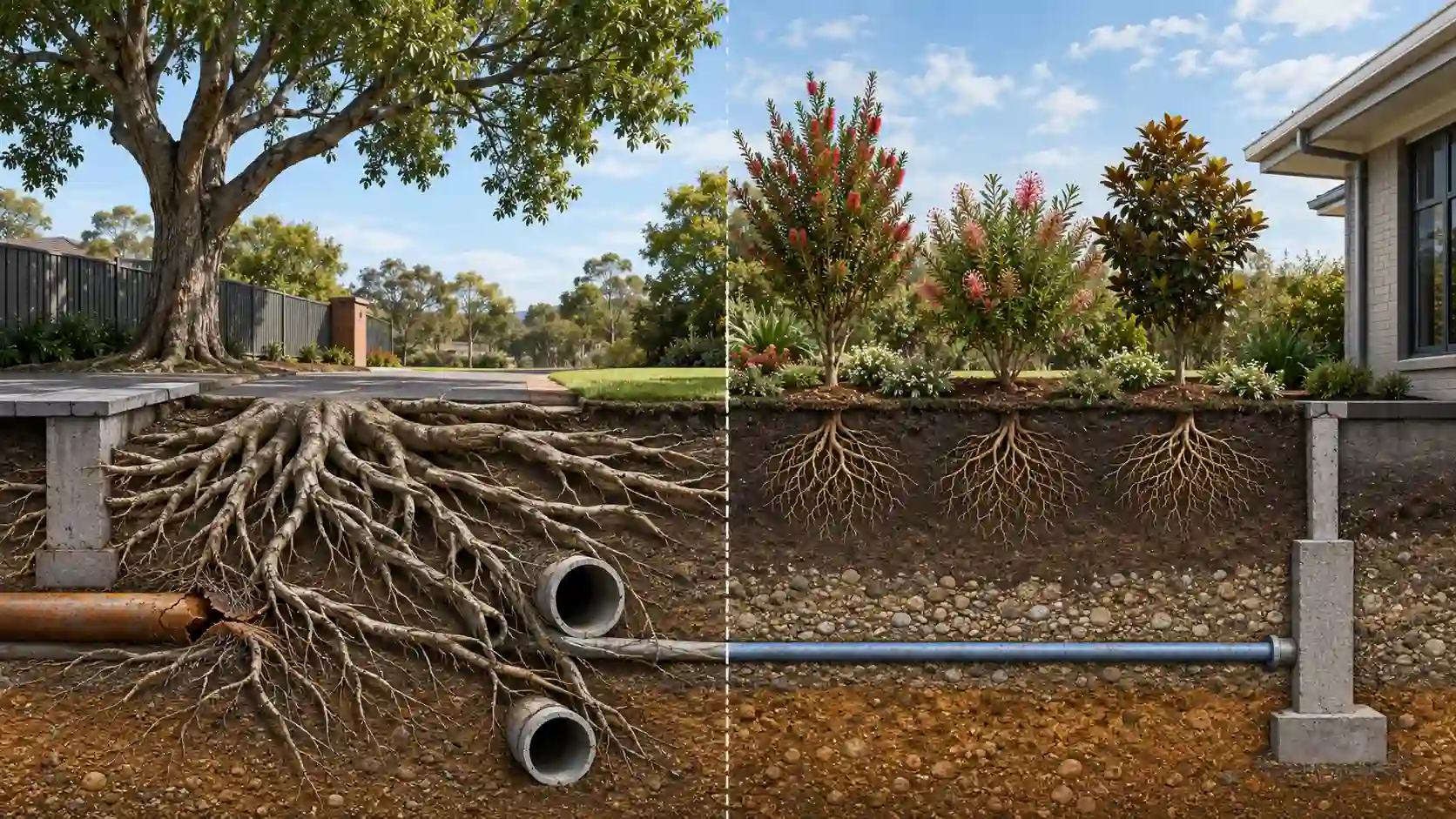
Root behaviour determines structural safety and long-term maintenance costs. For example, the Teddy Bear Magnolia root system is considered non-invasive compared to larger magnolia varieties. Many eucalyptus species develop extensive root networks — the Gum tree root system is a key consideration in suburban planting.
Aggressive root systems include Poinciana, some Gum Trees, and mature Jacaranda. Non-invasive options include Magnolia Teddy Bear, Leptospermum, and Bottlebrush. A safe rule is to plant trees at least as far from structures as their mature height. Large ornamental trees like Poinciana have wide surface roots — see Poinciana tree root system details before planting near structures.
Common Mistakes When Planting Flowering Trees in Australia
Choosing the Wrong Climate Zone
Tropical trees fail in frost-prone regions, while cool-climate species often fail to flower in heat.
Planting Too Close to Structures
Ignoring root spread leads to damage in driveways, pipes, and foundations.
Watering Errors
Young trees need consistent moisture for 1–2 years before becoming drought tolerant.
Seed-Grown Variability
Named cultivars ensure predictable height and flowering performance.
Ignoring Invasive Risks
Some species, including jacaranda in certain regions, require careful management.
Flowering Trees That Attract Wildlife in Australian Gardens
Bottlebrush, Grevillea, Banksia, Wattle, and Lilly Pilly are key wildlife-supporting flowering australian trees. Their nectar-rich flowers attract birds, bees, and pollinators year-round.
Planting diverse flowering trees creates continuous food sources, improving garden biodiversity and ecosystem health.
Conclusion
Flowering trees Australia offer unmatched diversity, colour, and ecological value, but success depends on choosing the right species for your climate, space, and purpose. From australian native flowering trees like wattles and bottlebrush to ornamental magnolias and crepe myrtles, each tree plays a specific role in garden design. Whether you need flowering evergreen trees for privacy, narrow screening plants for fence lines, or feature trees for front yards, proper selection ensures long-term success and minimal maintenance.
Frequently Asked Questions
What is the most popular flowering tree in Australia?
Jacaranda is the most visually iconic, while crepe myrtle is the most widely planted. Wattle remains the most ecologically significant native flowering tree.
What Australian native trees have yellow flowers?
Wattle species dominate, along with Grevillea ‘Moonlight’, native frangipani, and some Banksia varieties.
What are the best flowering trees for screening and privacy in Australia?
Lilly Pilly, Bottlebrush, Magnolia Teddy Bear, and Leptospermum are top choices depending on space and climate.
Can flowering trees be grown in pots in Australia?
Yes, especially dwarf cultivars like dwarf crepe myrtle and compact grevillea. Proper potting mix and drainage are essential.
What flowering trees grow in full sun in Australia?
Crepe myrtle, bottlebrush, grevillea, wattle, and magnolia perform best in full sun conditions.
Which flowering trees are native to Australia?
Wattle, bottlebrush, grevillea, banksia, lilly pilly, lemon myrtle, and ivory curl tree are key natives.
What is the fastest-growing flowering tree in Australia?
Crepe myrtle, lilly pilly, and wattle are among the fastest, often exceeding 1m growth per year in ideal conditions.
12 Comments