

Plant Benefits & Natural Wellness: Evidence-Based Guide
If you’ve ever felt a small lift in mood after watering a fern, or found yourself glancing at a desk plant between emails, you’ve probably also wondered whether that feeling means anything — or whether “plants improve your wellbeing” is just a nice story wellness brands like to tell.
It’s a fair question, and most of what’s written online doesn’t really answer it. Search “benefits of indoor plants” and you’ll find the same handful of studies recycled across dozens of articles, usually stripped of context, sitting next to claims that a peace lily can treat your arthritis. That’s not helpful — and if you’re newer to plant-keeping, or just trying to work out whether a couple of desk plants are worth the effort, it’s not what you need.
This guide takes a more grounded approach. We’ll look at what the research on plants and wellbeing actually supports, where popular claims get stretched too far, how many plants you realistically need to notice anything, and which specific plants suit specific goals — stress relief, focus, sleep, or air quality — rather than one generic “good plants for wellness” list. We’ll also flag the downsides nobody likes to mention. And because most of this content is written for the US or UK, we’ve grounded the practical advice in Australian conditions, with input from leafyheaven’s own grower, Elemo Baker, on what’s actually easy to keep alive here.
Quick Summary
- Indoor plants offer modest, genuine benefits for stress, mood, and air quality — they’re a supportive habit, not a cure for anything.
- The widely quoted NASA Clean Air Study tested plants in sealed lab chambers, not real rooms with normal airflow — its air-purifying claims don’t translate directly to your living room.
- Different plants suit different goals: aromatic plants like lavender for calm and sleep, hardy resilient species like snake plants and dracaena for air quality and low-effort upkeep.
- The act of caring for a plant — watering, checking leaves, repotting — may matter as much as simply having one in the room.
- A realistic starting point is one or two plants matched to a specific goal, not a large collection bought all at once.
- Common downsides (allergies, soil mould, pet toxicity) are real but manageable with basic precautions.
Do Indoor Plants Really Improve Wellbeing? (The Short Answer)
Yes, with a genuine caveat: the effect is real but modest, and it’s easy to overstate. Multiple independent studies — on stress physiology, mood, and mindfulness — find a consistent, positive association between having and caring for plants and measures of wellbeing. What they don’t show is that plants are a treatment for anxiety, depression, or any diagnosed condition, and most of the research shows correlation (people who keep plants report feeling better) rather than airtight proof that the plants themselves caused the improvement in every case.
That distinction matters, and we’ll come back to it throughout this guide. For now, the practical takeaway is this: plants are a small, low-cost, low-risk addition to a wellbeing routine — not a substitute for sleep, movement, social connection, or professional support when you need it.
The Physical Health Benefits of Keeping Plants
Air Quality — What’s Real and What’s Outdated
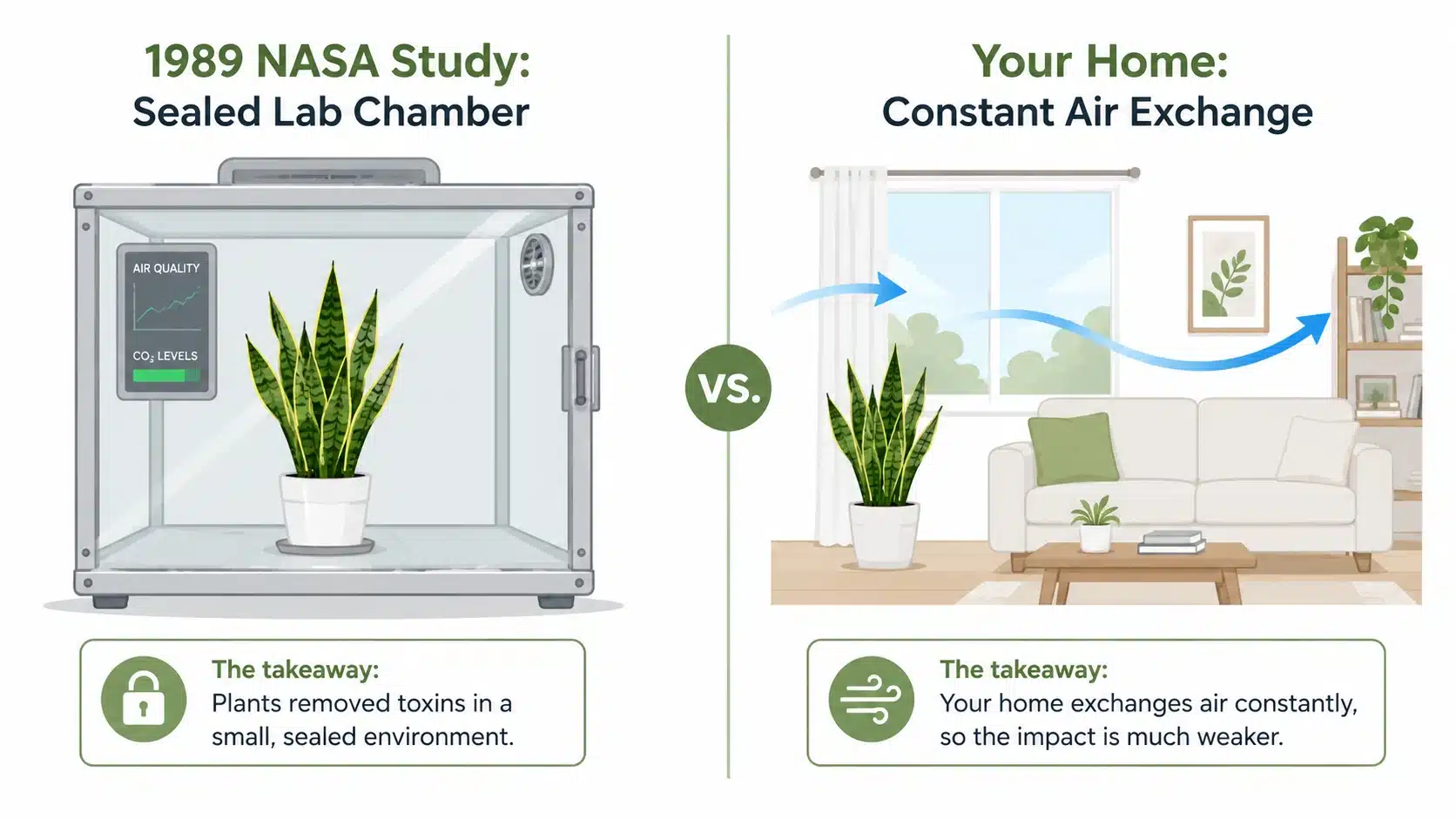
Almost every article on this topic leans on the same source: a 1989 study NASA ran with a landscaping industry group, looking at whether plants could help scrub volatile organic compounds (VOCs) like benzene and formaldehyde from the air aboard space stations. You can read NASA’s original 1989 technical report directly — in sealed test chambers, several common houseplants did reduce VOC concentrations, and the underlying chemistry was sound.
The problem is what happened next: that finding got applied to living rooms, which are nothing like a sealed chamber. A real home or office already exchanges air with the outside through gaps, windows, and ventilation systems, and that natural air exchange dilutes indoor pollutants far faster than a handful of potted plants can extract them. Follow-up research modelling plant performance against normal household ventilation rates has found you’d need an impractical number of plants — commonly cited estimates run into the hundreds per square metre — to match what passive airflow is already doing in a typical room.
None of this means plants do nothing for air quality. They can modestly reduce dust accumulation on surfaces and raise indoor humidity to more comfortable levels, particularly useful in Australia’s drier inland regions or during winter heating season when indoor air can get uncomfortably dry. But if air purification is your main goal, don’t expect a few pots to meaningfully outperform simply opening a window or running an air purifier. For a shortlist of species that hold up well and offer the best (realistic) combination of resilience and air-quality benefit, see our guide to the best air-purifying plants for Australian homes. Peace lily is a useful example of that distinction: our evidence-based guide to peace lily benefits explains what controlled studies actually show and where the popular air-purifying claims become overstated.
Stress, Blood Pressure, and Physiological Response
The strongest and most-cited physical evidence for plants and wellbeing comes from a 1996 Washington State University study published in the Journal of Environmental Horticulture. You can review Washington State University’s own summary of the research on its Department of Horticulture site. Researchers had participants complete a mildly stressful, timed task on a computer in a windowless room, either with or without live plants present, while tracking blood pressure and reaction times. The group working alongside plants completed the task faster and showed a smaller rise in blood pressure than the group without plants, and reported feeling more attentive afterwards.
It’s one study from nearly three decades ago, run in a lab setting with a specific task — it shouldn’t be treated as universal proof that plants lower blood pressure in every context. But it remains a well-designed, frequently replicated-in-spirit finding, and it lines up with a broader pattern in the research: consistent, small reductions in physiological stress markers when people are around greenery, whether that’s a desk plant, a window view of a garden, or time spent outdoors. For the fuller picture of what indoor plants are shown to do for the body and the home, see our complete breakdown of indoor plant benefits.
The Mental and Emotional Wellness Benefits
Stress Reduction and Mood
Beyond the physiological studies, there’s a separate strand of research rooted in biophilia — the idea that humans have an evolved affinity for nature that shows up even in small doses, like a plant on a windowsill. Some of the earliest work in this space, from Cornell and similar institutions, found that simply viewing green, natural imagery had a measurably calming effect compared with viewing built environments or no imagery at all. Rosemary is another aromatic plant with both traditional wellness uses and emerging human research, and our guide to the benefits of rosemary separates those findings from claims that remain unproven.
A more recent and more directly relevant study, published in 2022 in the International Journal of Environmental Research and Public Health, surveyed 421 adults across 19 Chinese cities and compared people who identified as “houseplant carers” against those who didn’t. The self-identified carers reported meaningfully higher mental wellbeing and higher trait mindfulness. Interestingly, the researchers found that the number of hours spent on plant care, the number of plants owned, and the number of years someone had been keeping plants were all positively associated with these benefits — suggesting the relationship builds over time rather than appearing the moment you buy a plant.
For a specific example of a plant with a long-standing reputation for calming, aromatic use, see our guide to lavender’s specific calming benefits at home.
Focus and Productivity (Desk and Office Plants)
If you’re working from home and wondering whether a desk plant is worth the desk space, the WSU study above is the most relevant evidence: faster task completion and better self-reported attentiveness when plants were present. It’s a reasonable basis for adding a plant to your workspace, but it’s worth being realistic — a plant is not a substitute for good lighting, breaks, or a properly set-up desk, and claims that a single plant will “boost productivity” by some precise percentage should be read with a healthy amount of scepticism about how directly lab findings translate to your specific desk.
What does hold up is the practical logic: a plant that’s easy to keep alive removes one source of low-grade stress (a dying plant staring back at you) while providing the visual, biophilic benefit. Hardy, low-maintenance species are the sensible choice here — see spider plants as a popular low-fuss desk option.
Sleep Support
Plants aren’t a sleep aid in any clinical sense, and be wary of any claim that a bedroom plant will “cure” insomnia. What’s more defensible is the indirect route: plants that improve indoor humidity can make a room more comfortable to sleep in, especially in Australia’s drier climate zones, and the act of tending to a plant as part of a wind-down routine may support the kind of calming ritual that helps some people settle before bed.
A common concern — that plants release carbon dioxide at night and will make a bedroom unsafe — isn’t well supported for a normal number of houseplants in a normally ventilated room; the amount of CO2 a plant or two releases overnight is negligible next to the air already moving through a house. For an example of an aromatic plant often placed bedside for this kind of ritual, see plants like the Vicks plant, popular for bedside placement.
The Benefit-to-Plant Matrix: Which Plant for Which Outcome
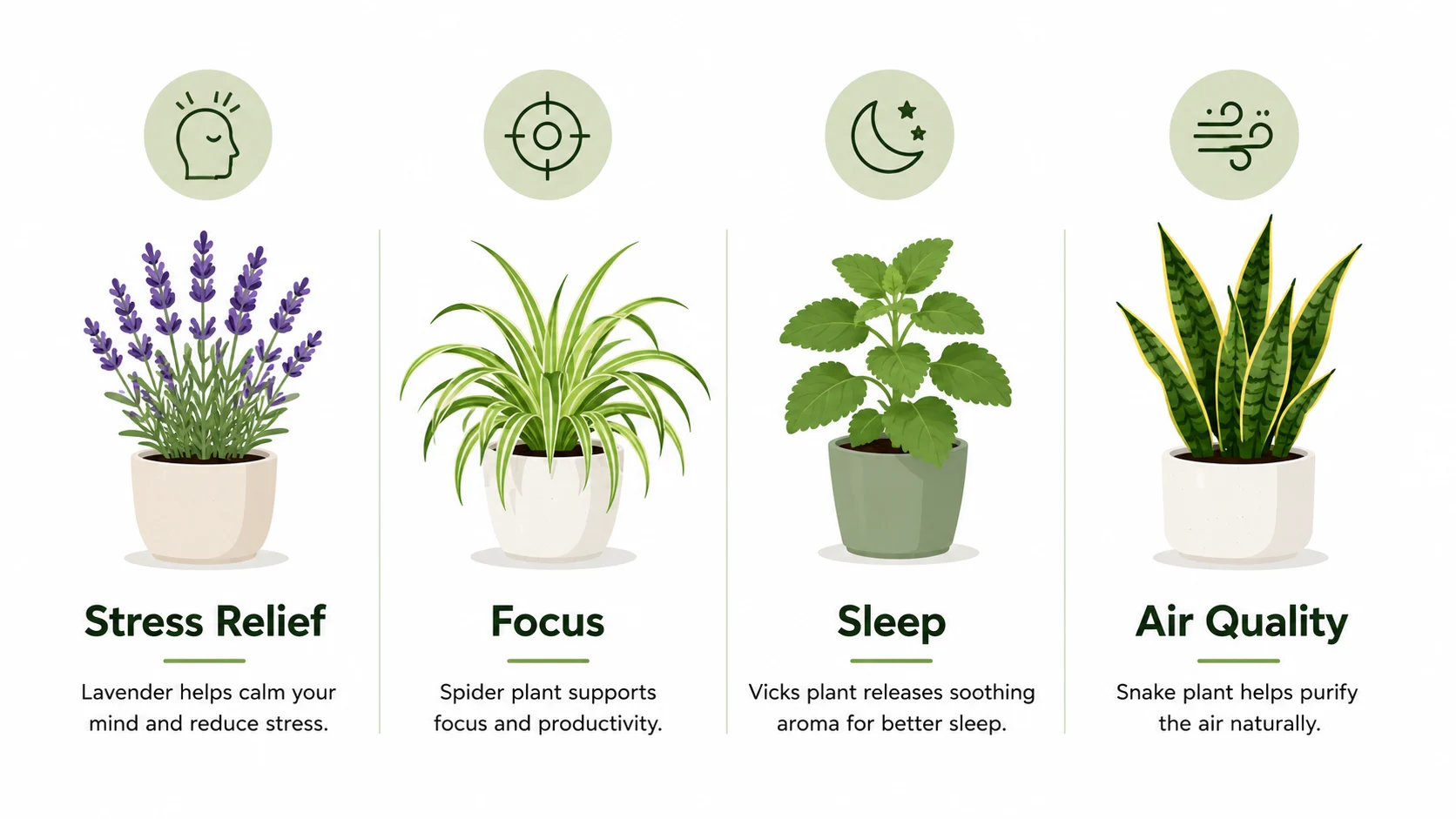
Most “plants for wellness” content stops at a single, generic list. In practice, different plants suit different goals — and matching the plant to what you’re actually trying to get out of it matters more than just picking whatever looks nice in a nursery. Here’s how the plants covered on this site map to the main outcomes people are looking for, with a rough sense of how much effort each one asks for.
| Outcome | Recommended Plant(s) | Why It Fits | Care Difficulty |
| Air quality & humidity | Snake plant, Dracaena marginata | Both are resilient, tolerate low light and irregular watering, and hold up well as long-term fixtures rather than needing constant attention | Very easy |
| Stress reduction & calm | Lavender, Purple passion plant | Aromatic and visually soft, associated with the calming, biophilic response found in the mood research above | Moderate (lavender needs good light and drainage) |
| Focus & desk use | Spider plant | Hardy enough to survive inconsistent desk conditions, with the kind of low-maintenance presence the WSU productivity study points toward | Very easy |
| Sleep & bedroom ritual | Vicks plant | Aromatic, commonly kept bedside, fits the “care ritual before bed” pattern rather than any direct sedative effect | Easy |
| General wellness & routine | Katuk plant, Leaf of life | Both have a longer tradition of home cultivation for general household use, giving a reason to engage in regular, hands-on care | Moderate |
| Beginner-friendly resilience | Tuna plant (prickly pear), Goosefoot plant | Tolerant of Australian heat and inconsistent watering — good for readers who want the benefit without the risk of killing the plant in month one | Very easy |
| Aesthetic & mood lift | Magenta plant | Strong, vivid colour that supports the “visually engaging plants” finding from wellbeing research (see the note on plant attractiveness below) | Moderate |
A note on plant attractiveness: research from the University of Reading and the Royal Horticultural Society has found that healthy, visually appealing plants provide a noticeably bigger wellbeing boost than neglected or unhealthy ones — and that a struggling plant can actually be worse for mood than no plant at all. That’s a genuine reason to pick plants you can realistically keep looking good, rather than the most fashionable option in a listicle. For readers interested in edible plants with traditional wellness interest, curry leaf benefits, uses, safety and growing in Australia covers the evidence, everyday culinary use and practical growing considerations.
Active Care vs Passive Presence — Does Tending the Plant Matter?
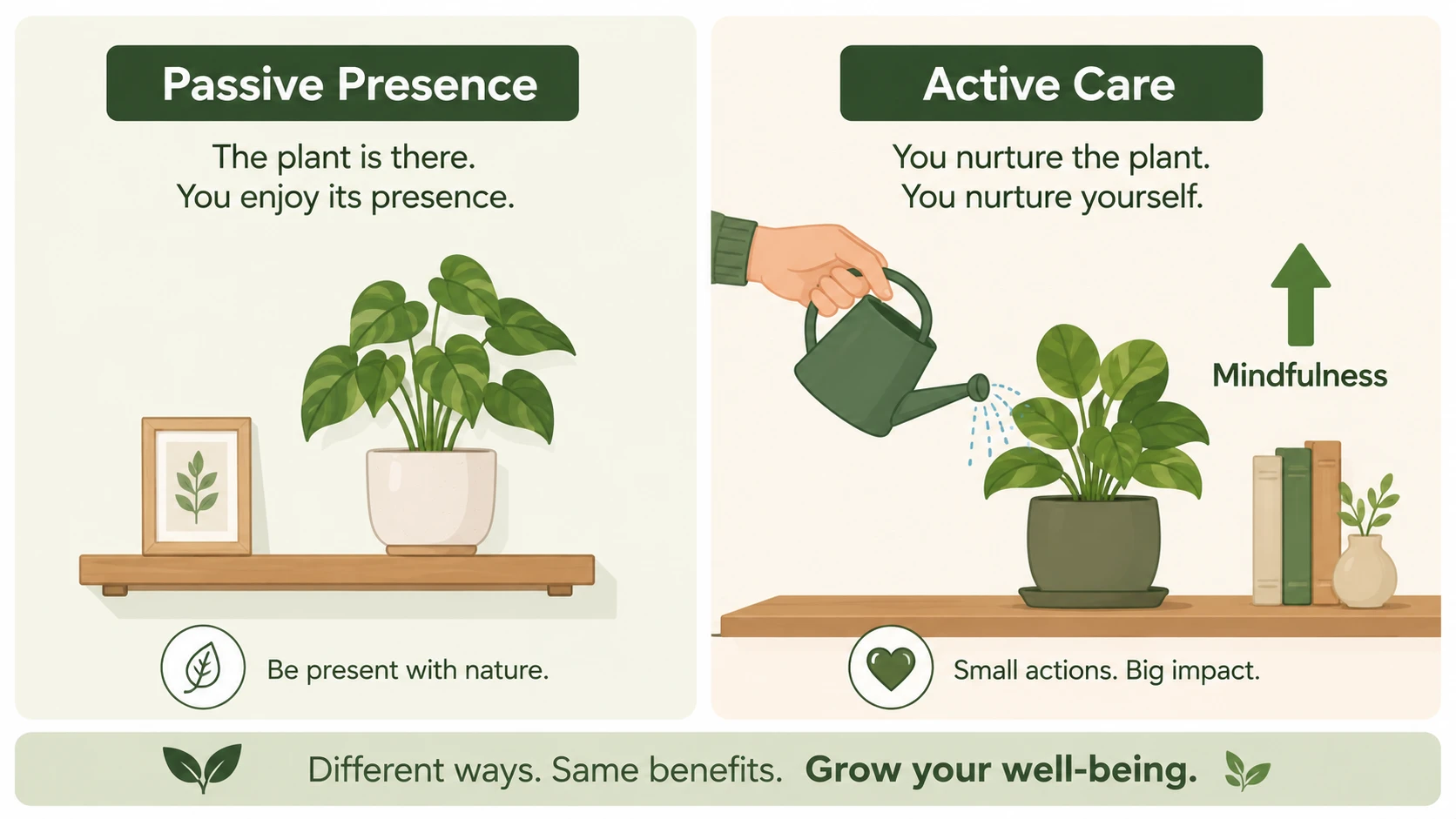
Here’s a distinction most articles on this topic skip entirely: is it the plant simply being in the room that helps, or is it the act of looking after it?
The 2022 houseplant-care study referenced above points toward the latter mattering more than people assume. It didn’t just compare “people with plants” to “people without” — it found that more hours spent on care, a higher plant count, and more years of ownership were all associated with greater wellbeing and mindfulness. That’s consistent with what a lot of mindfulness research finds more broadly: repetitive, attentive, low-stakes tasks (checking leaves for dust, noticing new growth, adjusting watering) give your attention somewhere calm to land, in much the same way other grounding rituals do.
The practical implication: if you’re time-poor, a plant sitting untouched on a shelf will still offer some passive, visual benefit, but you’re likely to get more out of a plant you actually interact with — even briefly — a few times a week. If you don’t currently have time for that, it’s worth being honest with yourself about which category you’re in before investing in a large collection.
Indoor Plants vs Outdoor Gardening — Is There a Difference?
Yes, and they’re complementary rather than competing. Outdoor gardening comes with benefits indoor plants can’t replicate: sunlight exposure (and the vitamin D that comes with it), physical activity from digging, weeding, and carrying, and for many people, a social or community dimension through shared gardens or simply being outside where neighbours are. Indoor plants can’t offer any of that, but they make up for it in convenience and consistency — you get a daily, low-effort dose of the same biophilic and routine-based benefits without needing a garden, good weather, or physical mobility.
If you have the space and ability for both, there’s no real trade-off to worry about; if you only have room for one, outdoor gardening likely offers the broader set of benefits, while indoor plants are the more accessible option for renters, apartment dwellers, and anyone working from a desk most of the day.
How Many Plants Do You Actually Need? A Practical Guide
This is one of the most common questions and one of the least answered anywhere online. There’s no single scientifically validated number, but the available research gives us a reasonable, honest way to think about it rather than a precise formula.
The physiological studies (like the WSU research) found measurable effects with a modest number of plants placed around a single room — not dozens, and not one lonely pot in a corner. The mindfulness research suggests the benefit scales gradually with plant count and years of ownership, rather than appearing all at once.
Put together, a sensible, non-hyperbolic starting point is:
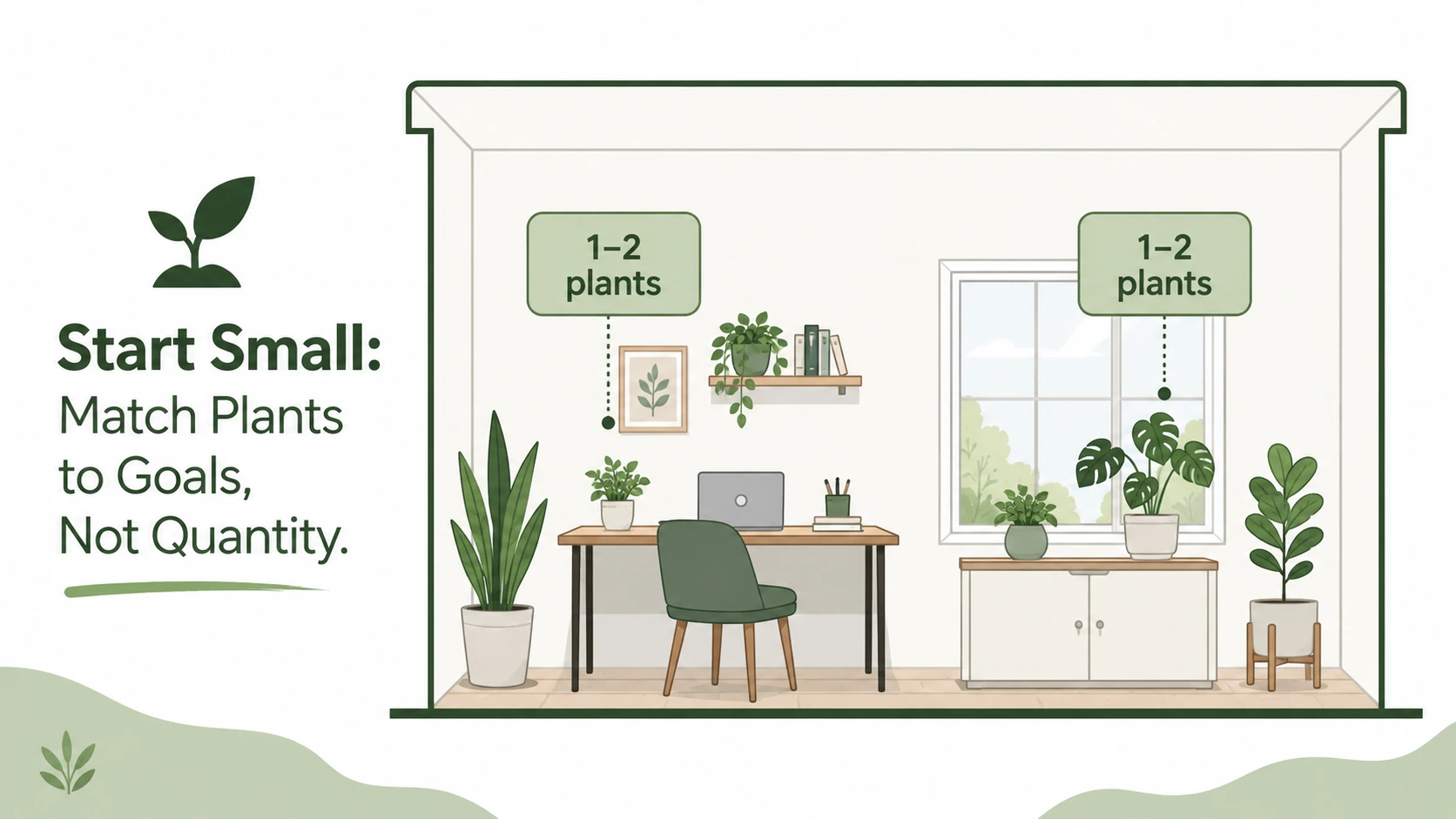
- One or two plants per main living space (desk, bedroom, living room) is enough to get a noticeable, passive visual and biophilic benefit.
- Air-quality and humidity effects are genuinely modest at any reasonable household plant count — don’t expect a handful of pots to replace ventilation.
- The wellbeing benefit tied to care and routine builds with consistency over months and years, not with buying more plants at once.
In other words: start small, pick plants matched to what you actually want (see the matrix above), and let your collection grow naturally as your confidence and interest do — rather than trying to hit a specific plant count.
Where You Put Your Plants Matters
Placement is less about arbitrary feng-shui-style rules and more about matching the plant to the room’s practical conditions and to the outcome you’re going for.
- Desk or office: prioritise low-light tolerance and resilience over fragrance — you want something that survives inconsistent attention, like a spider plant.
- Bedroom: aromatic, calming plants suit a wind-down routine; there’s no meaningful safety concern with a normal number of plants and normal ventilation.
- Living areas: this is where humidity and air-quality benefits are most noticeable, since it’s usually the room with the most airflow and the most time spent in it — a good spot for hardier, larger specimens like snake plants or dracaena.
Light availability should still come first for the plant’s own health — check each plant’s specific care needs before deciding on a spot, since even the right plant for your goal won’t deliver much benefit if it’s struggling in the wrong light.
Getting Started with Low-Maintenance Wellness Plants (Australian Conditions)
Most plant-and-wellness content online is written for US or UK conditions, which don’t map neatly onto Australian homes — different humidity levels, different light intensity, and a much wider range of climate zones from tropical Queensland to arid inland regions and cooler southern states.
“The plants that show up in every American wellness listicle aren’t always the ones that actually survive here without a lot of babying,” says Elemo Baker, leafyheaven’s resident grower. “For most people starting out, I’d rather point them toward something genuinely forgiving — a plant that can handle a missed watering or a stretch of dry heat — than the trendiest pick that needs constant fussing. You get more of the wellbeing benefit from a plant that’s thriving than from one you’re anxious about keeping alive.”
Not every drought-tolerant plant commonly grown in Australian gardens is native here; our guide to whether aloe vera is native to Australia explains its origin, Australian status and how that distinction affects how the plant is understood.
That’s a useful filter for choosing your first few plants: favour resilience over reputation. Species like the tuna plant (prickly pear) tolerate Australian heat and drought conditions with minimal intervention, making them a sensible entry point — see tuna plant benefits for more detail. For a broader starting list suited to Australian indoor conditions, our general guide to indoor plant benefits is a good next stop. Native Australian species with genuine indoor amenity value are a smaller category worth exploring separately if you want to lean into locally-adapted plants specifically.
Downsides and Overstated Claims to Be Aware Of
In the interest of giving you the full picture rather than a marketing pitch, here’s what’s worth knowing before you commit to a plant collection:
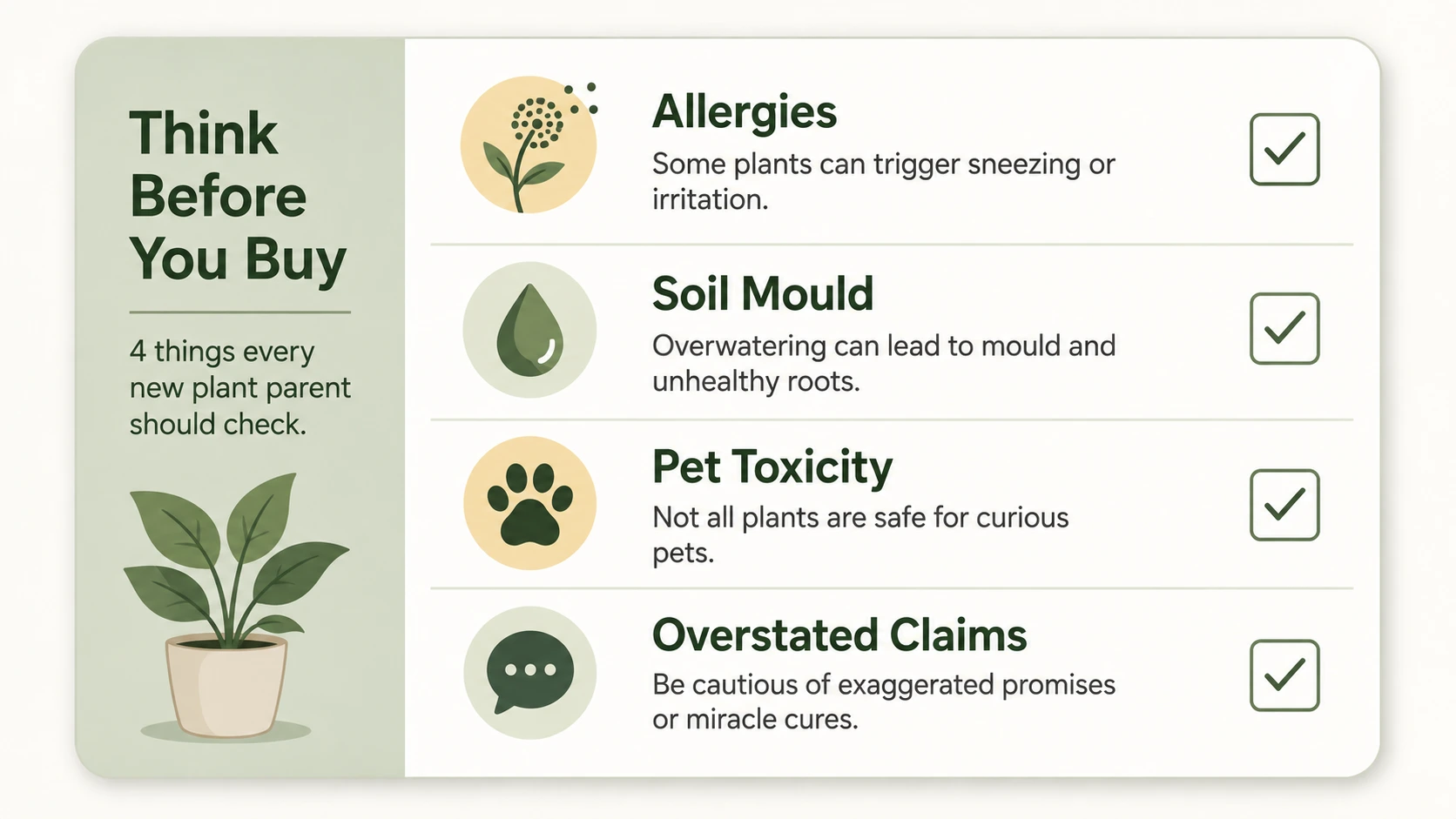
- Allergies and pollen. Some flowering plants can trigger reactions in people prone to hay fever or plant allergies. If you’re sensitive, favour foliage plants over heavily flowering ones, and introduce new plants one at a time so you can identify a cause if a reaction shows up.
- Soil mould. Overwatered pots, especially in humid conditions, can develop surface mould in the soil. This is usually a watering and drainage issue rather than a sign of a bad plant — letting soil dry out between waterings and using pots with proper drainage largely prevents it.
- Pet toxicity. A number of common houseplants are toxic to cats and dogs if chewed or ingested. This varies significantly by species, so check the specific plant before bringing it into a home with pets rather than assuming — we cover toxicity notes within each individual plant guide on this site.
- Overstated therapeutic claims. Be sceptical of any claim that a specific plant “cures” anxiety, depression, arthritis, or any other diagnosed condition. The genuine research supports plants as a supportive, low-cost wellbeing habit — not a medical treatment, and not a replacement for professional care when you need it.
None of this means you should be nervous about keeping plants — these are ordinary, manageable considerations, not reasons to avoid it. They’re just the parts of the story that get left out when a claim is being oversold. Neem is another example where traditional wellness claims need to be separated from the strength of human evidence; our guide to neem plant benefits in Australia covers its traditional uses, available research, safety considerations and Australian context.
A separate category worth flagging: plants used as herbal preparations. Some plants on this site are grown as much for traditional medicinal or tea use as for ambient wellness — for example, our guide to avocado leaves benefits covers a traditional herbal tea with genuine safety considerations, including a naturally occurring compound called persin that carries its own caution around dosage and pregnancy. Treat this as a different, more deliberate category from simply keeping a plant in a room — the caution profile is higher, and it’s worth reading a plant’s full safety guide before preparing anything to drink or ingest.
Building Your Own Wellness Routine with Plants
The honest version of this topic is less exciting than the marketing version, but more useful: plants offer a real, modest, cumulative wellbeing benefit, best understood as a supportive habit rather than a cure for anything. The research consistently points toward small, physiological improvements in stress and attention, alongside a mental-health benefit that seems to build with genuine, ongoing care rather than appearing the moment a plant arrives home.
If you’re starting out, resist the urge to buy a dozen plants at once. Pick one or two matched to what you actually want — calm, focus, sleep, or simply a healthier-feeling room — using the benefit-to-plant matrix above as a starting point, and build from there as your routine (and your confidence) grows.
Frequently Asked Questions
Do indoor plants actually improve air quality in a normal home, not just a lab?
Only modestly. The widely cited NASA study tested plants in sealed chambers, which don’t reflect real households with normal air exchange. Plants can help with humidity and dust reduction, but they’re not a substitute for ventilation or air purification.
How many plants do I need in a room to notice a wellbeing benefit?
There’s no exact figure, but one or two well-chosen plants per main living space is a reasonable, evidence-informed starting point rather than needing a large collection.
Which plants are best for reducing stress?
Aromatic, visually calming plants like lavender tend to fit the biophilic and mood research best, though the wider wellbeing benefit is associated with regular plant care generally, not one specific “stress plant.”
Which plants are best for helping with sleep?
No plant is a clinically proven sleep aid. Aromatic bedroom plants like the Vicks plant are popular for a calming bedtime routine, and normal houseplant numbers pose no meaningful safety concern overnight.
Does caring for a plant matter more than just having it in the room?
The available research suggests yes — hours spent on care, plant count, and years of ownership are all associated with greater wellbeing, more than simply having a plant present passively.
Are the mental health benefits of plants scientifically proven, or overstated?
The core findings (mood, stress physiology, mindfulness) are supported by real, published research, but claims that plants treat or cure specific conditions go well beyond what the evidence shows.
Do outdoor gardening and indoor plants offer the same wellbeing benefits?
No — outdoor gardening adds sunlight, physical activity, and often a social element that indoor plants can’t replicate, though indoor plants offer more convenience and accessibility.
Are there any downsides to keeping plants indoors?
Yes, though they’re manageable: possible allergies, soil mould from overwatering, and toxicity risk for pets depending on the species. None of these are reasons to avoid plants altogether, just things to plan around.
9 Comments