
Trees & Outdoor Plants: The Complete Australian Planning Guide
Most people start planning an outdoor garden the wrong way around. They see a tree they like at a nursery, or scroll through a “best flowering trees” list, and buy something before they know whether it actually suits their block. Then, two years later, the roots are lifting the driveway, the “small” tree has outgrown the courtyard, or half the new plants are dead because nobody checked the soil first.
This guide exists to fix that order of operations. Before you look at a single species name, there are four things worth knowing: your climate zone, your soil, the space you actually have, and what you want the planting to do for you. Get those four right, and choosing the plants themselves becomes easy — because you’ve already ruled out everything that wouldn’t have worked anyway.
This is the umbrella guide for everything on this site related to trees and outdoor plants in Australian gardens. It covers the planning framework in full, then points you to the right in-depth guide — native and feature trees, flowering and ornamental trees, flowers and blooms, or garden design and landscaping — once you know what you’re looking for.
Quick Summary
- Plan in this order: climate zone → soil type → available space → purpose. Species names come last, not first.
- Four planting roles, not four random categories: trees (structure and shade), shrubs and feature plants (colour and framing), ground covers (the garden floor), each doing a different job in the same design.
- Native isn’t automatically “better” — it’s a trade-off between water use and wildlife value versus the seasonal drama exotic species can offer. The right answer depends on your goals, not a rule.
- Low-maintenance and high-interest are a spectrum, not a choice between good and bad plants — you’re deciding how much of your weekend you want to spend on the garden.
- Safety and council rules are the step most people skip — planting distances from pools, fences, footings, and driveways matter more than the species itself in many cases.
- Once you know what you need, go deeper: native and structural trees, flowering and ornamental trees, flowers and blooms, or garden design and layout each have their own dedicated guide on this site.
What Counts as an “Outdoor Plant”? Trees, Shrubs, Ground Covers, and Feature Plants Explained
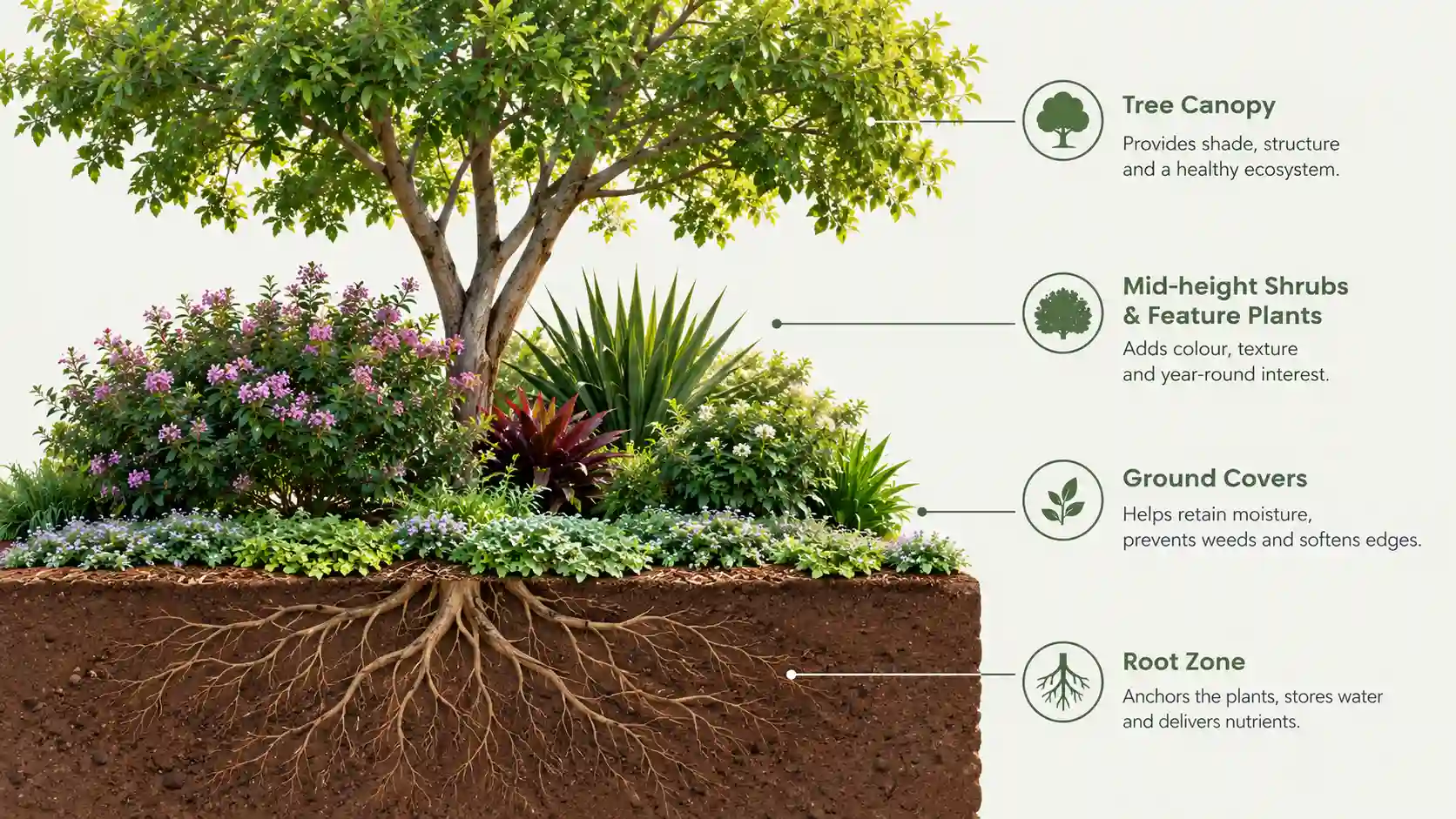
Nursery websites tend to sort plants by category — trees here, shrubs there, ground covers in another tab — as if they’re separate products you pick independently. In a real garden, they’re not separate at all. They’re layers of one system, and a garden that works is one where those layers were chosen to complement each other, not picked one at a time in isolation.
Think of it less as a shopping list and more as four jobs that need filling:
Trees as the Structural Layer
Trees are the layer that does the heavy lifting: shade, privacy screening from neighbours or the street, wind protection, and long-term structure that shapes how the rest of the garden is used. They’re also the layer with the longest-lasting consequences — a tree planted in the wrong spot is a ten-year problem, not a one-season one. If shade or screening is your main goal, native shade trees are usually the lowest-risk starting point for Australian conditions, since they’re already adapted to the rainfall and soil patterns most gardens deal with.
Shrubs and Feature Plants as the Middle Layer
This is the layer that carries most of a garden’s personality — colour, texture, and seasonal change. Shrubs fill and frame garden beds; feature plants are the ones chosen specifically to draw the eye, whether that’s a striking flower colour, unusual foliage, or a clipped, formal shape. This is also where most of the “which flower is this” and “what’s the best flowering tree for my space” questions on this site come in, because it’s the layer people notice first.
Ground Covers and the Garden Floor
Ground covers are the layer everything else sits on top of — low-growing plants that suppress weeds, reduce erosion on slopes, and fill the gaps between larger plants so beds don’t look sparse or need constant mulching. Popular, reliable options in Australian gardens include hibbertia scandens for sunny banks, baby lomandra for a tidy, evergreen strappy look, and mondo grass for shaded borders and pathway edges.
The mistake most new gardeners make is treating these four layers as unrelated purchases. The fix is simple: plan them together, from the top down — tree first, then the shrub layer beneath it, then the ground cover filling in underneath that.
How to Choose Outdoor Plants for Your Garden: A Decision Framework
Here’s the part most gardening content skips entirely. Nursery category pages let you filter by “type” and “style,” but they don’t tell you which type and style actually suits your specific block. Generic care-tip blogs cover watering and sunlight in the abstract, without ever asking what climate zone or soil you’re starting from. This section is the fix — a four-factor filter to work through before you buy anything, at a level that applies equally to trees, shrubs, ground covers, and feature plants. (If you’ve already settled on a tree specifically, our full trees and shrubs guide takes this same logic much further — species-level growth rates, root-risk distances, and mature-size comparisons.)
Step 1: Identify Your Climate Zone
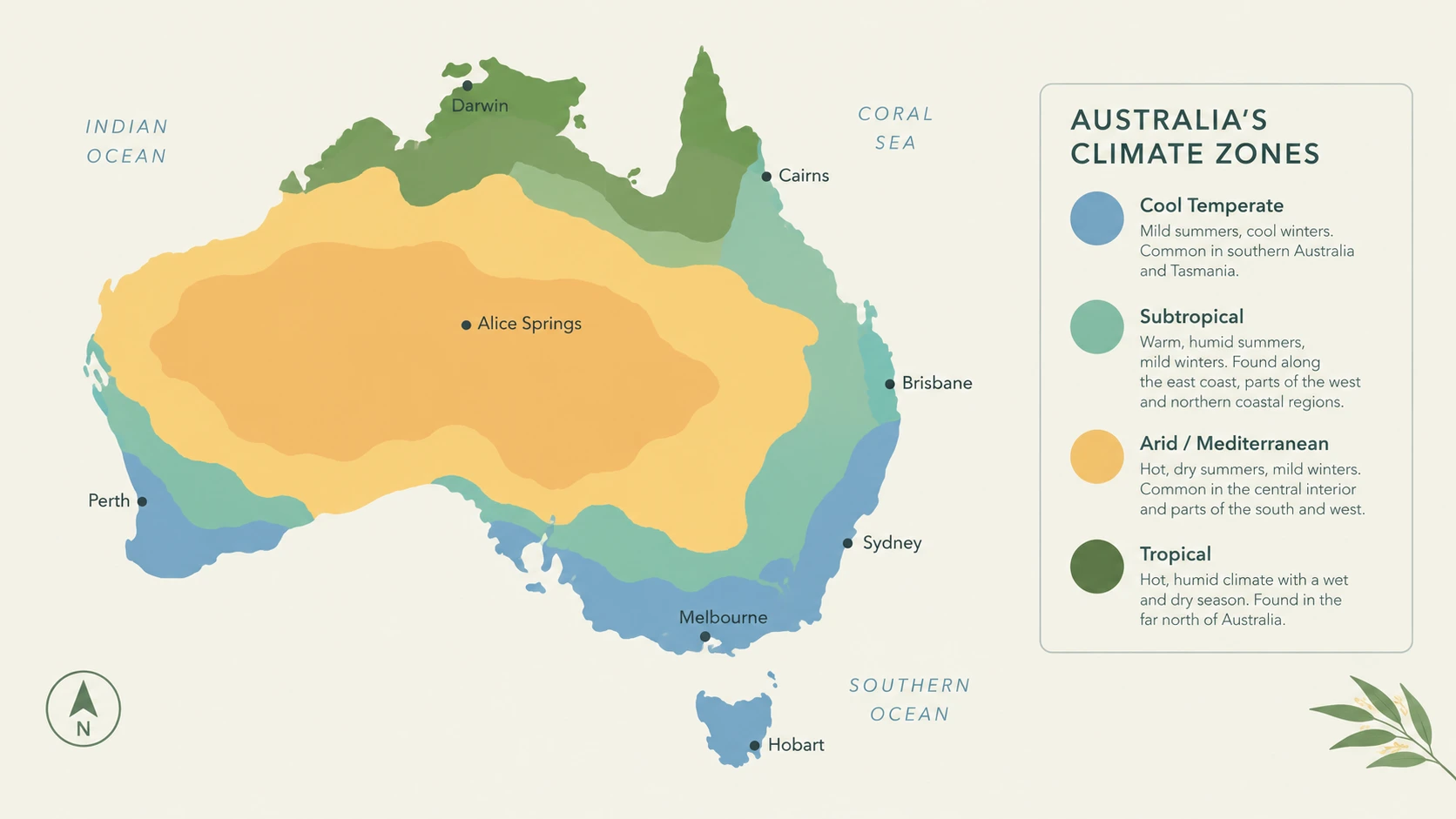
Australia spans an unusually wide range of growing conditions, and what thrives in a Brisbane courtyard can die outright in a Canberra winter. This is a starting filter, not the final word — think of it as ruling things out, not picking a species.
| Climate Zone | Typical Regions | General Growing Conditions |
|---|---|---|
| Cool temperate | Tasmania, Victorian highlands, ACT, southern NSW tablelands | Cold winters, frost risk, deciduous trees perform well, slower growth overall |
| Subtropical | Southeast Queensland, northern NSW coast | Warm, humid summers, mild winters, wide plant range, high rainfall in summer |
| Arid / Mediterranean | Inland NSW/Victoria, Adelaide and SA, much of WA’s south-west | Hot dry summers, low humidity, drought-tolerant and Mediterranean-style species suit best |
| Tropical | Far north Queensland, Darwin and the Top End | Hot and humid year-round, distinct wet/dry season, frost never a factor |
If you’re gardening in a cool-temperate zone, frost tolerance should be one of your first filters — see frost-tolerant plants for Australian gardens for options that won’t be wiped out by the first cold snap. For a more precise read on your specific location, the Bureau of Meteorology’s climate classification maps break Australia down further than the four broad zones covered here.
A quick aside for the curious rather than the practical: species like the rainbow eucalyptus, with its striking multicoloured bark, are a genuine tropical showstopper — but it’s a Florida/tropical-climate example, not a realistic pick for most Australian gardens outside the far tropical north.
Step 2: Assess Your Soil
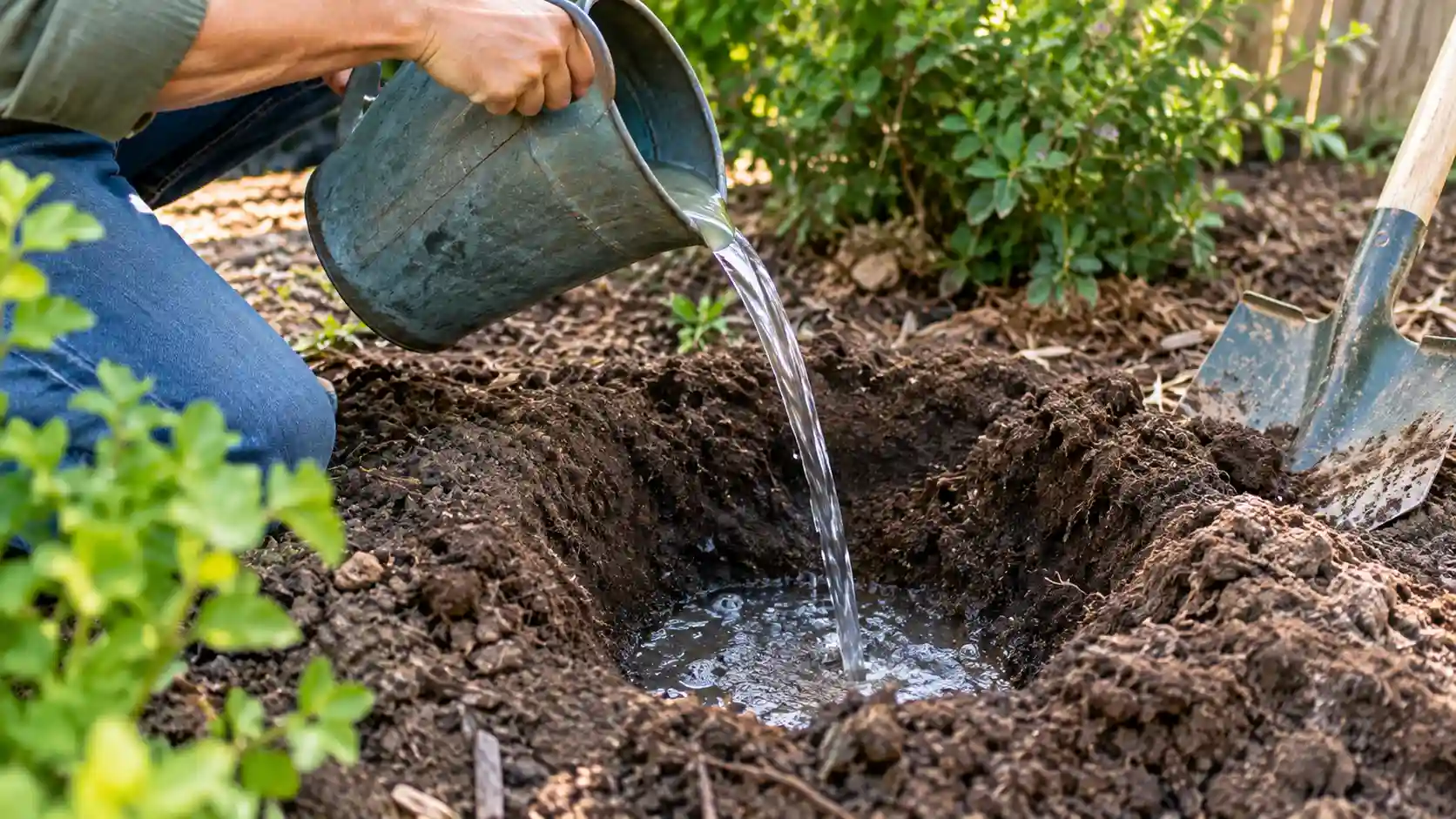
More outdoor plants fail from poor drainage than from the wrong species choice. Before picking anything, dig a hole roughly 30cm deep, fill it with water, and see how long it takes to drain. If water is still sitting after several hours, you’re dealing with heavy clay and will need to either choose plants tolerant of wet feet, improve drainage with raised beds or added organic matter, or both. Sandy soil, by contrast, drains fast and dries out quickly — it favours drought-tolerant species and will need more frequent watering for anything else. Most established Australian gardens sit somewhere between the two, which is worth confirming before you commit to species that need very specific conditions.
Step 3: Match Plants to Your Space
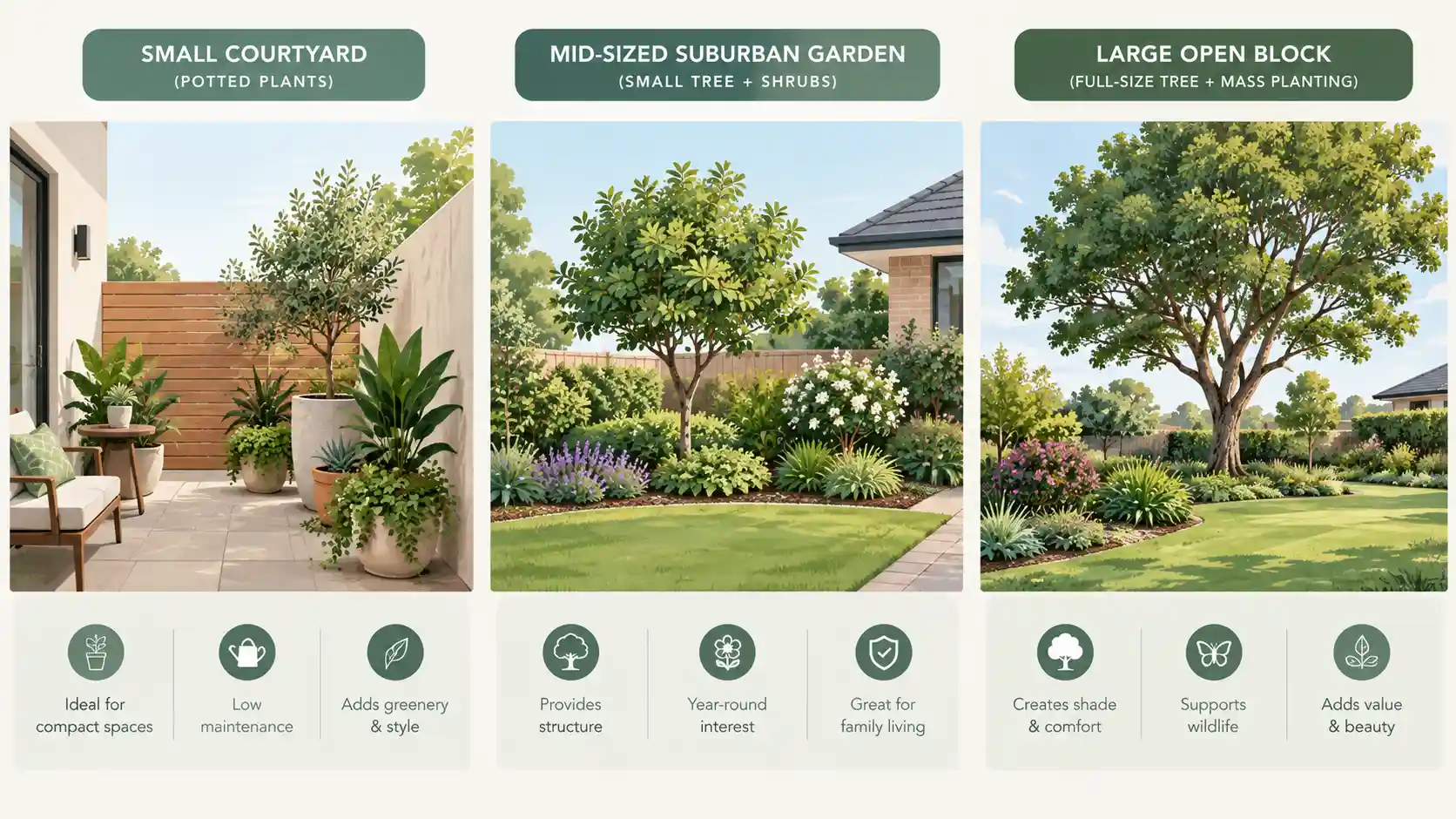
Space dictates what’s realistic more than almost any other factor — a tree that’s perfect for a large rural block can be entirely wrong for a courtyard.
| Garden Type | Sun Exposure | Realistic Plant Categories |
|---|---|---|
| Courtyard / pots | Full sun to part shade | Dwarf or compact flowering trees, feature plants in containers, trailing ground covers |
| Small block | Mixed sun/shade | Small-to-medium flowering trees, mid-sized shrubs, low ground covers along borders |
| Large block | Full sun typical | Full-size shade trees, tall boundary and screening plants, mass-planted borders |
For courtyards and small gardens, flowering trees suited to small spaces are worth starting from directly, since they’re already filtered for compact growth habits. For larger blocks, boundary and entrance planting is often where the biggest visual impact comes from — tall landscaping plants and driveway planting ideas are both good starting points for that kind of large-scale structure.
Step 4: Define Your Purpose
Finally, come back to the “roles” from the section above and get specific: are you planting for shade, for privacy, for colour, for formal structure, or purely to minimise how much time you’ll spend maintaining it? Shade points you toward trees. Privacy points toward dense shrubs or hedging. Colour points toward flowering shrubs and trees. Formal structure often points toward topiary — clipped, shaped plants used to create a deliberate, architectural look. And if low maintenance is the actual priority, that’s specific enough to deserve its own section below.
Native vs. Exotic Plants: What Actually Matters for Australian Gardens
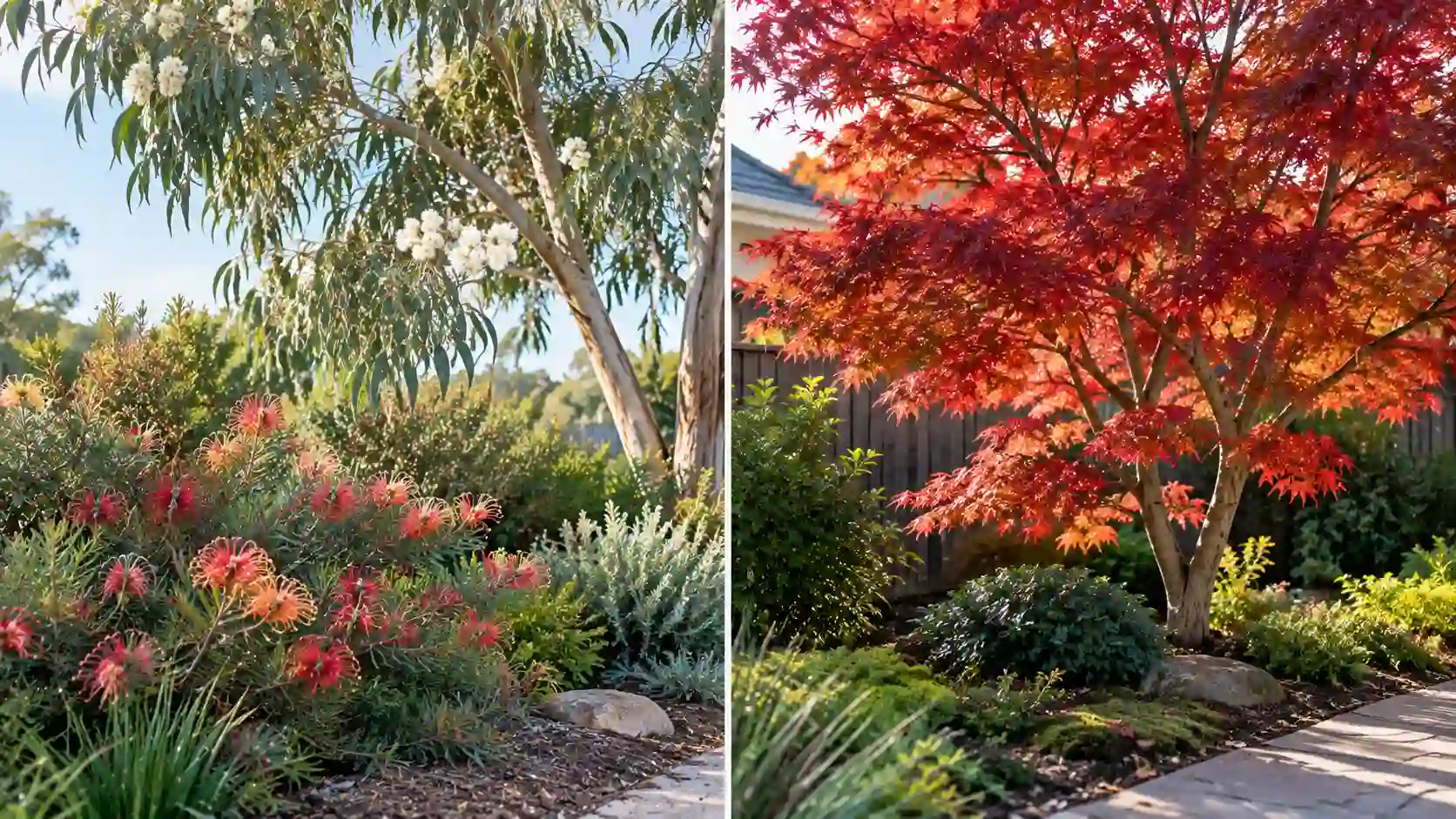
Neither is automatically the better choice — it’s a trade-off between lower water use and higher wildlife value on the native side, against bolder, shorter-window seasonal colour (like true autumn foliage) on the exotic side. Most well-designed gardens use a mix rather than committing fully to one. For the full breakdown of this trade-off specifically for trees — including a side-by-side comparison table — see our Native and Feature Trees guide. If you’re comparing native plants more broadly, Australian native plants and Australian native purple flowers are good starting points; Autumn Blaze maple is the clearest exotic example of the seasonal-colour trade-off.
Low-Maintenance vs. High-Interest Planting: Choosing for Your Lifestyle
Every outdoor plant asks something of you after it’s planted — the question is how much, and for how long. It’s worth being honest about this before you buy, because the single biggest source of buyer’s remorse in gardening isn’t the wrong species, it’s underestimating the upkeep.
Almost everything needs more attention in its first 12–18 months while roots establish, regardless of how “low maintenance” it’s described as later. Once established, though, some categories genuinely settle into a low-fuss routine: hardy natives suited to your specific climate zone, tough evergreen ground covers, and drought-tolerant species chosen correctly for your soil. Fast-growing evergreen trees and reliable ground covers like baby lomandra are good examples of plants that largely look after themselves once settled in.
At the other end, high-interest plants — flowering trees with a short, spectacular bloom window, formal topiary that needs regular clipping, or anything requiring specific pruning timing — trade ongoing effort for a visual payoff that low-maintenance planting simply can’t match. Neither approach is “correct.” The mistake is picking high-interest species without realising what you’ve signed up for, or picking exclusively low-maintenance plants and ending up with a garden that never quite excites you. If minimising upkeep really is the priority, our full low-maintenance garden design guide goes into this in far more depth than is useful here.
Seasonal Care Basics for Outdoor Trees and Plants
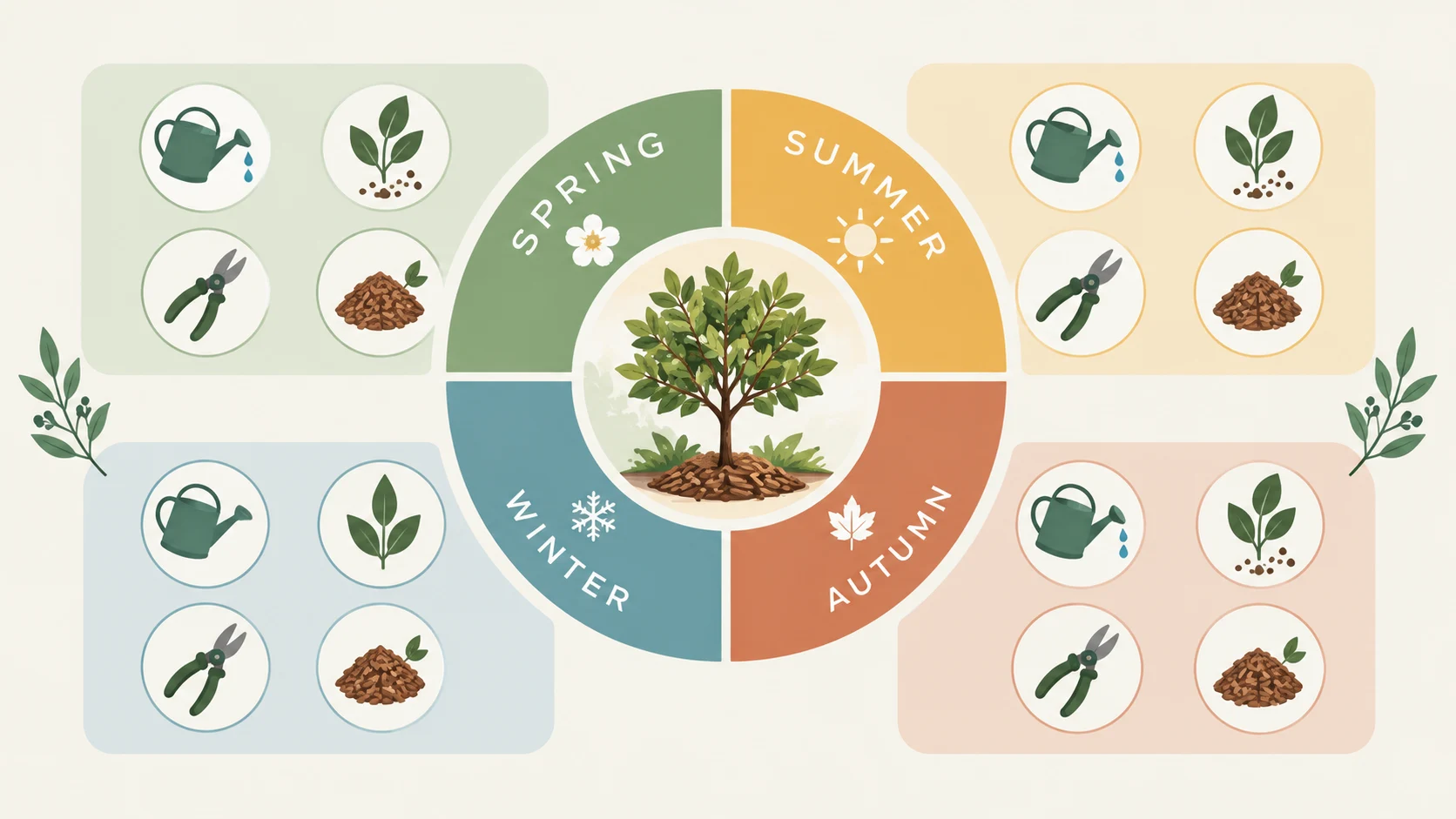
You don’t need a species-by-species manual to keep an outdoor garden alive — most care comes down to a handful of category-level habits applied consistently through the year.
Watering matters most in the establishment period — the first one to two summers after planting — when deep, infrequent watering that encourages roots downward matters more than frequent shallow watering. Once established, most trees and shrubs suited to your climate zone need supplemental water only during genuine dry spells; ground covers typically need slightly more consistent moisture since their root systems are shallower.
Feeding is generally lightest for natives (often none needed beyond initial establishment), moderate for flowering shrubs and exotic trees (a slow-release fertiliser in early spring is usually enough), and most important for anything in a pot, where nutrients wash out with every watering.
Pruning timing depends on what you’re growing: spring-flowering plants are typically pruned right after flowering finishes, while deciduous trees are usually pruned during winter dormancy. Getting this timing backwards is one of the most common reasons people accidentally prune off next season’s flowers. Pruning timing varies by species more than these general rules can cover — ABC’s Gardening Australia is a reliable source for species-specific seasonal advice if you want to confirm before you cut.
Mulching is the one universal recommendation across every category — a consistent layer suppresses weeds, retains moisture, and moderates soil temperature, cutting down on watering and weeding effort across the board.
Safety, Placement, and Council Considerations Before You Plant
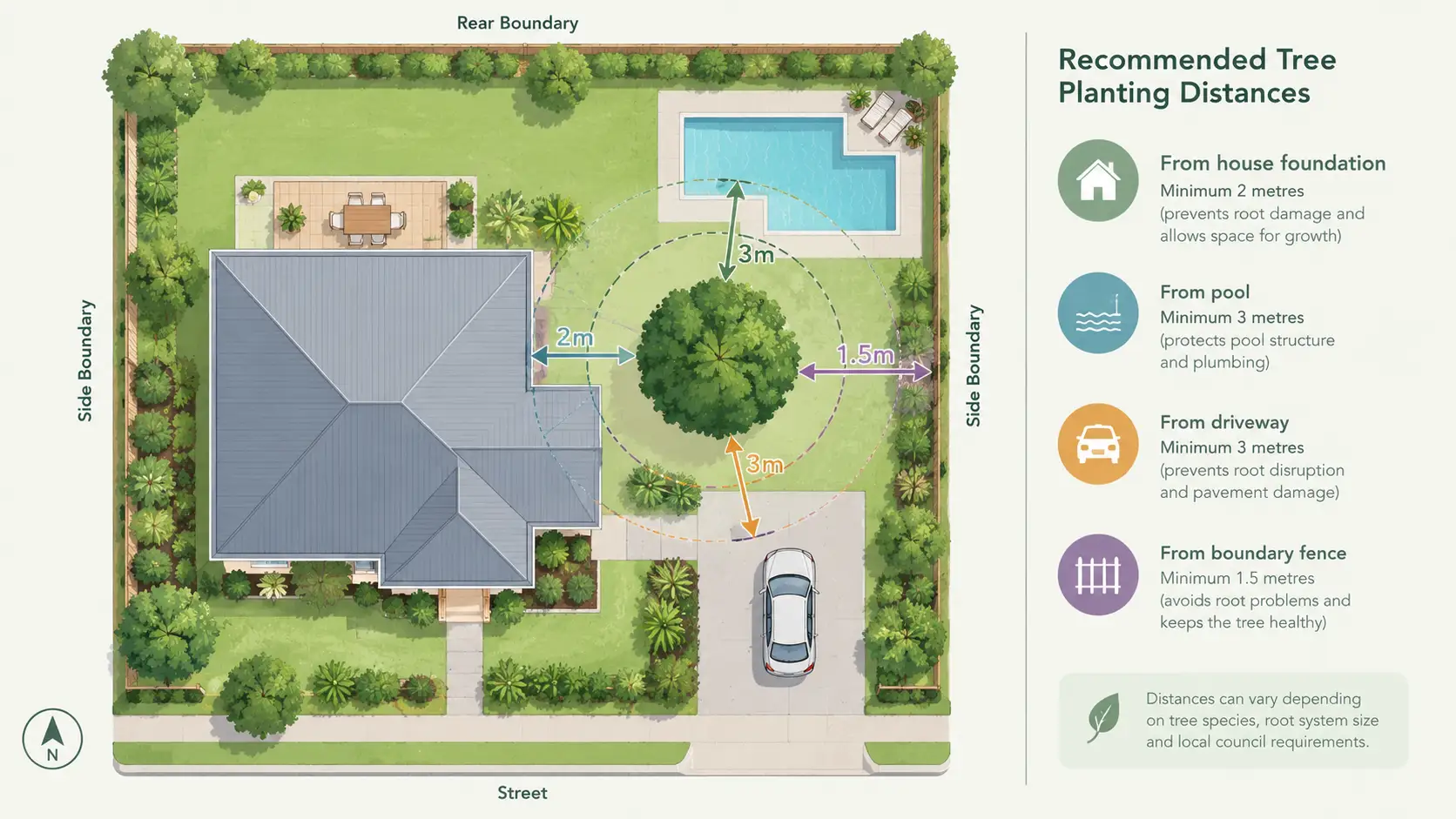
This is the step nursery listing pages and generic care blogs skip entirely — and it’s often more consequential than the species choice itself. Two things matter at the planning stage: distance from structures (pools, footings, driveways, powerlines) and whether your local council has rules about removing, planting near boundaries, or protecting large or significant trees. Both vary by species and by local government area, so treat this as a reminder to check, not a substitute for checking. For the full breakdown — safe planting distances, root-aggressiveness by species, and how council rules typically apply — see our Native and Feature Trees guide, which covers this in depth.
Trees for Every Garden: A Quick Overview
If shade, structure, or a native planting backbone is your priority, our Native and Feature Trees guide covers species selection, growth rates, and root behaviour in full depth. If you’re planning around blossom and seasonal colour instead, our Flowering and Ornamental Trees guide is the better next stop. Here’s a quick taste of what each covers.
Notable Trees Worth Knowing About
Beyond the shade-tree basics, several specific species come up often enough in Australian garden planning to deserve their own dedicated page: poinciana, liquid amber, dogwood, ivory curl tree, blueberry ash, Christmas palm, and fast-growing magnolia. The full Native and Feature Trees guide is the place to compare them properly.
Flowering and Ornamental Trees Worth Knowing About
The flowering side of the tree cluster is where colour and seasonal interest concentrate, and it’s a large enough category that it has its own full guide: flowering trees Australia. Species worth knowing about include dwarf forest pansy, port wine magnolia, Camellia ‘Setsugekka’, Japanese camellia, tibouchina, New Zealand Christmas bush, dwarf cherry blossom, dwarf flowering gum, Queensland fire wheel tree, ornamental pear, blue bougainvillea, and pink silk tree. Researching by colour instead? See trees with pink flowers or purple-flowering trees.
Flowers and Blooms: A Quick Overview
Flowers are the layer that carries most of a garden’s seasonal colour and cut-flower potential, and it’s where the majority of “what is this flower” and “does this colour exist” questions on this site come from. Our full Flowers and Blooms guide is the place to go for the complete picture — here’s a sense of what’s covered.
Popular Questions About Specific Flowers
By colour: purple, pink, and red marigolds; purple sunflowers; black lotus flowers.
By identification: bubble blossoms, pink fern leaf peony, pink tuberose, blue moonflower, blue heart lily, and general pink flowering shrub identification.
By naming and theme: nardos flowers, most masculine flower, and masculine plants.
By timing: flowers that bloom all year in Australia.
Garden Design and Landscaping: Bringing Trees and Plants Together
Once you know what to plant, the next question is how to lay it out — and that’s a design problem as much as a plant-selection one. Our full Garden Design and Landscaping guide covers layout, hardscaping, and style in depth.
Common Landscaping Elements Worth Exploring
Mass-planted border staples do a lot of the visual work in a finished garden design — Agapanthus ‘Snowball’ is a common, reliable finishing touch for exactly this kind of border or mass planting, and a good example of how a single well-chosen plant, repeated, can tie an entire design together.
Common Mistakes When Planning an Outdoor Garden
A handful of mistakes account for most outdoor planting failures and regrets:
- Buying on looks alone, before checking mature size. This applies beyond trees too — a shrub or feature plant that looks proportionate in a nursery pot can outgrow a courtyard bed within a couple of seasons.
- Skipping placement checks before planting anything structural in scale. Trees carry the most risk here — see our Native and Feature Trees guide for species-specific siting distances — but tall shrubs and screening plants near boundaries deserve the same check.
- Mixing incompatible water needs in the same bed. A drought-tolerant native and a thirsty exotic planted side by side means one of them is always being either overwatered or underwatered.
- Underestimating maintenance before committing to high-interest species. A garden full of plants that need constant attention, chosen without realising the time commitment, is a common reason gardens get neglected within a year or two.
- Skipping the climate-zone and frost check. Buying a plant because it looked good online, without checking whether it can actually survive your winter, is one of the most avoidable and most common mistakes on this list.
Where to Go From Here
The order matters more than the species: climate zone first, then soil, then space, then purpose — and only then the plant names. Get that sequence right and most of the expensive mistakes on this page simply don’t happen.
From here, where you go next depends on what you’re planning. If structure, shade, or a native backbone is the priority, head to Native and Feature Trees. If seasonal colour and blossom are the goal, Flowering and Ornamental Trees is the better fit. If you’re chasing a specific bloom, colour, or identification question, Flowers and Blooms covers that ground in depth. And once you know what you’re planting, Garden Design and Landscaping is where selection turns into an actual layout.
FAQs
What’s the difference between a tree, a shrub, and a feature plant in garden design?
Trees provide the structural, shade-giving layer of a garden and are the longest-lived, hardest-to-relocate choice you’ll make. Shrubs fill and frame garden beds at a mid-height, contributing most of the ongoing colour and texture. Feature plants are a subset of either category chosen specifically to draw attention — through colour, form, or an unusual growth habit — rather than to fill space.
How do I know what climate zone my garden is in?
Broadly: cool temperate covers Tasmania, the ACT, and the cooler parts of Victoria and southern NSW; subtropical covers southeast Queensland and northern coastal NSW; arid/Mediterranean covers much of inland Australia, Adelaide, and south-west WA; and tropical covers far north Queensland and the Northern Territory. Local microclimates (elevation, coastal exposure, urban heat) can shift this, so treat it as a starting point rather than a strict boundary.
Is it better to plant native or exotic trees and plants in an Australian garden?
Neither is universally better — natives generally cost less to maintain long-term and support more local wildlife, while exotics often deliver seasonal colour changes, like true autumn foliage, that few natives replicate. Most well-designed gardens use a mix rather than committing fully to one side.
What outdoor plants need the least maintenance?
Once established, hardy natives matched correctly to your climate zone, tough evergreen ground covers, and drought-tolerant species chosen for your specific soil type are generally the lowest-maintenance options. Even these need more attention in their first one to two years while establishing.
How far should trees be planted from a house, pool, or driveway?
It depends heavily on the species’ mature root spread, so there’s no single number that applies to every tree. Our Native and Feature Trees guide covers specific safe distances in detail.
Do I need council approval before planting a tree in my backyard?
Rules vary by state and local council, and can affect removal of established trees or plantings near boundaries in some areas. Check directly with your council — our Native and Feature Trees guide also covers how this typically applies to larger or feature specimens.
What’s the biggest mistake people make when planning outdoor planting?
Buying species before checking climate zone, soil, and mature size — which leads to plants that either fail outright or eventually outgrow the space they were planted in.
How do I choose plants for a small courtyard versus a large garden?
Small courtyards and pots suit dwarf or compact flowering trees, feature plants in containers, and trailing ground covers. Larger blocks can support full-size shade trees, taller boundary and screening plants, and mass-planted borders that would overwhelm a smaller space.
2 Comments